Choosing Your SPR Sensor Chip: A Practical Guide to CM5, NTA, and SA Selection
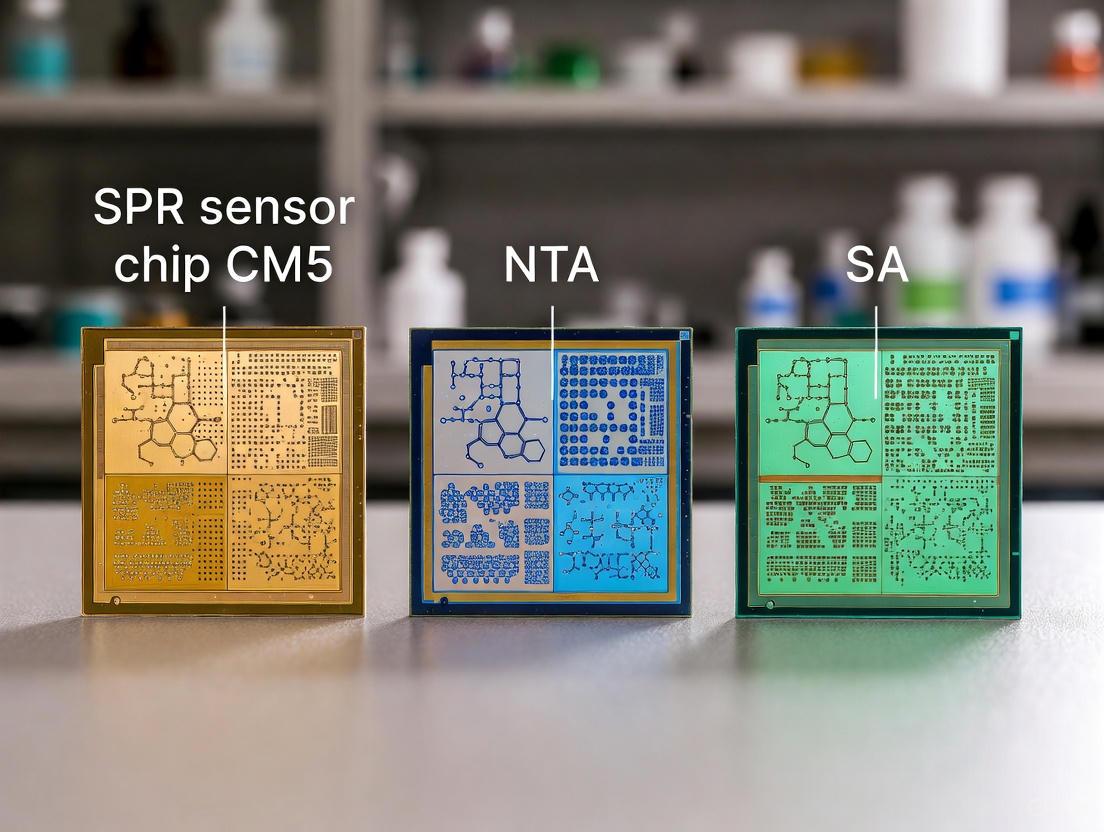
This article provides researchers, scientists, and drug development professionals with a comprehensive guide to selecting between CM5, NTA, and SA surface plasmon resonance (SPR) sensor chips.
Choosing Your SPR Sensor Chip: A Practical Guide to CM5, NTA, and SA Selection
Abstract
This article provides researchers, scientists, and drug development professionals with a comprehensive guide to selecting between CM5, NTA, and SA surface plasmon resonance (SPR) sensor chips. It covers the foundational principles of each chip type, details methodological protocols for immobilization and analysis, offers troubleshooting advice for common experimental challenges, and presents validation data and comparative studies to inform evidence-based chip selection for diverse applications in drug discovery and biomolecular interaction analysis.
Understanding SPR Sensor Chips: Core Principles of CM5, NTA, and SA Surfaces
The Core Function of SPR Sensor Chips
Surface Plasmon Resonance (SPR) is a powerful, label-free analytical technique that enables the real-time study of molecular interactions by measuring changes in the refractive index at a sensor surface [1]. At the heart of any SPR system is the sensor chip, a high-precision disposable component whose surface chemistry dictates the specificity and sensitivity of the assay [2] [3]. The fundamental principle of SPR involves a polarized light source striking a sensor chip coated with a thin metal layer (typically gold), causing electron resonance (plasmons) at a specific angle [1]. When molecules (analytes) in solution bind to molecules (ligands) immobilized on this sensor surface, the local mass changes, leading to a shift in the refractive index and consequently, a measurable change in the resonance condition [1] [3]. This physical phenomenon allows researchers to monitor binding events as they happen, providing rich kinetic data including association rates (k~a~), dissociation rates (k~d~), and equilibrium affinity constants (K~D~) without the need for fluorescent or radioactive labels [4] [1].
The sensor chip is therefore not a passive substrate but an active participant in the detection process. Its primary functions extend beyond simply holding the ligand and include:
- Facilitating Ligand Immobilization: The chip surface is functionalized with specific chemistries that enable stable and controlled attachment of ligands through covalent coupling, affinity capture, or hydrophobic interactions [5] [3].
- Generating the SPR Signal: The metal film (e.g., gold) on the chip is essential for generating the plasmon resonance effect, which transduces a binding event into a quantifiable signal [1] [2].
- Minimizing Non-Specific Binding: A critical function of the surface chemistry is to prevent the analyte from interacting non-specifically with the chip, which would produce false-positive signals and obscure data. This is often achieved using hydrophilic polymer matrices like carboxymethylated dextran [2] [3].
- Ensuring Assay Reproducibility and Sensitivity: The consistent and high-quality manufacturing of sensor chips ensures that performance is maintained across different experiments and users, which is paramount for reliable quantitative analysis [3].
Sensor Chip Surface Chemistry and Types
Sensor chips can be broadly classified by their physical structure and surface functionalization. Structurally, they fall into two main categories: 2D planar surfaces, which are virtually flat with functionalizations grafted directly onto the gold layer, and 3D-like surfaces, which feature a hydrogel matrix (such as dextran, alginate, or polycarbonate) that provides a significantly larger surface area for ligand immobilization [2]. This matrix increases the binding capacity, which is particularly beneficial for detecting small molecules or weak interactions [2] [6].
The following diagram illustrates the logical decision process for selecting an appropriate immobilization strategy and sensor chip based on ligand properties.
Figure 1. Decision workflow for selecting an SPR sensor chip and immobilization chemistry based on ligand properties, summarizing the strategic choices researchers face [5] [6].
The surface chemistry defines the method of ligand immobilization. The three primary strategies, each with distinct advantages, are:
- Covalent Coupling: This method creates a stable, irreversible bond between the ligand and the sensor surface, minimizing ligand dissociation during experiments [5]. It is a versatile method compatible with most biomolecules that possess amine, carboxyl, or thiol groups, thus minimizing the need for genetic or chemical modification of the ligand [5] [3].
- Capture Coupling: This strategy uses a high-affinity interaction between an immobilized capture molecule on the chip (e.g., streptavidin, NTA, Protein A) and a specific tag on the ligand (e.g., biotin, polyhistidine, Fc region) [5] [6]. The key advantages are controlled, uniform ligand orientation, which maximizes binding activity, and the ability to regenerate and reuse the capture surface [5] [6].
- Hydrophobic Capture: These specialized sensors are designed for immobilizing lipids, liposomes, or very hydrophobic proteins, enabling the study of membrane-associated interactions in a model membrane environment [5].
Comparative Analysis: CM5 vs. NTA vs. SA Sensor Chips
Selecting the correct sensor chip is pivotal for experimental success. For a thesis focused on comparing CM5, NTA, and SA chips, understanding their distinct characteristics, applications, and performance metrics is essential. The table below provides a structured, quantitative comparison of these three widely used chip types.
Table 1: Quantitative Comparison of CM5, NTA, and SA Sensor Chips
| Feature | CM5 Sensor Chip | NTA Sensor Chip | SA (Streptavidin) Sensor Chip |
|---|---|---|---|
| Surface Chemistry | Carboxymethylated dextran matrix [2] [3] | NTA groups chelated with Ni²⁺ ions [2] [6] | Recombinant streptavidin tetramer immobilized on a matrix [6] |
| Immobilization Method | Covalent coupling (via EDC/NHS) [5] [3] | Affinity capture of His-tagged ligands [5] [6] | Affinity capture of biotinylated ligands [5] [6] |
| Primary Application | Versatile; ideal for protein-protein interactions, antibody-antigen studies [3] | Capture of His-tagged recombinant proteins & peptides [3] [6] | Capture of biotinylated proteins, nucleic acids, peptides [6] |
| Binding Stability | Very high (irreversible covalent bond) [5] | Medium to High (reversible; depends on valency) [6] | Exceptionally high (K~D~ ≈ 10⁻¹⁵ M; near-irreversible) [6] |
| Ligand Orientation | Random | Oriented | Oriented (if biotinylation site is controlled) [6] |
| Surface Regeneration | Harsh conditions often damage ligand | Gentle (using EDTA or imidazole) [6] | Very stable, resistant to most regeneration protocols [6] |
| Typical Binding Capacity Range | Varies with dextran density/immobilization level | NiHC1500M: ~2000 µRIU (for His₆-peptide) [6] | SAHC1500M: 4500-6000 µRIU [6] |
CM5 Sensor Chip
The CM5 chip is a quintessential general-purpose tool in SPR. Its carboxymethylated dextran matrix forms a hydrophilic 3D environment that reduces non-specific binding and offers a high capacity for ligand immobilization [3]. The covalent immobilization via EDC/NHS chemistry, which targets primary amine groups on the ligand, is robust and reliable. However, a significant limitation is the random orientation of the immobilized ligand, which can sometimes lead to steric hindrance and mask binding sites, reducing the observed binding activity [5] [3]. Furthermore, regeneration of the surface often requires harsh conditions (low pH) that can denature the immobilized ligand, preventing surface reuse [5].
NTA Sensor Chip
NTA sensor chips are specialized for capturing proteins and peptides tagged with a polyhistidine sequence (typically His₆) [3] [6]. The key advantage is oriented immobilization and the reversible nature of the capture. The his-tag binds to the NTA groups charged with Ni²⁺ ions, and this interaction can be easily broken by injecting a chelating agent like EDTA, allowing for complete regeneration of the native surface and subsequent recapture of a fresh ligand [5] [6]. A critical consideration is the binding stability, which has been significantly improved with modern chips like XanTec's NiHC series. These employ a multivalent binding mechanism that increases stability by up to three orders of magnitude (k~off~ values of 10⁻⁵–10⁻⁶ s⁻¹), minimizing baseline drift [6]. The main weakness is the potential for ligand dissociation during long analysis cycles or from weaker, monovalent NTA surfaces.
SA Sensor Chip
SA sensor chips leverage the exceptionally strong non-covalent interaction between streptavidin and biotin, one of the strongest in nature [6]. This provides an extremely stable foundation for immobilization, with negligible ligand dissociation even under demanding conditions [6]. Like NTA chips, they enable oriented immobilization if the ligand is biotinylated at a specific, controlled site (e.g., using the AviTag system), maximizing binding activity and data reproducibility [6]. The primary constraint is the requirement for biotinylation of the ligand, which adds an extra step to sample preparation. However, the excellent stability often makes this the preferred choice for high-precision kinetic studies and for immobilizing a wide range of molecules, from nucleic acids to antibodies [6].
Experimental Protocols for Chip Utilization
A successful SPR assay requires a meticulously planned and executed experimental protocol. The workflow below outlines the key stages, from initial preparation to data analysis.
Figure 2. Standard workflow for a kinetic characterization experiment using SPR technology.
Immobilization Protocols
The immobilization step is critical and varies significantly by chip type.
CM5 Covalent Immobilization (EDC/NHS Chemistry):
- Activation: Inject a fresh mixture of EDC (1-ethyl-3-(3-dimethylaminopropyl)carbodiimide) and NHS (N-hydroxysuccinimide) over the dextran surface. This converts the carboxyl groups to reactive NHS esters [5].
- Ligand Coupling: Inject the ligand solution containing primary amines. The ligand covalently couples to the activated esters.
- Blocking: Inject ethanolamine to deactivate any remaining active esters, preventing non-specific binding in subsequent steps [5].
NTA Capture Immobilization:
SA Capture Immobilization:
Binding Kinetics Measurement and Data Analysis
A comprehensive kinetic analysis involves the following steps, which generate the characteristic sensorgram data:
- Sample Injection (Association Phase): A concentration series of the analyte is injected over the ligand surface and a reference surface [3]. The binding event causes an increase in the SPR signal. The rate of this increase is the association rate (k~a~).
- Buffer Flow (Dissociation Phase): The analyte injection is stopped, and buffer is flowed over the surface. The decrease in signal as the analyte dissociates from the ligand is monitored to determine the dissociation rate (k~d~) [3].
- Surface Regeneration: A brief pulse of a regeneration solution (e.g., glycine-HCl pH 1.5 for antibodies, 350 mM EDTA for NTA surfaces) is injected to remove all bound analyte, returning the signal to baseline and making the surface ready for the next analyte injection [5] [6].
- Data Fitting: The resulting sensorgrams for all analyte concentrations are globally fitted to a binding model (e.g., 1:1 Langmuir) by software to extract the kinetic constants k~a~ and k~d~. The affinity constant (K~D~) is calculated as k~d~/k~a~ [3].
The Scientist's Toolkit: Essential Research Reagents and Materials
Table 2: Essential Reagents and Materials for SPR Experiments
| Item | Function | Example Use Cases |
|---|---|---|
| SPR Instrument | Platform for performing real-time, label-free interaction analysis. | Biacore (Cytiva), OpenSPR (Nicoya), systems from ForteBio, BioNavis [1]. |
| Sensor Chips (CM5, NTA, SA) | Disposable core component where molecular interaction occurs. | CM5 for general covalent immobilization; NTA for His-tagged proteins; SA for biotinylated ligands [3] [6]. |
| EDC / NHS | Cross-linking reagents for activating carboxyl groups on sensor surfaces for covalent coupling. | Essential for ligand immobilization on CM5 and similar carboxymethylated chips [5]. |
| Ethanolamine | Blocking agent used to deactivate excess reactive groups on the sensor surface after ligand coupling. | Used after EDC/NHS activation and ligand injection to cap unreacted NHS esters, reducing non-specific binding [5]. |
| Regeneration Buffers | Solutions used to remove bound analyte from the immobilized ligand without damaging it. | Glycine-HCl (low pH) for antibodies; EDTA for NTA surfaces; mild detergents or high salt for weaker interactions [5] [6]. |
| Running Buffer | The consistent buffer solution used to maintain stability and establish the baseline signal. | HBS-EP (HEPES Buffered Saline with EDTA and Polysorbate) is common to minimize non-specific binding. |
| Ligand & Analyte | The interacting molecules; ligand is immobilized, analyte is in solution. | Proteins, antibodies, nucleic acids, small molecules, lipids, viruses [4] [6]. |
Surface Plasmon Resonance (SPR) technology has revolutionized biomolecular interaction analysis by enabling real-time, label-free detection of binding events, providing critical data on interaction kinetics, affinity, and concentration [7]. The sensor chip serves as the core of any SPR system, providing a stable and functional surface for ligand immobilization. Among the diverse range of available sensor chips, the CM5 sensor chip from Biacore stands as the versatile workhorse, balancing immobilization capacity, applicability, and experimental robustness [8] [3]. This technical guide provides an in-depth examination of the CM5 chip, framing its characteristics and optimal use cases within the broader context of SPR sensor chip selection, particularly against specialized alternatives like NTA and SA chips for targeted research applications.
Technical Specifications and Core Architecture
The CM5 chip features a gold film substrate coated with a carboxymethylated dextran hydrogel that forms a highly flexible, non-cross-linked, brush-like structure extending 100 to 200 nanometers from the surface [9] [8]. This three-dimensional matrix is pivotal to its function.
Key Structural and Functional Properties
- 3D Hydrogel Matrix: The dextran layer provides a hydrophilic, water-swollen environment that mimics physiological conditions, helping to maintain biomolecule stability and function [9] [3].
- Chemical Functionality: The dextran polymer is functionalized with carboxyl groups (-COOH), enabling covalent coupling of ligands containing primary amines, thiols, aldehydes, or carboxyl groups via standard chemistries like EDC/NHS [8].
- High Binding Capacity: The three-dimensional nature of the hydrogel allows for the immobilization of large amounts of protein—up to 50 ng/mm³—which is crucial for detecting interactions with low molecular weight analytes [9].
- Anti-Fouling Properties: The surface is very stable and resistant to non-specific binding of biomolecules, reducing background noise and improving data quality [9] [3].
Table 1: Core Technical Specifications of the CM5 Sensor Chip
| Parameter | Specification |
|---|---|
| Surface Matrix | Carboxymethylated dextran |
| Matrix Structure | 3D, flexible, non-cross-linked |
| Matrix Thickness | 100-200 nm [9] |
| Functional Groups | Carboxyl groups (-COOH) |
| Immobilization Capacity | High (up to ~50 ng/mm³ of protein) [9] |
| Compatible Coupling Chemistries | Amine, Thiol, Aldehyde, Carboxyl (EDC/NHS) [8] |
| Primary Applications | Protein-protein interactions, antibody-antigen studies, receptor-ligand binding, nucleic acid and small molecule studies [8] [3] |
The CM-Series Family: Comparative Analysis
The CM5 is part of a family of carboxymethyl dextran sensor chips, each with tailored properties for specific experimental challenges. Understanding the distinctions between these chips is essential for optimal selection.
Table 2: Comparison of CM-Series Sensor Chips
| Sensor Chip | Dextran Matrix | Carboxylation Level | Immobilization Capacity (Relative to CM5) | Ideal Application |
|---|---|---|---|---|
| CM5 | Standard length | Standard | 100% (Baseline) | General-purpose; proteins, nucleic acids, small molecules [8] |
| CM3 | Short | Standard | ~30% | Large analytes (cells, virus particles); reduced non-specific binding from crude samples [8] |
| CM4 | Standard length | Low | ~30% | Highly positively charged analytes; crude samples; low ligand density kinetics [8] |
| CM7 | Standard length | High | ~300% | Small molecules and fragments; high immobilization capacity required [8] |
The CM5's balance of matrix size and charge makes it suitable for the widest range of applications, explaining its status as the default choice. However, as the table indicates, CM3, CM4, and CM7 are specialized tools for addressing specific issues like steric hindrance with large particles, non-specific binding with charged impurities, or the need for maximum sensitivity with low-mass analytes.
CM5 vs. NTA vs. SA: A Strategic Selection Guide
Choosing the right sensor chip is a strategic decision that directly impacts data quality and experimental success. The following diagram outlines the key decision pathways for selecting between CM5, NTA, and SA chips.
Direct Comparison of Key Chip Types
Table 3: Strategic Comparison of CM5, NTA, and SA Sensor Chips
| Feature | CM5 Chip | NTA Chip | SA Chip |
|---|---|---|---|
| Immobilization Principle | Covalent coupling (amine, thiol, etc.) [8] | Affinity capture via His-tag/Ni²⁺ [3] | Affinity capture via biotin-streptavidin/neutravidin [9] [3] |
| Ligand Orientation | Random, based on reactive group availability | Controlled, via the tag | Controlled, via the tag |
| Ligand Stability | Highly stable, covalent bond [3] | Moderate; potential for leaching (metal ion dependency) [10] | Highly stable, high-affinity non-covalent bond [11] |
| Regeneration | Requires conditions that dissociate analyte but preserve ligand activity [8] | Can be harsh; may strip nickel and ligand | Mild conditions often sufficient |
| Best For | General-purpose interactions; untagged ligands; high-density immobilization [8] [3] | Screening His-tagged libraries; studies requiring ligand orientation [3] | High-affinity capture of biotinylated molecules; concentration analysis [3] |
| Key Consideration | Requires optimization of surface density to avoid steric hindrance [3] | Requires careful management of nickel ion concentration to prevent non-specific binding [3] | Avoid using Twin-Strep-tag and Avi-tag on the same protein due to cross-affinity issues [11] |
Essential Experimental Protocols
A core strength of the CM5 chip is its compatibility with a wide array of established immobilization protocols. Below are detailed methodologies for two fundamental coupling approaches.
Amine Coupling Protocol
Amine coupling is the most common method for immobilizing proteins, peptides, and other biomolecules containing primary amines onto the CM5 surface.
Key Reagent Solutions:
- EDC (1-Ethyl-3-(3-dimethylaminopropyl)carbodiimide): Activates carboxyl groups on the dextran matrix.
- NHS (N-Hydroxysuccinimide): Stabilizes the activated ester intermediate, increasing coupling efficiency.
- Sodium Acetate Buffer (pH 4.0-5.5): Low-pH buffer used to dilute the ligand, promoting a positive charge on primary amines for efficient coupling.
- Ethanolamine HCl: Blocks remaining activated ester groups after coupling is complete.
Procedure:
- Surface Activation: Inject a 1:1 mixture of EDC and NHS (typically 0.2 M EDC, 0.05 M NHS) for 5-10 minutes to activate the carboxyl groups on the dextran, forming reactive NHS esters [9].
- Ligand Injection: Dilute the ligand in a low-pH sodium acetate buffer (e.g., pH 4.0-5.5) to protonate its primary amine groups. Inject the ligand solution over the activated surface for 5-10 minutes. The ligand concentration and injection time determine the final immobilization level [3].
- Deactivation/Blocking: Inject a high-pH ethanolamine-HCl solution (e.g., 1.0 M, pH 8.5) for 5-10 minutes to deactivate and block any remaining NHS esters on the surface [9].
Capture of His-Tagged Proteins
While the NTA chip is specifically designed for His-tagged proteins, the CM5 chip can also be used for this purpose via a capture-coupling approach, which offers superior immobilization stability.
Procedure:
- Immobilize an Anti-His Antibody: First, use the standard amine coupling protocol (see 5.1) to covalently immobilize a specific anti-His antibody onto the CM5 surface [9].
- Capture His-Tagged Ligand: Inject the solution containing the His-tagged protein over the surface with the immobilized antibody. The antibody will specifically capture the His-tagged ligand.
- Stable Surface: The ligand is now held on the surface via a high-affinity antibody-antigen interaction. This method often results in a more stable surface than the NTA-Ni²⁺ capture method, which can be prone to ligand leaching [10].
The Researcher's Toolkit: Essential Reagents and Materials
Successful experimentation with the CM5 chip requires a suite of key reagents and materials.
Table 4: Essential Research Reagent Solutions for CM5 Chip Experiments
| Reagent/Material | Function | Application Notes |
|---|---|---|
| CM5 Sensor Chip | The core substrate providing a carboxymethyl dextran hydrogel surface for ligand immobilization [8]. | The versatile workhorse; suitable for most biomolecular interactions. |
| EDC & NHS | Cross-linking agents for covalent coupling during surface activation [3]. | Freshly prepared mixtures are recommended for optimal activation efficiency. |
| Sodium Acetate Buffers (pH 4.0-5.5) | Low-pH buffer for ligand dilution during amine coupling [3]. | Optimal pH depends on the isoelectric point (pI) of the protein being immobilized. |
| Ethanolamine-HCl | Blocking agent to deactivate excess reactive groups post-immobilization [9]. | Standard concentration is 1.0 M, pH 8.5. |
| HBS-EP Buffer | Common running buffer (HEPES, NaCl, EDTA, Surfactant P20) for SPR experiments [3]. | Provides a consistent chemical environment and reduces non-specific binding. |
| Regeneration Solutions | Dissociates bound analyte to regenerate the ligand surface for the next cycle [8]. | Condition-specific (e.g., low pH, high salt, mild detergent); must be harsh enough to remove analyte but gentle enough to preserve ligand activity. |
| Anti-His Antibody | For the capture-coupling of His-tagged proteins on the CM5 surface [9]. | An alternative to using NTA chips, offering potentially greater stability. |
The CM5 sensor chip has rightfully earned its status as the default choice in SPR analysis due to its remarkable versatility, high immobilization capacity, and well-characterized surface chemistry. Its carboxymethyl dextran hydrogel creates a favorable environment for studying a vast range of biomolecular interactions, from antibody-antigen binding to protein-small molecule screening. However, as this deep dive illustrates, a sophisticated SPR strategy involves understanding the entire chip ecosystem. The choice between CM5, NTA, and SA chips, or even other CM-series variants, is not one of superiority but of strategic alignment with experimental goals. The CM5 remains the indispensable workhorse, but its true power is unlocked when researchers can deftly deploy it alongside specialized tools like the NTA for tagged protein screening or the SA chip for ultra-stable biotinylated capture, thereby designing robust and informative SPR assays that yield high-quality kinetic and affinity data.
The NTA (Nitrilotriacetic Acid) sensor chip is a specialized surface plasmon resonance (SPR) biosensor designed specifically for the capture and analysis of polyhistidine-tagged (His-tagged) proteins. Within the broader context of SPR sensor chip selection, the NTA chip occupies a crucial niche for researchers working with recombinant proteins, complementing general-purpose chips like the CM5 (carboxymethyl dextran for covalent coupling) and specialized surfaces like the SA (streptavidin for biotinylated molecules) [2] [3] [12]. The core function of the NTA chip is to leverage immobilized metal affinity chromatography (IMAC) principles on a biosensor surface, utilizing a chelated nickel ion to capture proteins containing a histidine tag [13] [14]. This technology has become indispensable in drug development and basic research because it provides a method for oriented, homogeneous immobilization of protein ligands without requiring covalent chemistry that could potentially alter protein structure or function [5] [13].
The fundamental advantage of this system stems from the specific interaction between the chelated metal and the histidine tag. The NTA group forms a tetra-coordinate complex with a nickel ion (Ni²⁺), leaving two coordination sites available for binding to the imidazole ring of histidine residues in the tag [13]. This interaction is reversible, with a typical dissociation constant (K_D) in the micromolar range (approximately 10⁻⁶ M), which is sufficiently strong to permit detailed kinetic analysis of subsequent binding events yet allows for gentle regeneration of the sensor surface [15] [13]. The resulting immobilization is not only robust but also directs a uniform orientation of the ligand molecule, which is often critical for ensuring proper binding site accessibility for analyte molecules and for obtaining reliable kinetic data [5] [13]. This stands in contrast to random immobilization via amine coupling on a CM5 chip, where the binding site might be obscured in a fraction of the immobilized ligands [16].
Technical Mechanism of Action
Molecular Architecture and Binding Chemistry
The molecular architecture of an NTA sensor chip is a sophisticated layering of functional components engineered for optimal biosensing. The foundation is a glass substrate coated with a thin gold film, which is responsible for generating the surface plasmon resonance effect [17]. Upon this gold layer, the NTA chemistry is assembled, typically grafted either directly to create a 2D planar surface or within a hydrogel matrix (such as dextran) to form a 3D-like surface that increases binding capacity [2]. The key component, the nitrilotriacetic acid (NTA) group, is a chelating agent that tightly binds a nickel ion (Ni²⁺) through four of its coordination sites [13] [14]. This configuration leaves two vacant coordination sites on the nickel ion, which are precisely oriented and available for binding to the imidazole side chains of histidine residues in a His-tag [14].
The binding event is a coordination chemistry process. A standard hexahistidine (His6) tag provides multiple histidine residues that collectively interact with the chelated nickel. The affinity of this interaction can be enhanced significantly by using advanced tag designs. For instance, a double-hexahistidine tag, which comprises two hexahistidine sequences separated by an 11-amino acid spacer, demonstrates binding that is at least one order of magnitude stronger than a conventional single-His6 tag [15]. This design results in a much slower dissociation rate from the NTA surface, thereby increasing the stability of the immobilized ligand during an SPR experiment [15]. It is crucial to note that the local microenvironment can affect binding; moieties adjacent to the His-tag or changes in buffer pH and ionic strength can influence the observed affinity [13]. Furthermore, while side chains of cysteine, tyrosine, tryptophan, and lysine can potentially interact with the chelated metal, their affinity is typically much lower than that of a histidine tag [13].
Workflow for NTA Chip Utilization
The typical workflow for using an NTA sensor chip involves a sequential process of surface preparation, ligand capture, interaction analysis, and regeneration. The following diagram visualizes this core operational cycle:
The process begins with a Nickel Loading phase, where the sensor surface is conditioned with a solution of NiCl₂ or NiNO₃. This loads the chelating NTA groups with Ni²⁺ ions, a step that typically produces a baseline signal rise of approximately 40 response units (RU) [13]. Following this, the His-Tagged Ligand Capture occurs. A purified His-tagged protein, typically at concentrations below 200 nM and prepared in a metal-free buffer, is injected over the surface [13]. Low flow rates (2-5 µL/min) and controlled contact times (1-15 minutes) are used to achieve the desired immobilization level [13]. After ligand capture, the surface is ready for the Analyte Binding & Analysis phase, where the interaction partner is flowed over the captured ligand to study binding kinetics and affinity in real-time. Finally, Surface Regeneration is performed using a buffer containing EDTA or imidazole. EDTA acts as a chelating agent that strips the nickel ions (and with them, the His-tagged ligand) from the surface, while high concentrations of imidazole (e.g., 350 mM) compete with the His-tag for binding to the nickel, thus releasing the ligand [13]. This allows the same sensor surface to be reused for multiple analysis cycles.
Comparative Analysis of SPR Sensor Chips
Selecting the appropriate sensor chip is a critical first step in designing a robust SPR experiment. The choice hinges on the nature of the ligand, the required immobilization chemistry, and the specific research questions being addressed. The following table provides a detailed comparison of the NTA chip against two other prevalent types: the CM5 (a general-purpose carboxylated dextran chip) and the SA (streptavidin-coated chip).
Table 1: Comparative Analysis of Key SPR Sensor Chips
| Feature | NTA Chip | CM5 Chip | SA Chip |
|---|---|---|---|
| Primary Application | Capture of His-tagged proteins [3] [13] | General-purpose; protein-protein interactions, antibody-antigen studies [3] [12] | Capture of biotinylated ligands [2] [5] |
| Immobilization Chemistry | Affinity capture via Ni²⁺-His tag coordination [13] [14] | Covalent coupling (e.g., amine coupling) [16] [3] | Affinity capture via streptavidin-biotin interaction [5] |
| Ligand Orientation | Uniform and controlled [5] [13] | Random, which can lead to heterogeneity [16] [5] | Uniform and controlled [5] |
| Binding Affinity | K_D ~ 10⁻⁶ M [15] [13] | Irreversible (covalent) | Very high (K_D ~ 10⁻¹⁵ M); nearly irreversible [5] |
| Key Advantages | - Oriented immobilization- Gentle capture without chemical modification- Reusable surface [5] [13] | - Versatile and robust- High immobilization capacity- Wide range of applicable chemistries [3] | - Extremely stable binding- Excellent ligand orientation- Withstands harsh regeneration [5] |
| Key Limitations | - Potential for ligand dissociation- Sensitive to chelating agents in buffer- Possible non-specific metal binding [13] | - Risk of ligand denaturation during coupling- Heterogeneous surface sites [16] | - Requires biotinylation of ligand- Difficult to reverse binding for ligand recovery [5] |
| Optimal Ligand Density | Low to moderate (suitable concentrations < 200 nM) [13] | Can be varied from low to very high | High, due to strong bond strength |
The NTA chip is the superior choice when working with recombinant His-tagged proteins, as it allows for a specific and oriented capture that often preserves the ligand's native activity. However, researchers must be cautious of buffer composition, as chelating agents like EDTA can destabilize the surface by removing the essential nickel ions [13]. In contrast, the CM5 chip offers great flexibility and is a good default for untagged proteins, but the random covalent coupling can create a heterogeneous population of surface sites, potentially complicating data analysis [16]. The SA chip provides the most stable immobilization, ideal for high-precision kinetics, but requires the ligand to be biotinylated, adding an extra step to sample preparation.
Experimental Protocols and Best Practices
Essential Reagents and Materials
Successful experimentation with NTA sensor chips requires a specific set of reagents and buffers designed to maintain the integrity of the Ni²⁺-NTA interaction while minimizing non-specific binding. The following table lists the key research reagent solutions and their critical functions.
Table 2: Essential Research Reagent Solutions for NTA Chip Experiments
| Reagent / Solution | Function and Composition | Key Consideration |
|---|---|---|
| Nickel Solution | Loads Ni²⁺ onto the NTA surface. e.g., 500 µM NiCl₂ in eluent buffer [13] | A successful load gives a baseline rise of ~40 RU [13]. |
| Eluent Buffer | Running buffer for the SPR system. e.g., 10 mM HEPES, 150 mM NaCl, 50 µM EDTA, 0.005% P20, pH 7.4 [13] | The low EDTA neutralizes contaminating metal ions without stripping surface Ni²⁺ [13]. |
| Ligand Sample Buffer | Buffer for preparing the His-tagged ligand. | Should be metal-free; can add 250 µM EDTA to reduce non-specific binding from crude samples [13]. |
| Regeneration Solution | Removes ligand and nickel from the surface. e.g., 350 mM EDTA, pH 8.3, or 50-500 mM imidazole [13] [14] | EDTA is a harsh regenerant that requires re-loading nickel. Imidazole is milder and may allow for nickel retention. |
| His-Tagged Ligand | The molecule to be immobilized on the sensor surface. | Should be purified and used at low concentrations (< 200 nM) for stable binding [13]. |
Step-by-Step Immobilization and Analysis Protocol
A typical protocol for immobilizing a His-tagged protein and analyzing its interaction with an analyte is outlined below. This methodology is adapted from established practices in the field [13].
- System Preparation: Prime the SPR instrument with the recommended eluent buffer (e.g., HEPES buffer with 50 µM EDTA) to establish a stable baseline.
- Nickel Loading: Inject the nickel solution (e.g., 20 µL of 500 µM NiCl₂ at a flow rate of 20 µL/min) over the NTA sensor surface. Monitor for a signal increase of approximately 40 RU, confirming successful charging of the surface with Ni²⁺ ions [13].
- Ligand Capture: Inject the purified His-tagged ligand at a concentration typically below 200 nM. Use a low flow rate (e.g., 5 µL/min) and a contact time of 1-5 minutes to achieve the desired immobilization level. Over-injection or using excessively high ligand concentrations can lead to multiphasic binding curves and unstable surfaces due to engagement of low-affinity, non-specific sites [13].
- Analyte Binding Analysis: Inject a series of analyte concentrations (prepared in eluent buffer) over the ligand-functionalized surface. Use a medium to high flow rate (e.g., 30 µL/min) to minimize mass transport limitations and observe the association phase. This is followed by a dissociation phase where buffer alone flows over the surface.
- Surface Regeneration: After each analyte injection cycle, regenerate the surface by injecting a regeneration solution. A 30-60 second injection of 350 mM EDTA (pH 8.3) will remove both the captured ligand and the nickel ions. Alternatively, high concentrations of imidazole (e.g., 300-500 mM) can be used to displace the His-tagged ligand while leaving the nickel layer intact, allowing for immediate recapture of the same or a different ligand [13] [14].
Troubleshooting and Optimization Strategies
- High Non-Specific Binding: This can occur due to interactions with the exposed nickel ions. To mitigate this, include a low concentration of imidazole (e.g., 10-25 mM) in the running buffer and ligand sample. This competes for weak, non-specific binding sites without displacing the His-tagged ligand [14]. Ensuring the ligand is purified also significantly reduces this risk [13].
- Instability During Ligand Capture: If the sensorgram shows a maximum response followed by a decline during the ligand injection phase, this indicates unstable binding, often due to the ligand concentration being too high. This phenomenon is attributed to rebinding effects and can be resolved by using a more diluted ligand preparation [13].
- Low Binding Capacity: If the ligand immobilization level is insufficient, consider increasing the contact time during the ligand injection step rather than increasing the concentration. Using a lower flow rate can also effectively increase contact time. Furthermore, verify the activity and tag accessibility of the recombinant protein.
Applications in Drug Development and Research
NTA sensor chips have proven invaluable across a wide spectrum of research and development applications, particularly in the pharmaceutical industry. Their primary use case is in the characterization of protein-protein interactions involving recombinant receptors, enzymes, or antibodies, where the preservation of native protein conformation is paramount [3] [12]. The oriented capture method helps ensure the binding site is accessible, leading to more accurate measurements of kinetic parameters (association rate k_a, dissociation rate k_d) and affinity (K_D) [13].
Another critical application is in fragment-based drug discovery (FBDD) and small molecule screening. For low molecular weight analytes, capturing the target protein uniformly and with high activity on an NTA chip maximizes the sensitivity of the assay, allowing for the detection of weak binding events that are characteristic of initial drug leads [3] [12]. The ability to regenerate and reuse the surface with a fresh batch of captured protein also makes the NTA platform efficient and cost-effective for screening large compound libraries.
Furthermore, NTA technology is being adapted for the study of more complex targets, such as virus-ligand interactions. Immobilizing whole viruses or virus-like particles (VLPs) via engineered His-tags allows researchers to study receptor engagement and antibody neutralization in a context that closely mimics the natural viral surface, providing critical insights for vaccine and antiviral drug development [17]. The NTA chip, therefore, serves as a versatile and powerful tool that bridges basic protein biochemistry and applied therapeutic development.
The SA sensor chip is a specialized component for Surface Plasmon Resonance (SPR) analysis, designed to immobilize biotinylated molecules through the exceptionally strong and specific biotin-streptavidin interaction [18] [19]. This chip is pre-immobilized with streptavidin, forming a stable, ready-to-use surface that captures ligands tagged with biotin [18]. The primary advantage of the SA chip lies in its ability to provide a robust and reliable platform for studying molecular interactions without the need for complex covalent chemistry [3]. Due to the very low affinity constant between biotin and streptavidin (approximately 10⁻¹⁵ M), this binding method is extremely stable, making it suitable for long-term analyses or experiments requiring highly stable ligand fixation [19]. A combination of high affinity, binding capacity, reproducibility, and chemical resistance gives excellent performance in a broad range of applications [18].
Within the context of SPR chip selection, the SA chip offers a distinct approach compared to covalent chips like the CM5 or metal-chelate chips like the NTA. Its capture methodology provides a gentle yet secure means of immobilization, often preserving the native activity of sensitive biomolecules [20]. This technical guide explores the core principles, applications, and experimental protocols for the SA chip, providing researchers and drug development professionals with the knowledge to leverage its capabilities effectively.
Core Mechanism and Key Advantages
The Biotin-Streptavidin Interaction
The functionality of the SA sensor chip centers on the non-covalent interaction between biotin (a vitamin, also known as Vitamin B7) and streptavidin (a protein derived from the bacterium Streptomyces avidinii). This interaction is one of the strongest known in nature, characterized by an equilibrium dissociation constant (KD) of approximately 10⁻¹⁵ M [19]. This ultra-high affinity ensures that once a biotinylated ligand is captured on the SA chip surface, the complex remains virtually intact throughout the duration of an SPR experiment, even under a continuous flow of buffer [18]. The interaction is also highly specific, which significantly minimizes non-specific binding and contributes to a low background signal [19].
Operational Advantages in SPR Assays
The unique mechanism of the SA chip translates into several key operational advantages for SPR-based research and screening:
- Mild Immobilization: Unlike covalent coupling methods that require chemical activation and can potentially damage sensitive ligands, biotinylation is a gentle process. The capture by streptavidin does not involve harsh chemicals, helping to preserve the conformational integrity and biological activity of the immobilized molecule [20] [19].
- Experimental Flexibility: The SA chip supports reversible fixation. While the biotin-streptavidin bond itself is extremely stable, the immobilized ligand can often be stripped from the surface using specific regeneration agents, allowing the streptavidin surface to be re-used for a new round of ligand capture [18] [19].
- High Reproducibility: The pre-immobilized streptavidin surface is uniform and consistent, leading to highly reproducible immobilization levels and binding data across different experimental cycles and sensor chips [18] [20].
- Resistance to Harsh Regeneration: The biotin-streptavidin complex is resistant to a wide range of chemical agents. This allows for the use of relatively harsh regeneration solutions to remove tightly bound analyte from the captured ligand without dissociating the ligand itself from the chip surface [18].
Comparative Chip Analysis: SA vs. CM5 vs. NTA
Selecting the appropriate sensor chip is critical for experimental success. The table below provides a structured comparison of the SA chip with two other widely used chips, CM5 and NTA, to guide researchers in making an informed choice.
| Feature | SA Sensor Chip | CM5 Sensor Chip | NTA Sensor Chip |
|---|---|---|---|
| Immobilization Chemistry | Affinity capture via biotin-streptavidin [3] [19] | Covalent coupling (e.g., amine, thiol) [19] | Affinity capture via Ni²⁺-His-tag [3] [19] |
| Immobilization Strength | Very high (KD ~10⁻¹⁵ M) [19] | Permanent (covalent bond) | Moderate (reversible, KD ~ μM) [19] |
| Ligand Requirement | Must be biotinylated [18] | Requires specific functional groups (e.g., -NH₂, -SH) | Must contain a His-tag (typically 6xHis) [19] |
| Typical Applications | Nucleic acids, biotinylated proteins/peptides, small molecules [18] [21] | Broad range: proteins, antibodies, small molecules, nucleic acids [19] | His-tagged recombinant proteins, membrane proteins [19] [22] |
| Regeneration of Ligand | Possible with specific agents (e.g., 1 mM HCl, 50 mM NaOH/1 M NaCl) [18] | Not possible; surface is permanently modified | Simple; chelation of Ni²⁺ releases ligand [19] |
| Key Advantage | Extreme stability and specificity of capture [18] [19] | Versatility and high immobilization capacity [19] | Gentle, reversible immobilization for His-tagged proteins [19] |
Key Applications and Experimental Protocols
The SA chip's versatility makes it suitable for a diverse set of applications in biomolecular interaction analysis.
Primary Application Areas
- Nucleic Acid Interaction Studies: The SA chip is extensively used to immobilize biotinylated DNA or RNA oligonucleotides. This is crucial for studying hybridization kinetics, protein-nucleic acid interactions, and the binding of small molecules to structured nucleic acids [21] [19]. For long nucleic acid fragments, low flow rates (2–5 μl/min) and longer contact times are recommended, often with 0.5 M NaCl included in the sample buffer to control immobilization levels [18].
- Capture of Biotinylated Proteins: The chip can directly capture any biotinylated protein, from recombinant ligands to antibodies. This is particularly useful for proteins that are sensitive to the conditions required for covalent coupling [20].
- The "Extract2Chip" Method: A groundbreaking application of the SA chip is the Extract2Chip method, which bypasses traditional protein purification [20]. In this protocol, a target protein is genetically fused to an AviTag and biotinylated in vivo by co-expression with the BirA enzyme. The cleared cellular lysate containing the biotinylated target is then injected directly over the SA chip. The chip captures the specific biotinylated target from the complex lysate mixture, enabling kinetic characterization without ever purifying the protein [20].
Detailed Experimental Protocols
Protocol 1: Standard Immobilization of a Biotinylated Ligand
This protocol outlines the general procedure for capturing a biotinylated molecule on the SA chip.
- Ligand Preparation: Dilute the biotinylated ligand (e.g., a DNA oligonucleotide or protein) in a suitable running buffer (e.g., HBS-EP). The concentration may need to be as low as pM for high-affinity binders, and contact times should be short to control the immobilization level [18].
- Surface Preparation: The SA chip surface is typically pre-washed with running buffer to equilibrate it.
- Ligand Capture: Inject the diluted ligand solution over the SA chip surface at a controlled flow rate (e.g., 5-10 μL/min). Monitor the sensorgram in real-time until the desired immobilization level (Response Units, RU) is achieved.
- Washing: Inject running buffer to wash away any unbound or weakly associated ligand. The high affinity of the interaction ensures that only specifically captured ligand remains.
Protocol 2: Regeneration of the SA Chip Surface
After an analyte binding experiment, the surface often needs to be regenerated for reuse. The choice of regeneration solution depends on the stability of the captured ligand.
- For Short Oligonucleotides: 1 mM HCl is recommended [18].
- For Longer Oligonucleotides and Proteins: A solution of 50 mM NaOH containing 1 M NaCl can be used [18].
- General Robust Regeneration: The biotin-streptavidin binding is resistant to a wide range of agents, allowing for the use of harsh regeneration protocols with retained cycle-to-cycle reproducibility [18]. If some ligand dissociates, a short injection with a fresh solution of biotinylated ligand can be used to restore the original surface concentration [18].
Workflow Visualization: The Extract2Chip Method
The following diagram illustrates the innovative Extract2Chip method, which leverages the SA chip to bypass protein purification.
The Scientist's Toolkit: Essential Research Reagents
Successful experimentation with the SA sensor chip requires a set of specific reagents and materials. The table below details the key components of the research toolkit.
| Research Reagent / Material | Function / Description | Key Considerations |
|---|---|---|
| SA Sensor Chip | The core platform with pre-immobilized streptavidin for capturing biotinylated ligands [18] [19]. | Check compatibility with your SPR instrument. |
| Biotinylated Ligand | The molecule of interest (DNA, RNA, protein, peptide) that will be immobilized on the chip [18]. | The biotinylation efficiency and site (e.g., N-terminus vs. lysine residues) can affect activity. |
| AviTag & BirA Ligase | A genetically encoded 15-amino acid tag (AviTag) that is specifically and covalently biotinylated by the BirA enzyme [20]. | Essential for the Extract2Chip method and for site-specific biotinylation. |
| Regeneration Solutions | Chemical agents used to remove bound analyte without stripping the captured ligand (e.g., 1 mM HCl, 50 mM NaOH/1 M NaCl) [18]. | Must be optimized for the specific ligand-analyte pair to maintain ligand activity over multiple cycles. |
| HBS-EP Buffer | A common running buffer (10 mM HEPES, 150 mM NaCl, 3 mM EDTA, 0.005% surfactant P20) for SPR experiments [16]. | Surfactant P20 reduces non-specific binding. Buffer composition can be modified (e.g., adding 0.5 M NaCl for nucleic acids) [18]. |
| Sensor Chip NA | An alternative chip pre-immobilized with NeutrAvidin, a derivative with reduced non-specific binding compared to streptavidin [18]. | Consider if non-specific binding is a significant issue in your assays. |
The SA sensor chip, with its foundation in the robust biotin-streptavidin interaction, is an indispensable tool in the SPR arsenal. It provides a unique combination of immobilization stability, experimental flexibility, and high reproducibility. For researchers navigating the choice between SPR sensor chips, the SA chip is the unequivocal solution when working with biotinylated molecules, particularly in nucleic acid research, with sensitive proteins, or when employing advanced methods like Extract2Chip that streamline the drug discovery workflow. Its ability to provide high-quality kinetic and affinity data for challenging targets ensures its continued relevance in modern biophysical analysis and therapeutic development.
Surface Plasmon Resonance (SPR) is a powerful, label-free analytical technique that enables real-time monitoring of biomolecular interactions, providing critical data on binding affinity and kinetics [3]. The sensor chip serves as the foundational component of any SPR system, providing a solid substrate on which molecular interactions are captured [3]. The sensor chip's surface is functionally designed to support the immobilization of a specific ligand, such as a protein, peptide, or DNA molecule. When an analyte binds to this immobilized ligand, it causes a change in the refractive index near the sensor surface, generating a detectable signal [3]. The selection of an appropriate sensor chip is paramount, as its unique surface chemistry and functionalization options directly impact the sensitivity, specificity, and overall success of the assay [23] [3]. This guide provides a detailed comparative analysis of three prevalent sensor chip types—CM5, NTA, and SA—within the context of strategic assay design for research and drug development.
Technical Specifications and Comparative Analysis
Sensor chips can be broadly categorized based on their surface architecture and immobilization chemistry. The CM5 chip features a carboxymethylated dextran matrix that enables covalent coupling of ligands [2] [3]. The NTA sensor chip is functionalized with nitrilotriacetic acid for capturing His-tagged proteins via nickel chelation [2] [5]. The SA sensor chip is coated with streptavidin for high-affinity capture of biotinylated molecules [2] [5]. The following table summarizes the core characteristics, advantages, and limitations of each chip type.
Table 1: Core characteristics and specifications of CM5, NTA, and SA sensor chips.
| Feature | CM5 Sensor Chip | NTA Sensor Chip | SA Sensor Chip |
|---|---|---|---|
| Surface Chemistry | Carboxymethylated dextran matrix [3] | Nitrilotriacetic acid (NTA) for nickel chelation [5] | Immobilized streptavidin [2] |
| Immobilization Chemistry | Covalent coupling (e.g., amine, thiol) [3] | Affinity capture of His-tagged ligands [5] [3] | Affinity capture of biotinylated ligands [2] [5] |
| Binding Stability | Very high (covalent bond) [24] [3] | Moderate (can dissociate over time) [5] [24] | Very high (biotin-streptavidin bond is nearly covalent) [24] |
| Ligand Orientation | Random, which may block binding sites [24] | Defined, via the His-tag [24] | Defined, via the biotin tag [24] |
| Typical Ligand Density | High (can be controlled during coupling) [2] | Variable (depends on tag accessibility) | High and consistent [2] |
| Requires Ligand Modification | No (uses native functional groups) [5] | Yes (requires a His-tag) [5] [3] | Yes (requires biotinylation) [5] |
| Surface Regeneration | Harsh conditions can damage the ligand [16] | Gentle (ligand can be stripped and surface recharged) [5] | Gentle (ligand can be removed, streptavidin remains) [5] |
Experimental Protocols and Methodologies
Immobilization on CM5 Chip via Amine Coupling
The CM5 chip is the most versatile and widely used sensor surface, ideal for general protein-protein interaction studies and antibody-antigen assays [3]. The standard amine coupling protocol is a multi-step process that utilizes the primary amines in lysine residues or the N-terminus of proteins.
Table 2: Key reagents and solutions for CM5 amine coupling.
| Research Reagent | Function in the Protocol |
|---|---|
| EDC (N-(3-dimethylaminopropyl)-N'-ethylcarbodiimide hydrochloride) | Activates carboxyl groups on the dextran matrix to form reactive intermediates [16] [5]. |
| NHS (N-hydroxysuccinimide) | Stabilizes the reactive ester intermediate, improving coupling efficiency [16] [5]. |
| Sodium Acetate Buffer (pH 4.5-5.5) | Low-pH buffer for ligand dilution, which typically confers a positive charge to the ligand, enhancing attraction to the negatively charged dextran surface [16] [5]. |
| Ethanolamine-HCl | Blocks any remaining activated ester groups on the surface after coupling, preventing unwanted side reactions [16] [5]. |
Step-by-Step Protocol:
- Surface Activation: Inject a 1:1 mixture of EDC and NHS over the carboxymethylated dextran surface for 7-10 minutes. This creates reactive NHS esters [16] [5].
- Ligand Injection: Dilute the ligand to 10-100 µg/mL in a low-pH sodium acetate buffer (e.g., pH 5.0). Inject this solution over the activated surface for 5-10 minutes. The flow rate and injection time can be adjusted to control the final immobilization level [16].
- Blocking: Inject ethanolamine-HCl (typically 1 M, pH 8.5) for 5-7 minutes to deactivate and block any remaining reactive groups [16] [5].
- A reference surface should be prepared simultaneously using the same protocol but with a blank buffer injection during the ligand injection step to account for any non-specific binding and bulk refractive index changes [16].
Immobilization on NTA Chip for His-Tagged Proteins
The NTA chip is the optimal choice for studying recombinant proteins containing a polyhistidine (His) tag, leveraging the specific interaction between the tag and chelated nickel ions [5] [3]. This method is particularly valuable when a covalent approach might inactivate the protein.
Step-by-Step Protocol:
- Surface Conditioning: Inject a solution of EDTA (e.g., 350 mM) to strip any pre-existing metal ions and clean the surface.
- Nickel Charging: Inject a solution of NiCl₂ (e.g., 0.5 mM) for 2-5 minutes to load nickel ions onto the NTA groups.
- Ligand Capture: Dilute the His-tagged ligand in a suitable running buffer (note: buffers must be free of chelating agents like EDTA). Inject the ligand solution for 5-10 minutes to achieve the desired capture level [5].
- Regeneration and Reuse: After the binding experiment, the surface can be regenerated by injecting EDTA to remove the His-tagged ligand along with the nickel ions. The surface can then be recharged with nickel for a new experiment [5]. This reversible binding is a key advantage but can also be a limitation if the ligand dissociates prematurely during an analyte injection [5].
Immobilization on SA Chip for Biotinylated Ligands
The SA sensor chip exploits the exceptionally strong and specific non-covalent interaction between streptavidin and biotin, making it ideal for capturing biotinylated ligands with high stability and defined orientation [5] [24].
Step-by-Step Protocol:
- Surface Preparation: The SA chip comes pre-immobilized with streptavidin. It is recommended to condition the surface with 1-3 short injections of a mild regenerant (e.g., 50 mM NaOH or 10 mM Glycine-HCl, pH 1.5-2.0) to ensure consistency.
- Ligand Capture: Dilute the biotinylated ligand in running buffer. Inject the ligand for 5-10 minutes. Due to the high affinity, capture is typically very efficient and stable [5].
- A key advantage is that the biotin-streptavidin bond is resistant to many regeneration conditions, allowing the same captured ligand surface to be used for multiple analyte cycles without significant ligand loss [24]. The main disadvantage is the requirement for a biotinylated ligand, which must be prepared beforehand [5].
Strategic Selection and Decision Framework
Choosing the correct sensor chip is a critical strategic decision that depends on the specific experimental goals and the properties of the molecules involved. The following diagram provides a logical workflow to guide researchers in selecting the most appropriate chip type.
Figure 1. SPR Sensor Chip Selection Workflow
Application-Based Selection Guidelines
The final choice should align the chip's characteristics with the intended application, as summarized in the table below.
Table 3: Ideal use cases and application guidance for each sensor chip type.
| Chip Type | Ideal Applications & Use Cases | Strategic Considerations |
|---|---|---|
| CM5 | General purpose protein-protein interactions [3]; Antibody-antigen binding studies [3]; Interactions with untagged ligands [5]. | Best for versatility. Optimize immobilization level to avoid steric hindrance, especially for small molecule analytes [16] [3]. The random orientation may reduce the fraction of active ligand [24]. |
| NTA | Studies with His-tagged recombinant proteins [5] [3]; Protein-small molecule screening; When ligand orientation is important [24]. | Best for tagged protein flexibility. Ensure running buffer is free of chelating agents (EDTA). Monitor for ligand dissociation during long runs. Lower binding strength can be a limitation [5]. |
| SA | Capture of biotinylated antibodies, DNA, or proteins [2] [5]; Studies requiring highly stable surfaces and precise orientation [24]; Nucleic acid interaction studies (e.g., RNA-small molecule) [21]. | Best for stability and orientation. The nearly irreversible binding creates a very stable surface. Requires a biotinylated ligand, which can add a step to sample preparation [5] [24]. |
The strategic selection of an SPR sensor chip—CM5, NTA, or SA—is a foundational decision that directly influences the quality, reliability, and interpretability of binding data. The CM5 chip offers unparalleled versatility for covalent immobilization of a wide range of untagged ligands. The NTA chip provides a flexible platform for the directed capture of His-tagged proteins, though it requires careful management of metal chelation. The SA chip delivers exceptional stability and controlled orientation for biotinylated molecules, making it a robust choice for demanding kinetic studies and nucleic acid applications. By aligning the immobilization chemistry, capacity, and inherent strengths of each chip type with the specific experimental goals and molecular system, researchers can optimize their SPR assays to generate high-quality kinetic and affinity data, thereby accelerating research and drug development workflows.
Protocols and Best Practices: Immobilization Strategies for CM5, NTA, and SA Chips
Surface Plasmon Resonance (SPR) technology has revolutionized the field of biomolecular interaction analysis by enabling real-time, label-free detection of binding events. The foundation of a successful SPR experiment lies in the effective immobilization of molecules on sensor chips. This technical guide provides an in-depth examination of covalent immobilization on CM5 chips using EDC/NHS chemistry, positioning this method against alternative capture-based approaches utilizing NTA and SA chips. By offering detailed protocols, quantitative comparisons, and strategic insights, this whitepaper equips researchers and drug development professionals with the knowledge to select optimal immobilization strategies for their specific applications, ultimately enhancing data quality and experimental efficiency.
The sensor chip serves as the heart of any SPR system, functioning as a high-precision disposable component that directly influences experimental sensitivity, stability, and repeatability [2] [19]. Sensor chips can be broadly categorized into two types based on their surface architecture: two-dimensional (2D) planar surfaces that are virtually flat with functionalizations grafted directly onto the gold layer, and three-dimensional (3D) surfaces that incorporate a hydrogel matrix between the gold surface and functionalizations to increase surface area and binding capacity [2]. The CM5 chip falls into the latter category, featuring a carboxymethylated dextran matrix that provides rich carboxyl functional groups for various coupling chemistries [19].
Selecting the appropriate sensor chip requires careful consideration of multiple factors, including the nature of target molecules, detection requirements, coupling chemistry, experimental environment, device compatibility, and application categories [25]. The strategic choice between covalent immobilization (as with CM5 chips) and capture-based methods (as with NTA or SA chips) fundamentally shapes experimental design, data quality, and applicability to specific research questions in drug development and biomolecular research.
Table 1: Core Characteristics of Primary SPR Sensor Chip Types
| Chip Type | Immobilization Mechanism | Best Applications | Key Advantages | Regeneration Potential |
|---|---|---|---|---|
| CM5 | Covalent bonding via EDC/NHS chemistry | General purpose; proteins, antibodies, small molecules, nucleic acids | High stability, reusable, versatile coupling options | Excellent with proper conditions |
| NTA | Reversible capture of His-tagged molecules | His-tagged proteins, rapid ligand screening | Oriented immobilization, minimal protein modification | Good with EDTA/imidazole |
| SA | High-affinity biotin-streptavidin binding | Biotinylated molecules, nucleic acid studies | Extreme stability (KD ≈ 10⁻¹⁵ M), mild immobilization | Limited due to extreme stability |
The CM5 sensor chip represents one of the most versatile and widely used platforms in SPR systems, particularly when covalent immobilization of ligands is required [19]. Its surface consists of a carboxymethylated dextran matrix grafted onto a gold plasmonic layer, providing both a 3D hydrogel structure that increases binding capacity and carboxyl functional groups that enable diverse coupling chemistries including amine, sulfhydryl, and hydroxyl coupling [19].
The key advantage of the CM5 chip lies in its exceptional versatility. It supports the immobilization of a broad spectrum of biomolecules including proteins, antibodies, nucleic acids, small molecules, and polysaccharides [19]. This flexibility makes it suitable for diverse applications ranging from kinetic analysis and affinity determination to concentration analysis and competition experiments. The covalent nature of the immobilization provides exceptional stability, allowing for long-term experiments and multiple regeneration cycles when appropriate conditions are applied [19].
For drug development professionals, the CM5 chip offers particular value in small molecule screening, where the high immobilization capacity of the dextran matrix enhances sensitivity for detecting low-molecular-weight analytes [25] [19]. The reusable nature of properly maintained CM5 surfaces also makes it cost-effective for extended screening campaigns and method development.
EDC/NHS Chemistry: Principles and Mechanism
The EDC/NHS chemistry employed for covalent immobilization on CM5 chips represents a well-established carbodiimide coupling method that facilitates the formation of stable amide bonds between carboxyl groups on the chip surface and primary amine groups on target ligands [26]. This process occurs through a three-step mechanism: activation, coupling, and deactivation.
The fundamental reaction begins with the activation of carboxyl groups on the carboxymethylated dextran matrix using a mixture of EDC (N-ethyl-N'-(dimethylaminopropyl) carbodiimide) and NHS (N-hydroxysuccinimide) [26]. EDC first reacts with the carboxyl groups to form an unstable O-acylisourea intermediate, which is then substituted by NHS to create a more stable amine-reactive NHS ester. This activated ester subsequently reacts with primary amine groups (typically from lysine residues or the N-terminus of proteins) to form stable amide bonds, covalently tethering the ligand to the sensor surface [26]. The process concludes with a deactivation step where remaining activated esters are quenched with a high-pH amine solution such as ethanolamine.
The following diagram illustrates the stepwise workflow and underlying chemical reactions:
This covalent coupling approach offers significant advantages for SPR studies requiring long-term stability and repeated regeneration cycles. The stable amide bonds maintain ligand positioning throughout extended experiments and harsh regeneration conditions that would dissociate non-covalent interactions used in capture-based methods [26] [19].
Step-by-Step Covalent Immobilization Protocol
Required Materials and Reagents
Table 2: Essential Research Reagent Solutions for EDC/NHS Immobilization
| Reagent/Solution | Composition/Concentration | Primary Function | Critical Notes |
|---|---|---|---|
| EDC Solution | 0.2 M N-ethyl-N'-(dimethylaminopropyl) carbodiimide in water | Activates carboxyl groups to form reactive intermediates | Fresh preparation recommended; hygroscopic |
| NHS Solution | 0.05 M N-hydroxysuccinimide in water | Stabilizes activated carboxyl groups as NHS esters | Enhances coupling efficiency |
| Activation Mixture | 1:1 mixture of EDC and NHS solutions | Combined activation reagent | Typically injected for 5-7 minutes |
| Ligand Solution | 5-100 μg/mL in appropriate coupling buffer | Provides molecules for surface immobilization | Concentration optimization critical |
| Coupling Buffer | 10 mM sodium acetate, pH 4.0-5.5 | Optimal environment for amine coupling | pH depends on ligand's isoelectric point |
| Deactivation Solution | 1 M ethanolamine-HCl, pH 8.5 | Quenches unreacted NHS esters | High ionic strength removes non-covalent binding |
| Running Buffer | Suitable physiological buffer (e.g., HBS-EP) | Maintains system operation during immobilization | Should not interfere with coupling chemistry |
Detailed Immobilization Procedure
The covalent immobilization process on CM5 chips follows a standardized three-step procedure that can be optimized for specific experimental requirements:
Step 1: Surface Activation
- Prime the SPR instrument with running buffer to establish a stable baseline [27].
- Prepare a fresh 1:1 mixture of EDC and NHS solutions immediately before use [26].
- Inject the EDC/NHS activation mixture over the CM5 sensor surface for 5-7 minutes at a flow rate of 5-10 μL/min [26] [27]. The standard activation period for a CM5 sensor chip is typically 7 minutes with 0.05 M NHS/0.2 M EDC at a flow rate of 5 μL/min [26].
- Monitor the activation response, which typically shows a significant increase in response units (RU) due to the conversion of carboxyl groups to NHS esters.
Step 2: Ligand Coupling
- Dilute the ligand in an appropriate low ionic strength coupling buffer (typically 10 mM sodium acetate, pH 4.0-5.5) [27]. The optimal pH should be approximately 1.0 unit below the isoelectric point (pI) of the protein to facilitate electrostatic pre-concentration.
- Immediately after activation, inject the ligand solution for 5-7 minutes at a flow rate of 10 μL/min [27]. The actual contact time and ligand concentration should be optimized based on the desired immobilization level.
- Monitor the coupling response in real-time, which will show a rapid increase as the ligand covalently binds to the activated surface.
Step 3: Surface Deactivation
- Inject 1 M ethanolamine-HCl (pH 8.5) for 4-7 minutes to block any remaining activated ester groups [26] [27].
- The deactivation solution also serves to wash away electrostatically bound but not covalently linked ligand molecules due to its high ionic strength and pH [26].
- For applications involving positively charged analytes, ethylenediamine can be used as an alternative blocking agent to reduce the negative charge of the sensor surface and minimize non-specific binding [26].
Optimization Guidelines
The immobilization level can be controlled by varying several parameters during the activation and coupling steps. To increase ligand density, extend the activation time (up to 10-14 minutes) or increase the concentration of the NHS/EDC mixture [26]. Higher ligand concentrations and longer contact times during the coupling phase will also increase immobilization density. Conversely, reducing these parameters will yield lower density surfaces.
The optimal ligand density depends significantly on the application. For kinetic measurements, lower ligand densities (typically yielding Rmax values around 100 RU for the analyte injection) are preferred to minimize mass transport limitations and steric hindrance [26]. For concentration measurements or small molecule detection, higher ligand densities are advantageous to enhance sensitivity and facilitate mass transfer limitation [26].
Table 3: Optimization Parameters for Different Experimental Applications
| Application Type | Recommended Immobilization Level | Critical Optimization Parameters | Data Quality Considerations |
|---|---|---|---|
| Kinetics Analysis | Low density (Rmax ≈ 100 RU for analyte) | Minimal mass transfer limitation | Accurate kₐ and kₑ determination |
| Affinity Ranking | Low to moderate density | Saturate analyte in reasonable time | Relative comparison sufficient |
| Small Molecule Binding | High density | Maximum signal enhancement | Improved signal-to-noise ratio |
| Concentration Measurements | Highest possible density | Mass transfer controlled conditions | Concentration-dependent binding |
Comparative Analysis: CM5 vs. NTA vs. SA Chips
Immobilization Strategy Comparison
The selection between covalent immobilization on CM5 chips and capture-based methods on NTA or SA chips represents a fundamental strategic decision in SPR experimental design. Each approach offers distinct advantages and limitations that must be aligned with research objectives.
NTA sensor chips, functionalized with nitrilotriacetic acid groups, enable reversible capture of polyhistidine-tagged molecules through coordination with nickel ions [19] [6]. This approach provides exceptional convenience for experiments requiring frequent ligand changes, as the surface can be regenerated with EDTA or imidazole to remove the captured ligand [6]. The oriented immobilization through the His-tag typically preserves protein activity and presents a uniform binding surface. However, the stability of NTA-captured ligands is generally lower than covalent immobilization, with potential baseline drift observed in some systems [28]. For enhanced stability, captured ligands on NTA chips can be subsequently stabilized with EDC/NHS treatment to create covalent bonds [28].
SA sensor chips pre-immobilized with streptavidin utilize the extremely high affinity (KD ≈ 10⁻¹⁵ M) biotin-streptavidin interaction for ligand capture [19] [18]. This method offers exceptional stability once biotinylated ligands are captured, resisting dissociation even under harsh regeneration conditions [18]. The main limitations include the requirement for biotinylated ligands and potential interference from the streptavidin moiety in certain binding studies. The orientation control is excellent when site-specific biotinylation strategies are employed.
CM5 covalent immobilization provides the highest stability among the three approaches, making it ideal for long-term studies and multiple regeneration cycles [19]. The versatility to immobilize virtually any molecule containing primary amines without additional tags or modifications represents a significant advantage. The main limitations include the random orientation of immobilized ligands and potential activity loss if critical functional groups are involved in the coupling reaction.
Application-Based Selection Guidelines
The optimal chip selection varies significantly based on the specific research application and experimental requirements:
For protein-protein interaction studies:
- CM5 chips are recommended for long-term stability and comprehensive analysis [19].
- NTA chips are ideal for rapid screening of multiple His-tagged proteins [6].
- SA chips are suitable for stable presentation of biotinylated protein partners [18].
For antibody-antigen interactions:
- CM5 chips with direct covalent immobilization provide excellent stability for kinetic studies [19].
- Protein A/G chips (specialized variants) offer oriented antibody capture through Fc region binding [25] [6].
- SA chips work effectively with biotinylated antibodies [18].
For small molecule screening:
- CM5 chips with high-density protein immobilization enhance sensitivity for low molecular weight analytes [25] [19].
- SA chips work well when the target protein can be biotinylated without functional compromise [6].
- NTA chips may require stabilization for reliable small molecule detection [28].
For nucleic acid studies:
- CM5 chips support direct amine coupling of modified oligonucleotides [19].
- SA chips provide excellent stability for biotinylated capture probes [18].
- CAP chips offer specialized reversible capture systems for nucleic acid analysis [19].
For membrane protein studies:
- CM5 chips with antibody capture provide stable platforms for nanodisc-incorporated membrane proteins [28].
- NTA chips enable direct capture of His-tagged membrane proteins but may show instability without cross-linking [28].
- L1 chips (specialized hydrophobic surfaces) effectively capture lipid nanodiscs through membrane interactions [28].
Troubleshooting and Best Practices
Common Immobilization Challenges
Successful covalent immobilization on CM5 chips requires attention to potential pitfalls that can compromise data quality:
Low Immobilization Levels:
- Ensure the coupling buffer pH is approximately 1.0 unit below the ligand's isoelectric point to facilitate electrostatic pre-concentration.
- Increase ligand concentration or extend coupling time.
- Verify the activity and concentration of the EDC/NHS activation mixture.
High Non-Specific Binding:
- Include non-ionic detergents such as Tween-20 in running buffers (typically 0.05%).
- Optimize the deactivation step to ensure complete quenching of charged groups.
- Incorporate a blocking step with inert proteins like BSA or casein if necessary [26].
Baseline Instability:
- Allow sufficient time for the system to equilibrate to room temperature before beginning immobilization.
- Ensure thorough degassing of all buffers to prevent bubble formation.
- Check for particulate matter in samples and use centrifugation or filtration when necessary.
Rapid Ligand Dissociation:
- Verify that covalent bonding has occurred by testing regeneration resistance.
- Ensure adequate activation of the surface before ligand injection.
- Confirm that the ligand contains accessible primary amine groups for coupling.
Experimental Design Considerations
Proper experimental design significantly enhances the quality of SPR data obtained from CM5 covalent immobilization:
Reference Surface Preparation: Always include a reference flow cell subjected to activation and deactivation without ligand coupling to account for bulk refractive index changes, matrix effects, and non-specific binding [27]. For capture methodologies, reference surfaces should be prepared with the capture molecule without the specific ligand.
Ligand Density Optimization: Titrate immobilization levels to identify optimal density for specific applications. For kinetic studies, aim for low densities (Rmax ≈ 100 RU for analyte) to minimize mass transport limitations [26]. For small molecule detection, use higher densities to maximize signal.
Regeneration Scouting: Identify optimal regeneration conditions through systematic screening of various solutions (low pH, high salt, mild detergents) before full experimental runs. The goal is to identify the mildest conditions that completely remove analyte while maintaining ligand activity through multiple cycles.
Covalent immobilization on CM5 chips using EDC/NHS chemistry represents a robust, versatile approach for SPR-based biomolecular interaction analysis. This method provides exceptional stability, reusability, and broad applicability across diverse molecular systems, making it particularly valuable for drug development applications requiring high-quality kinetic and affinity data. While capture-based methods using NTA and SA chips offer distinct advantages for specific scenarios involving tagged molecules, the CM5 platform remains the gold standard for general-purpose SPR studies.
The strategic selection between these immobilization approaches should be guided by the specific research objectives, molecular systems under investigation, and data quality requirements. By following the detailed protocols, optimization guidelines, and troubleshooting recommendations presented in this technical guide, researchers can maximize the effectiveness of their SPR studies and generate reliable, publication-quality data that advances scientific understanding and drug development efforts.
Surface Plasmon Resonance (SPR) is a powerful, label-free technology that revolutionizes the study of biomolecular interactions by enabling real-time monitoring of binding events, providing critical data on interaction kinetics and affinity [29]. The sensor chip is the core of an SPR system, and its selection is a pivotal determinant for experimental success. Within the diverse ecosystem of SPR sensor chips—including versatile workhorses like the CM5 and specialized capture chips like the SA (Streptavidin)—the NTA (Nitrilotriacetic Acid) chip occupies a unique and vital niche [30] [3]. It is specifically engineered for the highly efficient capture of polyhistidine (His)-tagged proteins, a mainstay in recombinant protein production.
This technical guide provides an in-depth examination of protocols for charging NTA chips with nickel ions and regenerating them for reuse, framed within a broader context of strategic chip selection. For researchers deciding between CM5, NTA, and SA chips, the NTA chip offers the distinct advantage of reversible immobilization, which is particularly valuable for screening applications and working with unstable proteins [31]. Mastering its specialized handling protocols is essential for generating high-quality, reproducible kinetic data.
SPR Sensor Chip Comparison: CM5 vs. NTA vs. SA
Selecting the appropriate sensor chip is the first critical step in experimental design. The table below summarizes the core characteristics, advantages, and limitations of CM5, NTA, and SA chips to guide this decision.
Table 1: Comparative Analysis of CM5, NTA, and SA Sensor Chips
| Feature | CM5 Chip | NTA Chip | SA Chip |
|---|---|---|---|
| Surface Chemistry | Carboxymethylated dextran matrix for covalent coupling [3] | NTA groups charged with Ni²⁺ ions [3] | Pre-immobilized streptavidin [18] |
| Primary Immobilization Method | Covalent (e.g., amine coupling) [3] | Affinity capture via His-tag [3] | Affinity capture via biotin tag [18] |
| Typical Ligand | Proteins, antibodies, nucleic acids [30] | His-tagged proteins or peptides [3] | Biotinylated molecules (DNA, proteins) [18] |
| Key Advantages | High stability; versatile; low non-specific binding [3] | Standardized capture; oriented immobilization; reversible [31] [3] | Very high affinity (KD ~10⁻¹⁵ M); extreme stability [18] |
| Key Limitations/Considerations | Irreversible immobilization; potential for steric hindrance [3] | Requires Ni²⁺ charging; susceptible to metal chelators; baseline drift with unstable proteins [31] | Irreversible biotin binding; requires biotinylated ligand [18] |
The CM5 chip is a general-purpose favorite, suitable for a wide range of covalent immobilizations. The SA chip provides an exceptionally stable surface for biotinylated ligands. In contrast, the NTA chip is the optimal choice for a capture-oriented strategy with His-tagged molecules, facilitating a uniform binding orientation and allowing the same protein lot to be used on multiple, regenerated surfaces [31] [3].
The Scientist's Toolkit: Essential Reagents for NTA Chip Experiments
Successful experimentation with NTA chips requires a specific set of reagents and materials. The following table details the essential components of your research toolkit.
Table 2: Essential Reagents and Materials for NTA Chip-Based Assays
| Item | Function / Purpose |
|---|---|
| NTA Sensor Chip | The biosensor itself, pre-derivatized with poly-NTA groups on a hydrogel surface [32]. |
| Nickel Chloride (NiCl₂) | Solution used to charge the NTA groups on the chip surface with Ni²⁺ ions, enabling His-tag capture [32]. |
| His-Tagged Protein | The recombinant protein ligand containing a polyhistidine tag (e.g., 6xHis) for capture onto the surface. |
| Running Buffer | HBS-EP or similar buffer (HEPES, NaCl, EDTA, Surfactant P20) to maintain a stable baseline and prevent non-specific binding. |
| EDTA Solution | Chelating agent that strips Ni²⁺ ions from the NTA surface, serving as a powerful regeneration agent [32]. |
| Imidazole Solution | Competes with the His-tag for coordination to Ni²⁺, used for gentle elution of captured protein [32]. |
| Regeneration Buffers | Solutions like 350 mM EDTA or 10-500 mM imidazole, used to remove ligand and recharge the surface between analysis cycles [32]. |
Experimental Workflow: Nickel Charging and Regeneration
A standardized workflow is crucial for obtaining consistent results with NTA chips. The process involves preparing the surface, capturing the ligand, running the interaction analysis, and then thoroughly regenerating the chip.
Diagram 1: NTA chip experimental workflow.
Workflow Step Details and Protocols
The following section details the key experimental procedures for the workflow.
Surface Preparation and Nickel Charging: For a new or used chip, begin with a surface conditioning step. Subsequently, the core charging protocol involves injecting a solution of NiCl₂ (e.g., 0.5 mM) over the NTA surface at a flow rate of 10 µL/min for 1-2 minutes. This saturates the NTA groups with Ni²⁺ ions, creating a surface ready to capture His-tagged proteins [32].
Ligand Capture: Dilute the His-tagged protein in a suitable running buffer. Inject this solution over the nickel-charged surface. The contact time and protein concentration will determine the final immobilization level, which should be optimized for the specific experiment. Note that using a crude sample may lead to co-capture of other His-tagged contaminants, which can increase non-specific binding [32].
Regeneration Protocol: A key advantage of NTA chips is their regenerability. A two-step regeneration strategy is often most effective:
- Soft Regeneration (Ligand Elution): Inject a solution of 10-500 mM imidazole to disrupt the coordination between the His-tag and nickel, eluting the captured protein without damaging the surface [32]. This is sufficient if the same ligand will be re-captured for the next experiment.
- Hard Regeneration (Metal Stripping): If a new ligand is required or the surface performance degrades, a more rigorous regeneration is needed. Inject a 350 mM EDTA solution to chelate and remove the Ni²⁺ ions from the NTA surface entirely. The surface must then be re-charged with NiCl₂ before subsequent use [32].
Data Presentation: Quantitative Analysis of Chip Performance
To illustrate the practical performance of different SPR chips, the following table summarizes kinetic data from a comparative study.
Table 3: Kinetic Parameter Comparison from a Model Protein A / IgG Interaction Study
| Sensor Chip | Association Rate Constant, kₒₙ (M⁻¹s⁻¹) | Dissociation Rate Constant, kₒff (s⁻¹) | Equilibrium Dissociation Constant, K_D (M) | Source / Context |
|---|---|---|---|---|
| CM5 (Cytiva) | Benchmark Value | Benchmark Value | Benchmark Value | [33] |
| CMD500M (XanTec) | +18% difference | +10% difference | +9% difference | Study confirms functional interchangeability with CM5 [33] |
| NTA Chip | Varies by experiment | Can be elevated due to tag dynamics | Varies by experiment | Useful for reversible immobilization; potential for baseline drift [31] |
Mastering the protocols for nickel charging and regeneration is fundamental to leveraging the full potential of NTA sensor chips in SPR. This guide outlines how the standardized capture of His-tagged proteins on NTA chips provides a powerful tool for interaction analysis, particularly in drug discovery and screening pipelines. While CM5 chips offer robust covalent immobilization and SA chips provide ultra-stable biotin capture, the NTA platform uniquely balances excellent performance with the flexibility of a reversible system. By carefully selecting the chip based on experimental needs and adhering to detailed operational protocols, researchers can generate highly reliable and informative kinetic data to drive their scientific inquiries forward.
Surface Plasmon Resonance (SPR) technology has emerged as a cornerstone technique in biomolecular interaction analysis, enabling real-time, label-free detection of binding events. This technology provides invaluable insights into kinetic parameters, affinity constants, and specificity of molecular interactions, making it particularly indispensable in drug discovery and basic research. The core principle of SPR involves measuring changes in the refractive index near a sensor surface, which occur when biomolecules interact, allowing for precise quantification of binding events without the need for fluorescent or radioactive labels [29] [34]. The significance of SPR lies in its ability to provide detailed kinetic information—including association (ka) and dissociation (kd) rate constants—from which equilibrium binding constants (KD) can be derived, offering a comprehensive view of interaction dynamics.
At the heart of any SPR experiment is the sensor chip, a disposable component whose surface chemistry directly determines the success and quality of the data obtained. Sensor chips can be broadly categorized into 2D planar surfaces and 3D-like surfaces with hydrogel matrices that increase binding capacity [2]. Among the variety of commercially available options, three chip types predominate in research applications: CM5, NTA, and SA. The CM5 chip, functionalized with a carboxymethylated dextran matrix, serves as a general-purpose surface for covalent immobilization of ligands through amine, thiol, or carboxyl chemistry [35] [2]. The NTA chip employs nitrilotriacetic acid to capture polyhistidine-tagged molecules via nickel chelation, ideal for purified His-tagged proteins [35] [2]. The SA chip, coated with streptavidin, specializes in capturing biotinylated ligands, leveraging one of the strongest non-covalent interactions in nature (KD ≈ 10-14 M) for stable and oriented immobilization [35] [36].
Selecting the appropriate sensor chip is a critical decision that must align with experimental objectives, molecular characteristics, and desired data outcomes. Each chip type offers distinct advantages and limitations concerning immobilization stability, ligand orientation, regeneration potential, and applicability to different biological systems. This technical guide focuses specifically on exploiting the SA chip for optimal ligand capture, with biotinylation serving as the strategic cornerstone for achieving precisely oriented and functional binding surfaces.
Table 1: Core Characteristics of Major SPR Sensor Chips
| Chip Type | Surface Chemistry | Immobilization Mechanism | Primary Applications | Key Advantages |
|---|---|---|---|---|
| SA | Streptavidin-coated surface | Capture of biotinylated ligands | Studies requiring stable, oriented immobilization; reusable surfaces | Excellent orientation; high stability; minimal ligand denaturation |
| NTA | Nitrilotriacetic acid | Chelation of His-tagged molecules | Purified His-tagged proteins; reusable surfaces | Controlled orientation via His-tag; surface regenerability |
| CM5 | Carboxymethylated dextran | Covalent coupling (amine, thiol, carboxyl) | General purpose protein immobilization | High binding capacity; flexible chemistry |
The SA Chip: Principles and Advantages
The SA sensor chip represents a sophisticated platform for biomolecular interaction studies, capitalizing on the exceptionally high affinity between streptavidin and biotin. Streptavidin, a tetrameric protein purified from Streptomyces avidinii, possesses four binding sites for biotin with remarkable specificity and stability. This natural interaction, characterized by a dissociation constant (KD) on the order of 10-14 M, forms the foundation of the SA chip's functionality [35]. The streptavidin is covalently attached to a dextran matrix or directly to the chip surface, creating a stable landscape for capturing biotinylated molecules without compromising the binding pockets' accessibility or affinity.
The operational principle of the SA chip involves a sequential capture process. First, the biotinylated ligand in solution is injected over the streptavidin-functionalized surface. As the ligand flows through the microfluidic channel, biotin moieties rapidly engage with available streptavidin binding sites. This interaction effectively tethers the ligand to the chip surface in a manner that is both stable and spatially defined. Once captured, the ligand presents its binding domains in a consistent orientation, primed for interaction with analytes introduced in subsequent injections [35] [36]. This capture methodology stands in contrast to covalent immobilization approaches, which may result in random ligand orientation and potential masking of critical binding epitopes.
The strategic advantages of the SA chip approach are multifold, particularly when compared to alternative immobilization strategies:
Controlled Orientation: By biotinylating specific sites on the ligand molecule, researchers can dictate how the ligand presents itself to analytes in solution. This controlled orientation maximizes the availability of binding epitopes and more closely mimics natural interaction geometries, leading to more physiologically relevant kinetic data [35].
Enhanced Stability: The streptavidin-biotin complex withstands a wide range of buffer conditions, pH variations, and temperature fluctuations without dissociating. This resilience ensures ligand retention throughout extended experimental runs and during surface regeneration procedures that would typically displace covalently attached molecules [36].
Preserved Functionality: Unlike covalent chemistry that may modify critical amino acid residues, biotin capture leaves the ligand's structural and functional integrity largely undisturbed. The mild capture conditions help maintain the ligand in its native, functional state, reducing the risk of activity loss due to immobilization-induced denaturation [35].
Experimental Flexibility: The SA chip supports reversible capture approaches when used with specialized systems like the Biotin CAPture Kit, where a streptavidin-DNA conjugate hybridizes with a complementary oligonucleotide on the sensor surface. This configuration enables efficient ligand removal and surface reconfiguration between analysis cycles, which is particularly valuable when screening multiple ligands against the same analyte [36].
These advantages make the SA chip particularly well-suited for studying complex interactions involving antibodies, receptors, nucleic acids, and other biomolecules where proper orientation and preserved functionality are paramount for obtaining accurate kinetic data.
Biotinylation Strategies for Optimal Orientation
The strategic implementation of biotinylation is paramount to harnessing the full potential of SA sensor chips, as the location and chemistry of biotin attachment directly influence ligand orientation, accessibility, and ultimately, the quality of interaction data. Biotinylation—the process of attaching biotin molecules to a target biomolecule—can be accomplished through various chemical and enzymatic approaches, each offering distinct advantages for specific experimental requirements and ligand characteristics.
Biotinylation Techniques
Amine-Reactive Biotinylation: This most common approach utilizes N-hydroxysuccinimide (NHS) esters that react with primary amines in lysine residues or the N-terminus of proteins. While efficient and widely applicable, this method typically produces heterogeneous populations of biotinylated ligands with varying degrees of modification and orientations. The resulting stochastic labeling may obstruct critical binding interfaces if biotin moieties are attached near active sites [35].
Site-Specific Biotinylation: For optimal orientation control, site-specific biotinylation methods are preferred. These include:
- Cysteine-Specific Biotinylation: Maleimide- or haloacetyl-based biotin reagents target free thiol groups in cysteine residues. When the ligand contains engineered or naturally unique cysteine residues, this approach enables precise placement of biotin tags at locations distant from functional domains.
- Enzymatic Biotinylation: BirA ligase recognizes a specific 15-amino acid sequence (Avitag) and attaches a single biotin molecule to a specific lysine within this tag. This method, compatible with recombinant protein engineering, ensures uniform, mono-biotinylation at a defined site, yielding a homogeneous ligand population with consistent orientation on the SA chip [35].
Chemical-Free Capture: For ligands that are sensitive to chemical modification, alternative strategies utilize recombinant fusion proteins with inherent biotin-binding capabilities or native biotin-containing proteins, completely bypassing the need for in vitro biotinylation procedures.
Orientation Considerations by Ligand Type
The optimal biotinylation strategy varies significantly depending on the nature of the ligand:
Antibodies: For capturing antibodies on SA chips, biotin is typically conjugated to the Fc region, ensuring the antigen-binding Fab domains remain freely accessible. This is commonly achieved through amine-reactive biotinylation of lysine residues in the Fc portion or via secondary capture systems using biotinylated Protein A, G, or L that specifically bind antibody constant regions [35].
Membrane Proteins: GPCRs and other membrane proteins often require stabilization in lipid environments such as nanodiscs or lipoparticles. In these systems, biotin tags can be incorporated into the scaffolding proteins or lipid components rather than the membrane protein itself, preserving native conformation and function [37].
Nucleic Acids: Synthetic oligonucleotides can be easily modified during synthesis with a 5' or 3' biotin tag, providing a consistently oriented capture platform for hybridization studies or protein-nucleic acid interactions [38].
Table 2: Biotinylation Methods for Optimal Orientation on SA Chips
| Biotinylation Method | Reaction Chemistry | Specificity | Orientation Control | Ideal Use Cases |
|---|---|---|---|---|
| Amine-Reactive | NHS esters target primary amines | Low (multiple sites) | Limited | Robust proteins without critical lysines; initial screening |
| Sulfhydryl-Reactive | Maleimides target thiol groups | Medium to High | Good | Proteins with unique cysteine residues; engineered cysteines |
| Enzymatic (BirA) | BirA ligase targets AviTag | High | Excellent | Recombinant proteins; precise mono-biotinylation required |
| In Vitro Transcription/Translation | Incorporation of biotinylated lysine | Medium | Moderate | Protein produced in cell-free systems |
The following diagram illustrates the key biotinylation strategies and their impact on ligand orientation upon capture on the SA chip:
Experimental Protocol: Ligand Capture on SA Chips
Implementing a robust experimental protocol for ligand capture on SA chips requires meticulous attention to preparation, execution, and validation. The following comprehensive methodology ensures reproducible and reliable results for biomolecular interaction studies.
Pre-Capture Preparation
Sensor Chip Equilibration: Remove the SA chip from storage at 4°C and allow it to acclimatize to room temperature while still in its original packaging to prevent condensation formation. Once equilibrated, assemble the chip into the SPR instrument according to manufacturer specifications, taking care to handle the chip only by its edges with clean forceps to avoid surface contamination [2].
Buffer System Selection: Prepare a running buffer compatible with both the ligand-analyte interaction and the streptavidin-biotin complex. HEPES-buffered saline (HBS) or phosphate-buffered saline (PBS) at physiological pH (7.2-7.4) with added salts (150 mM NaCl) to maintain ionic strength are commonly employed. For hydrophobic or prone-to-aggregation molecules, include surfactants such as Tween-20 (0.005-0.01%) to minimize non-specific binding [39]. Critical consistency note: The same buffer must be used for ligand dilution and throughout the capture process to prevent refractive index artifacts.
Ligand Solution Preparation: Dialyze or dilute the biotinylated ligand into the running buffer immediately before the experiment to ensure buffer compatibility. Centrifuge the ligand solution at 14,000 × g for 5-10 minutes to remove any potential aggregates or particulate matter that could clog microfluidic channels or create unstable baselines [39]. Determine an appropriate ligand concentration based on the desired capture level, typically starting with 1-10 μg/mL for preliminary experiments.
Capture Process Workflow
The sequential procedure for immobilizing biotinylated ligands on an SA chip involves:
Baseline Establishment: Initiate buffer flow at the operational rate (typically 5-10 μL/min) until a stable baseline is achieved, indicating thermal and hydraulic equilibrium. Monitor the baseline signal for at least 5-10 minutes to verify stability before proceeding with capture phases [39].
Ligand Injection: Inject the prepared biotinylated ligand solution using contact times sufficient to reach near-saturation of the desired response units. For most applications, a 5-7 minute injection at 5 μL/min effectively captures adequate ligand levels without consuming excessive sample. The injection phase should be performed using the instrument's kinject or similar command to ensure precise volume delivery and consistent flow front formation [35].
Ligand Stabilization: Following ligand injection, resume buffer flow to wash away unbound or loosely associated molecules. Monitor the signal for an additional 5-10 minutes to confirm stable ligand attachment. A minimal signal decrease (<5% from capture maximum) during this wash phase indicates successful formation of stable streptavidin-biotin complexes [36].
Surface Blocking (Optional): For ligands with low biotinylation efficiency or when using partially biotinylated preparations, inject a 1-2 minute pulse of free D-biotin (100-500 μM) to block any unoccupied streptavidin binding sites. This prevents subsequent non-specific binding of analytes to exposed streptavidin pockets, particularly important when working with complex biological samples [36].
The following workflow diagram summarizes the key steps in the ligand capture process:
Capture Level Optimization
The density of captured ligand profoundly influences data quality and must be optimized for each specific interaction system. Overly dense surfaces may cause mass transport limitations or steric hindrance, while sparse surfaces yield weak signals with poor signal-to-noise ratios. For kinetic analysis, aim for capture levels that produce maximum analyte binding responses (Rmax) between 50-150 response units (RU) for most systems [39].
To calculate the theoretical Rmax for a given capture level:
Where MWanalyte and MWligand are molecular weights, RL is the captured ligand level in RU, and S is the stoichiometry of binding. Use this calculation during experimental design to determine appropriate ligand capture levels. For small molecule analytes (<500 Da), higher ligand densities may be necessary to achieve detectable binding responses, though mass transport effects should be carefully evaluated [39].
Comparative Analysis: SA vs. CM5 vs. NTA Chips
The strategic selection of an appropriate sensor chip is fundamental to experimental success in SPR studies. Each primary chip type—SA, CM5, and NTA—offers distinct advantages and limitations that must be weighed against specific research objectives, molecular systems, and data requirements. The following comparative analysis provides a technical framework for informed chip selection within the context of ligand capture applications.
Technical Comparison
Table 3: Comprehensive Comparison of SPR Sensor Chip Characteristics
| Parameter | SA Chip | CM5 Chip | NTA Chip |
|---|---|---|---|
| Immobilization Chemistry | Streptavidin-biotin affinity | Covalent amine coupling | Metal chelation (Ni2+) |
| Ligand Orientation | High (with specific biotinylation) | Random | Medium (via His-tag) |
| Immobilization Stability | Very high (KD ~10-14 M) | High (covalent) | Moderate (reversible) |
| Typical Ligand Density | Medium to high | High | Low to medium |
| Regeneration Conditions | Harsh (may damage ligand) | Moderate to harsh | Mild (imidazole/EDTA) |
| Experimental Throughput | Medium | High | Medium |
| Optimal Use Cases | Oriented capture; antibody studies; reusable surfaces | General purpose; high-capacity needs | His-tagged proteins; sensitive ligands |
| Common Challenges | Biotinylation requirement; potential heterogeneity | Random orientation; ligand denaturation | Metal-induced interference; leakage |
Selection Criteria for Specific Applications
The optimal chip selection varies significantly based on experimental goals and ligand characteristics:
SA Chip Preference Scenarios:
- Antibody-Antigen Interactions: When studying antibody-antigen interactions, the SA chip combined with site-specific biotinylation enables optimal Fc-oriented capture, preserving antigen-binding capacity and providing more accurate kinetic measurements compared to random immobilization approaches [35].
- Membrane Protein Studies: For GPCRs and other membrane proteins stabilized in lipid nanodiscs or liposomes, the SA chip allows for incorporation of biotinylated lipids or tags within the membrane structure, maintaining native conformation while enabling surface capture [37].
- Regeneration-Intensive Studies: In screening applications requiring multiple regeneration cycles, the exceptional stability of the streptavidin-biotin bond ensures minimal ligand loss over successive analysis cycles.
CM5 Chip Preference Scenarios:
- High-Capacity Requirements: When studying analytes with very low affinity or when signal amplification is necessary, the CM5's dextran matrix provides significantly higher binding capacity compared to planar surfaces [2].
- Non-Biotinylated Ligands: For ligands that cannot be biotinylated without functional compromise, CM5 covalent coupling offers a viable alternative despite potential orientation challenges.
- Established Methodologies: In applications with well-characterized immobilization and regeneration protocols, the CM5 provides consistent, reproducible results.
NTA Chip Preference Scenarios:
- His-Tagged Protein Screening: For rapid screening of multiple His-tagged proteins, the NTA chip enables convenient capture and mild regeneration with EDTA or imidazole [35].
- Function-Sensitive Ligands: When working with ligands susceptible to covalent modification-induced denaturation, the non-covalent His-tag capture preserves native conformation and activity.
- Transient Interaction Studies: For interactions with very fast off-rates, the slightly reversible nature of NTA capture may better accommodate rapid ligand exchange requirements.
Troubleshooting and Optimization
Even with meticulous experimental design, SA chip-based studies may encounter technical challenges that require systematic troubleshooting and optimization. The following section addresses common issues and provides evidence-based solutions to ensure data quality and reliability.
Common Technical Challenges and Solutions
Non-Specific Binding:
- Problem: Unwanted signal from analyte adhesion to the chip surface rather than specific ligand interaction.
- Diagnosis: Significant response in reference flow cell or with negative control ligands.
- Solutions:
- Incorporate surface blocking with inert proteins (BSA, casein) or synthetic blocking agents after ligand capture.
- Add non-ionic detergents (Tween-20, 0.005-0.01%) to running buffer to minimize hydrophobic interactions.
- Optimize ionic strength (50-150 mM NaCl) to reduce electrostatic non-specific binding.
- Include carboxymethyl dextran in running buffer as a competitive agent [39].
Low Capture Efficiency:
- Problem: Insufficient ligand immobilization despite adequate injection concentrations.
- Diagnosis: Minimal response increase during ligand injection phase.
- Solutions:
- Verify biotinylation efficiency through gel shift or spectrophotometric assays.
- Increase ligand injection concentration or extend contact time.
- Check for buffer incompatibility (e.g., presence of free biotin in preparation buffers).
- Ensure streptavidin surface integrity by running a control biotinylated protein [39].
Mass Transport Limitations:
- Problem: Analyte diffusion to the surface becomes rate-limiting, distorting kinetic measurements.
- Diagnosis: Linear rather than curved association phase; flow rate-dependent binding responses.
- Solutions:
- Reduce ligand density to decrease binding site occupancy.
- Increase flow rate (30-100 μL/min) to enhance analyte delivery.
- Incorporate stirring or mixing in sample preparation to ensure homogeneity [39].
Baseline Instability:
- Problem: Signal drift before or after ligand capture.
- Diagnosis: Gradual baseline increase or decrease exceeding 5 RU/min.
- Solutions:
- Extend equilibration time to ensure thermal stability.
- Degas all buffers to prevent micro bubble formation.
- Verify buffer consistency between sample and running buffers.
- Check for particulate contamination in buffers or samples [39].
Quality Assessment Parameters
Implement the following quality control checkpoints to validate successful ligand capture:
Capture Consistency: Between multiple flow cells or replicate experiments, capture levels should vary by less than 15%, indicating reproducible immobilization efficiency.
Stability Criterion: After wash phase, ligand loss should not exceed 5% over 10 minutes, confirming stable streptavidin-biotin complex formation.
Functionality Validation: A positive control analyte should produce characteristic binding responses consistent with established values, confirming retained ligand activity.
Specificity Verification: Negative controls (non-interacting analytes) should yield minimal responses (<5% of specific signal), demonstrating interaction specificity.
The Scientist's Toolkit: Essential Reagents and Materials
Successful implementation of SA chip-based studies requires access to specialized reagents and materials optimized for SPR applications. The following toolkit compilation serves as a practical resource for researchers designing ligand capture experiments.
Table 4: Essential Research Reagent Solutions for SA Chip Experiments
| Reagent/Material | Function/Purpose | Key Considerations | Example Commercial Sources |
|---|---|---|---|
| SA Sensor Chips | Platform for biotinylated ligand capture | Choose manufacturer compatibility; consider capacity needs | Cytiva, XanTec, Bio-Rad |
| Biotin CAPture Kit | Reversible capture system | Alternative when regeneration challenging | Cytiva |
| Amine-Reactive Biotin Reagents | Non-specific biotinylation of primary amines | Multiple biotins per ligand; potential heterogeneity | Thermo Fisher, Sigma-Aldrich |
| Sulfhydryl-Reactive Biotin Reagents | Site-specific biotinylation via cysteine residues | Requires unique cysteine; controlled orientation | Thermo Fisher, Sigma-Aldrich |
| BirA Biotinylation Kit | Enzymatic site-specific biotinylation | Requires AviTag sequence; uniform mono-biotinylation | Avidity, Thermo Fisher |
| HBS-EP Buffer | Standard running buffer | Low non-specific binding; compatible with most interactions | Cytiva, Teknova |
| Regeneration Reagents | Surface regeneration between cycles | Varies by ligand stability; test stringency | Various suppliers |
| D-Biotin | Blocking unused streptavidin sites | Prevents non-specific binding | Sigma-Aldrich, Thermo Fisher |
| Reference Ligands | System suitability testing | Verify chip and instrument performance | Various suppliers |
Advanced Applications and Future Perspectives
The strategic implementation of SA chip technology continues to evolve, enabling sophisticated applications across diverse research domains while pushing the boundaries of biomolecular interaction analysis.
Cutting-Edge Applications
GPCR Drug Discovery: SA chips have proven invaluable in G protein-coupled receptor (GPCR) studies, where immobilization strategies preserve the fragile native conformation of these membrane proteins. By incorporating biotin tags on lipid nanodiscs or lipoprotein particles that house the GPCRs, researchers maintain receptor stability while enabling capture on SA surfaces [37]. This approach has accelerated drug screening campaigns against historically challenging targets like adrenergic receptors, adenosine receptors, and chemokine receptors.
Nanoparticle Characterization: In nanomedicine development, SA chips facilitate precise characterization of nanoparticle-biomolecule interactions. Biotinylated liposomes, lipid nanoparticles, and polymeric nanocarriers can be captured on SA surfaces to study their interactions with plasma proteins, target receptors, or therapeutic cargoes [34]. This application provides critical insights into nanoparticle behavior in biological systems, informing rational design of delivery systems with optimized pharmacokinetic profiles.
High-Throughput Screening: Modified SA surfaces with enhanced stability support fragment-based drug discovery, where weak interactions between small molecular fragments and drug targets require exceptionally low background and stable baselines. The consistent orientation provided by SA capture minimizes false positives/negatives in primary screens against targets like kinases, proteases, and epigenetic regulators [29].
Emerging Methodological Innovations
The future landscape of SA chip technology reveals several promising directions:
Multiplexed Capture Systems: Advanced SA chips with spatially patterned capture domains enable parallel analysis of multiple ligands on a single sensor surface, dramatically increasing throughput while conserving precious samples.
Enhanced Surface Chemistries: Next-generation streptavidin mutants with tailored biotin binding characteristics (e.g., reversible variants, acid-resistant forms) expand experimental flexibility under challenging buffer conditions.
Integrated Methodologies: Coupling SPR with complementary techniques such as mass spectrometry (SPR-MS) or electrochemical analysis creates powerful hybrid platforms that provide both kinetic and structural information from a single experiment.
Nanostructured Surfaces: SA chips incorporating plasmonic nanostructures or metamaterials push detection limits toward single-molecule sensitivity, opening new possibilities for studying low-abundance interactions and rare cellular events.
These advancements collectively reinforce the position of SA chip technology as a cornerstone methodology in biomolecular interaction analysis, with expanding applications in basic research, drug discovery, diagnostic development, and biotechnology innovation.
Surface Plasmon Resonance (SPR) biosensors have revolutionized the study of biomolecular interactions by enabling real-time, label-free detection with high specificity and sensitivity [40] [3]. The sensor chip serves as the core component of SPR systems, providing a functionalized surface for immobilizing biological recognition elements. Among the diverse sensor chips available, the CM5 chip stands as a versatile and widely adopted platform, particularly for challenging applications such as aptamer-based detection of small molecules [8] [19].
The CM5 sensor chip features a carboxymethylated dextran matrix covalently attached to a gold film. This hydrogel structure provides a hydrophilic environment that reduces non-specific binding while offering abundant carboxyl functional groups for the covalent immobilization of a wide range of ligands, including proteins, nucleic acids, and small molecules [8] [19]. The dextran matrix separates immobilized ligands from the metal surface, minimizing steric interference and preserving biomolecular activity [16]. For aptamer-based sensing, particularly for small molecule targets, the CM5 chip offers distinct advantages through its flexible surface chemistry and capacity for controlled, dense immobilization of nucleic acid aptamers.
This technical guide explores the application of CM5 sensor chips in aptamer-based detection of small molecules, framed within the broader context of selecting appropriate SPR sensor surfaces. We provide a detailed examination of the CM5 chip's properties, direct comparisons with alternative surfaces (NTA and SA), optimized experimental protocols, and practical considerations for researchers developing aptamer-based SPR biosensors.
CM5 vs. NTA vs. SA: A Comparative Analysis for Aptamer Immobilization
Selecting the appropriate sensor chip is critical for successful SPR assay development. The choice depends on the nature of the interaction, immobilization strategy, and target characteristics. The following section provides a detailed comparison of three common sensor chips used in aptamer-based sensing.
Table 1: Comparison of SPR Sensor Chips for Aptamer-Based Applications
| Feature | CM5 Chip | NTA Chip | SA Chip |
|---|---|---|---|
| Surface Chemistry | Carboxymethylated dextran matrix [8] | Nitrilotriacetic acid (NTA) on hydrogel [6] | Streptavidin on hydrogel [6] |
| Immobilization Mechanism | Covalent coupling (amine, thiol, etc.) [19] | Reversible capture of His-tagged molecules [6] [19] | High-affinity binding to biotin [19] |
| Ligand Stability | High (covalent linkage) [19] | Medium (reversible, may require stabilization) [6] | Very High (biotin-streptavidin interaction) [19] |
| Optimal for Small Molecules | Excellent (controlled density reduces steric hindrance) [40] | Good (oriented immobilization) [6] | Good (oriented immobilization) [6] |
| Typical Immobilization Capacity | High (matrix allows dense coupling) [8] | Medium (depends on His-tag accessibility) [6] | High (efficient biotin binding) [6] |
| Regeneration | Possible with specific conditions [8] | Easy with EDTA or imidazole [6] | Challenging (very stable interaction) [19] |
| Best Suited Applications | Broad range; covalent aptamer immobilization [40] | His-tagged protein capture; reversible studies [19] | Biotinylated aptamers; highly stable surfaces [6] |
Table 2: Performance Characteristics for Small Molecule Detection
| Parameter | CM5 Chip | NTA Chip | SA Chip |
|---|---|---|---|
| Non-Specific Binding | Low (dextran is hydrophilic) [8] | Low to Medium [6] | Low [6] |
| Surface Heterogeneity | Can be optimized via density control [16] | Low (oriented capture) [6] | Low (oriented capture) [6] |
| Experimental Flexibility | High (multiple coupling chemistries) [19] | Medium (requires His-tag) [19] | Medium (requires biotinylation) [19] |
| Assay Development Time | Longer (optimization required) [40] | Shorter (direct capture) [6] | Shorter (direct capture) [6] |
| Cost Effectiveness | Medium | Medium to High | Medium |
For aptamer-based small molecule detection, the CM5 chip offers particular advantages. Its carboxymethylated dextran matrix provides a three-dimensional environment that can be optimized to achieve appropriate aptamer density, balancing between sufficient signal response and minimizing steric hindrance for small target binding [40] [16]. Research has demonstrated that the surface density of aptamers significantly affects target binding efficiency, especially for small molecules whose responses are much lower than macromolecules in SPR detection [40].
Diagram 1: CM5 chip application workflow for small molecule detection.
CM5-Specific Experimental Protocols for Aptamer-Based Sensing
Aptamer Immobilization Strategies on CM5 Chips
Effective immobilization of aptamers on CM5 chips is crucial for successful small molecule detection. The following protocol outlines the optimized procedure based on recent research:
Direct Covalent Immobilization via Amine Coupling
- Aptamer Design: Incorporate an amine-modified group (e.g., 5'-NH2-(CH2)6) during aptamer synthesis [40]. For the chloramphenicol aptamer, the sequence 5'-NH2-(CH2)6-ACT TCA GTG AGT TGT CCC ACG GTC GGC GAG TCG GTG GTA G-3' has been successfully employed [40].
- Surface Activation: Prepare fresh mixture of 0.4 M EDC (1-(3-Dimethylaminopropyl)-3-ethylcarbodiimide) and 0.1 M NHS (N-hydroxysuccinimide). Inject over the CM5 chip surface for 7 minutes at flow rate of 5 μL/min [40] [19].
- Aptamer Coupling: Dilute amino-modified aptamer to 1 μM in appropriate coupling buffer (typically low salt, pH 5.5). Inject over activated surface for 30-60 minutes. In the chloramphenicol aptamer study, indirect immobilization using a CM5 chip demonstrated optimal performance [40].
- Surface Deactivation: Block remaining activated groups by injecting 1 M ethanolamine-HCl (pH 8.5) for 7 minutes [19].
- Surface Washing: Use multiple buffer washes (e.g., HBS-EP+) to remove non-covalently bound aptamers and stabilize baseline [40].
Critical Optimization Parameters
- Aptamer Density: For small molecule detection, moderate surface density (typically 500-2000 RU) reduces steric hindrance and improves accessibility [40] [16]. High density may limit conformational changes needed for aptamer-target binding.
- Running Buffer: Include divalent cations (Mg2+, Ca2+) in running buffers to promote aptamer folding. For CAP detection, Buffer C (100 mM NaCl, 20 mM Tris-HCl, 2 mM MgCl2, 5 mM KCl, 1 mM CaCl2, 0.02% Tween 20, pH 7.4) showed superior performance [40].
- Regeneration Conditions: Optimize regeneration solution to completely dissociate target without damaging immobilized aptamer. Mild conditions (low pH or mild denaturants) typically work best for maintaining aptamer functionality across multiple cycles.
Case Study: Chloramphenicol Detection in Milk
Recent research demonstrates the practical application of CM5-based aptasensors for antibiotic detection in food products:
Experimental Setup
- Target: Chloramphenicol (CAP), a broad-spectrum antibiotic banned in food-producing animals due to serious adverse effects [40].
- Aptamer: DNA aptamer with modified sequence immobilized on CM5 chip.
- Sample Matrix: Milk samples with CAP spiked at relevant concentrations.
Optimized Detection Protocol
- Surface Preparation: CM5 chip activated with EDC/NHS, followed by aptamer coupling in acetate buffer (pH 5.5) [40].
- Binding Assay: CAP standards or sample extracts injected using kinject mode at 30 μL/min for 2 minutes association time.
- Dissociation Phase: Running buffer (HBS-EP+) flowed for 5-10 minutes to monitor complex stability.
- Surface Regeneration: Glycine-HCl (pH 2.5) injected for 30 seconds to completely remove bound CAP without damaging aptamer layer.
- Specificity Assessment: Evaluated against structurally similar antibiotics (thiamphenicol, florfenicol) and unrelated antibiotics (cefuroxime) [40].
Performance Metrics
- Detection Range: Suitable for monitoring CAP at regulatory limits.
- Specificity: High specificity for CAP with minimal cross-reactivity to related compounds.
- Matrix Tolerance: Successful detection in milk samples with appropriate sample preparation.
- Regeneration Stability: Aptamer surface maintained functionality through multiple regeneration cycles.
The Scientist's Toolkit: Essential Reagents and Materials
Table 3: Key Research Reagent Solutions for CM5-Based Aptasensing
| Reagent/Material | Function/Application | Specifications & Notes |
|---|---|---|
| CM5 Sensor Chip | General-purpose chip with carboxymethylated dextran matrix [8] | Compatible with various coupling chemistries; ideal for diverse biomolecules [19] |
| Amino-Modified Aptamers | Ligand for target capture [40] | 5'-amine modification with C6 or other spacers; HPLC-purified recommended [40] |
| EDC/NHS Kit | Surface activation for covalent coupling [19] | Fresh preparation critical for consistent activation; commercial kits available |
| HBS-EP+ Buffer | Standard running buffer [40] | 10 mM HEPES, 150 mM NaCl, 3 mM EDTA, 0.05% surfactant P20, pH 7.4 |
| Ethanolamine-HCl | Blocking reagent [19] | 1 M solution, pH 8.5; deactivates residual activated esters |
| Acetate Coupling Buffers | Optimization of aptamer immobilization [40] | Various pH (4.0-5.5); low salt concentration enhances pre-concentration |
| Regeneration Solutions | Surface regeneration between cycles [40] | Mild acids (glycine-HCl), bases, or denaturants; requires optimization |
Technical Considerations and Optimization Strategies
Successful implementation of CM5-based aptasensors for small molecule detection requires careful attention to several technical aspects:
Addressing Signal Enhancement Challenges Small molecules generate limited mass changes upon binding, resulting in low SPR responses. Several strategies can enhance detection sensitivity:
- Signal Amplification: Use secondary binding elements or nanoparticle enhancement to increase mass change [40]. In CAP detection, signal enhancement strategies were specifically optimized to improve sensitivity [40].
- Optimal Surface Density: Lower aptamer density often improves accessibility for small molecules while reducing steric hindrance and mass transport limitations [40] [16].
- Buffer Composition: Include additives that stabilize aptamer structure and enhance binding affinity. Divalent cations (Mg2+) are particularly important for maintaining aptamer tertiary structure [40].
Minimizing Non-Specific Binding The carboxymethylated dextran matrix of CM5 chips naturally resists non-specific binding, but additional measures may be necessary:
- Surfactant Addition: Include non-ionic surfactants (Tween 20) in running buffers at 0.01-0.05% [40].
- Blocking Agents: Incorporate inert proteins (BSA, casein) or nucleic acids (salmon sperm DNA) in sample diluents.
- Buffer Optimization: Adjust ionic strength and pH to minimize electrostatic interactions without compromising specific binding.
Experimental Design Considerations
- Reference Surface: Always include an appropriate reference flow cell (deactivated surface without aptamer or scrambled sequence aptamer) for subtraction of bulk refractive index changes and non-specific binding [16].
- Binding Time Optimization: For small molecules with fast kinetics, shorter injection times may be sufficient and conserve sample.
- Temperature Control: Maintain consistent temperature throughout experiment, as aptamer folding and binding kinetics are temperature-sensitive.
Diagram 2: Troubleshooting common challenges in CM5-based aptasensing.
The CM5 sensor chip provides an exceptionally versatile platform for developing aptamer-based SPR biosensors targeting small molecules. Its carboxymethylated dextran matrix offers a balance of immobilization capacity, controlled density, and low non-specific binding that is particularly advantageous for detecting low molecular weight targets. While NTA and SA chips provide excellent alternatives for specific applications requiring oriented immobilization, the CM5 chip's flexibility in coupling chemistry and well-characterized performance make it an ideal starting point for aptasensor development.
The optimization strategies and experimental protocols outlined in this guide provide researchers with a foundation for developing robust CM5-based aptasensors. As demonstrated in the chloramphenicol detection case study, proper attention to immobilization density, buffer composition, and regeneration conditions enables sensitive and specific detection of small molecules in complex matrices. With continued advancement in aptamer selection and SPR technology, CM5-based aptasensors are poised to play an increasingly important role in food safety, environmental monitoring, and pharmaceutical applications.
Surface Plasmon Resonance (SPR) has revolutionized the study of biomolecular interactions by enabling real-time, label-free detection of binding events [29]. At the heart of every SPR instrument is the sensor chip, a disposable component whose surface chemistry fundamentally determines the success of an experiment. The selection of an appropriate sensor chip is therefore critical for generating reliable kinetic data (association rate kₐ, dissociation rate kₜ, and equilibrium dissociation constant K_D) [41] [2].
For researchers studying histidine (His)-tagged biomolecules, the choice often narrows to three primary options: the general-purpose CM5 chip with carboxylated dextran matrix, the NTA chip functionalized with nitrilotriacetic acid for capturing His-tagged molecules, and the SA chip pre-immobilized with streptavidin for biotinylated ligands [2] [18]. This technical guide provides an in-depth examination of NTA chips, with a specific focus on their application in the kinetic characterization of His-tagged proteins, situating their performance within the broader context of CM5 and SA chip alternatives.
Technical Comparison: CM5 vs. NTA vs. SA Sensor Chips
The table below summarizes the core characteristics, advantages, and limitations of the three main sensor chip types used in kinetic studies.
Table 1: Technical Comparison of CM5, NTA, and SA Sensor Chips
| Feature | CM5 Chip | NTA Chip | SA Chip |
|---|---|---|---|
| Surface Chemistry | Carboxymethylated dextran hydrogel [42] | Nitrilotriacetic acid (NTA) coupled to a matrix [2] | Streptavidin pre-immobilized on a matrix [18] |
| Immobilization Method | Covalent coupling (e.g., via EDC/NHS) [42] | Reversible capture of His-tagged ligands [43] | High-affinity capture of biotinylated ligands [18] |
| Primary Application | General-purpose protein-protein/small molecule interactions [41] | Kinetic studies of His-tagged proteins [43] | Studies with biotinylated ligands (e.g., DNA, proteins) [2] |
| Key Advantage | High immobilization capacity; well-established protocol [42] | Controlled, oriented immobilization; avoids random coupling [43] | Extremely stable binding (K_D ~10⁻¹⁵ M); resistant to harsh regeneration [18] |
| Key Limitation | Random ligand orientation can inactivate binding sites [44] | Ligand leaching (baseline drift) due to reversible binding [43] | Potential for non-specific binding; biotinylation required [2] |
| Regeneration | Often requires harsh conditions (low pH) which can damage ligand [45] | Gentle (e.g., EDTA or imidazole) [43] | Can use harsh conditions (e.g., 1 mM HCl, 50 mM NaOH) [18] |
The NTA Chip: An In-Depth Technical Examination
Structure and Binding Mechanism
NTA sensor chips feature a surface functionalized with NTA groups, which chelate nickel ions (Ni²⁺) to form a stable complex. This Ni²⁺-NTA complex has a high affinity for the polyhistidine tag (typically six histidines, or His6), providing a specific mechanism for capturing and orienting His-tagged proteins [43] [46]. The underlying surface matrix can vary; it may be a 3D hydrogel (e.g., dextran or a linear polycarboxylate) or a 2D planar surface. The choice of matrix affects the binding capacity and its suitability for analyzing large biomolecules [42] [2].
A critical technical consideration is the stability of the underlying polymer. Traditional NTA chips based on carboxymethyldextran can suffer from significant ligand leaching (baseline drift), as the His6-tag interaction is reversible with dissociation constants in the low micromolar range [43] [46]. This leaching complicates accurate kinetic measurement. Advanced NTA surfaces, such as XanTec's NiHC series which use a strictly linear, flexible, and hydrophilic polycarboxylate, address this issue. These surfaces immobilize His6-tagged proteins with a stability 2–3 orders of magnitude greater, making them suitable for sensitive applications like small-molecule screening [42].
Experimental Protocol: Capture and Stabilization of His-Tagged Proteins
A major breakthrough in using NTA chips for robust kinetic analysis is the capture-and-stabilize protocol, which mitigates ligand leaching. The following workflow, adapted from a study on His-tagged cyclophilin A, yields a surface stable for at least 36 hours with immobilized protein activity levels of 85-95% [43].
Diagram 1: NTA Chip Preparation Workflow
Detailed Step-by-Step Methodology:
- Ligand Capture: The His-tagged protein (ligand) is diluted in an appropriate running buffer (e.g., HBS-EP) and injected over the NTA sensor chip already charged with Ni²⁺. This results in the oriented capture of the protein via its His-tag [43].
- Covalent Stabilization: To eliminate baseline drift from ligand dissociation, the captured protein is briefly cross-linked to the sensor chip matrix. A fresh mixture of EDC (1-ethyl-3-(3-dimethylaminopropyl)carbodiimide) and NHS (N-hydroxysuccinimide) is injected. This activates carboxyl groups on the matrix, allowing them to form covalent bonds with primary amines (lysine residues) on the captured protein [43] [44].
- Surface Blocking: Any remaining activated ester groups on the surface are deactivated by an injection of ethanolamine-HCl. This step ensures no reactive groups remain, preventing non-specific coupling during the analyte injection phase [43] [44].
This protocol combines the benefit of oriented capture from the NTA system with the stability of a covalent bond, creating a highly robust platform for kinetic characterization.
Kinetic Analysis: Experimental Design and Data Interpretation
With a stable ligand surface prepared, the interaction with the analyte can be characterized using one of two primary kinetic methods:
Table 2: Comparison of SPR Kinetic Analysis Methods
| Aspect | Multi-Cycle Kinetics (MCK) | Single-Cycle Kinetics (SCK) |
|---|---|---|
| Workflow | Each analyte concentration is injected in a separate cycle, followed by surface regeneration [45]. | Increasing analyte concentrations are injected sequentially in a single cycle, without regeneration between samples [45]. |
| Pros | Generates multiple, independent sensorgrams for easier diagnosis of fitting issues; includes a buffer blank for double-referencing in each cycle [45]. | Faster assay time; reduces consumption of ligand and analyte; ideal for surfaces that are difficult or damaging to regenerate [45]. |
| Cons | Time-consuming; requires a robust regeneration protocol that does not damage the ligand [45]. | Reduced informational content from a single dissociation phase; more difficult to diagnose problematic injections or complex binding models [45]. |
For NTA chips, SCK is often the preferred method because it minimizes the number of regeneration steps, thus preserving the integrity of the captured ligand and the Ni²⁺-NTA surface over the course of the experiment.
The kinetic analysis of His-tagged protein binding to Ni-NTA surfaces can reveal complex behavior. A stopped-flow fluorescence study on the association of His-tagged SfGFP to Ni-NTA-decorated liposomes found the kinetics to be multiexponential, comprising a fast phase (kobs ~ 10–20 s⁻¹) and a slower phase (kobs < 4 s⁻¹) [46]. This suggests the binding process involves multiple steps, potentially initial binding in a sterically occlusive "side-on" conformation followed by reorganization to a more densely packed "end-on" conformation [46].
The Scientist's Toolkit: Essential Research Reagents
Successful execution of an NTA-based kinetic experiment requires careful preparation of key reagents.
Table 3: Essential Reagents for NTA Chip-Based Kinetics
| Reagent / Material | Function / Explanation |
|---|---|
| NTA Sensor Chip | The core platform. Choices include standard dextran-based NTA or advanced surfaces like XanTec's NiHC for superior stability [42] [2]. |
| His-Tagged Ligand | The purified molecule to be immobilized. High purity is essential for a functional surface. |
| Running Buffer | The solution for diluting analytes and continuous flow. Must contain no chelating agents (e.g., EDTA) that would strip Ni²⁺ from the surface. |
| EDC / NHS | Cross-linking agents used in the "capture-and-stabilize" protocol to covalently lock the captured ligand to the chip matrix [43] [44]. |
| Regeneration Solution | Used in MCK to break the analyte-ligand complex and reset the surface. For NTA, this can be mild imidazole (e.g., 350 mM) or a pulse of EDTA (e.g., 10-350 mM) to strip the ligand entirely [43]. |
| NTA Chip Enhancer | A leading molecule, such as an anti-mouse IgG, can be used in a capture kit to pre-bind and orient the ligand, dramatically improving activity [44]. |
Strategic Guidance: When to Use NTA vs. Alternatives
The following decision diagram provides a logical framework for selecting the most appropriate sensor chip for a given experimental goal.
Diagram 2: Sensor Chip Selection Guide
Specific Use-Case Scenarios:
- Choose an NTA Chip when: Your ligand is His-tagged, and you require controlled, oriented immobilization to preserve activity [43] [44]. This is particularly crucial for sensitive kinetic studies of small molecules (<5 kDa), where maximizing active ligand density is paramount [42]. NTA is also the best choice when your protein is incompatible with the conditions for covalent coupling or if you need a reversible surface for easy ligand exchange.
- Choose a CM5 Chip when: Your ligand lacks affinity tags and is robust enough to withstand the EDC/NHS covalent coupling chemistry and subsequent harsh regeneration conditions (e.g., low pH) [42] [45]. It is a versatile workhorse for standard protein-protein interactions.
- Choose an SA Chip when: Your ligand is efficiently biotinylated, and you require an exceptionally stable, near-irreversible immobilization, such as for multiple screening campaigns or when using very harsh regeneration conditions [18].
NTA sensor chips provide a powerful and versatile platform for the kinetic characterization of His-tagged biomolecules. By enabling oriented immobilization, they often yield surfaces with higher functional activity compared to random covalent coupling on CM5 chips. While traditional NTA surfaces faced challenges with ligand leaching, modern iterations and robust protocols like "capture-and-stabilize" have largely overcome these limitations. For researchers navigating the choice between CM5, NTA, and SA chips, the decision ultimately hinges on the biochemical properties of the ligand, the required surface stability, and the specific kinetic information desired. When applied correctly, NTA chips are an indispensable tool in the modern biophysicist's and drug discoverer's arsenal, enabling the precise determination of interaction kinetics that are fundamental to understanding biological function and guiding therapeutic development.
In Surface Plasmon Resonance (SPR) research, the strategic selection of your ligand—the molecule immobilized on the sensor chip—is a pivotal first step that fundamentally dictates the success and quality of your interaction data. This decision directly impacts the immobilization efficiency, orientation, and ultimate activity of the ligand, thereby influencing the reliability of the kinetic and affinity parameters you extract. For scientists navigating the choice between common sensor chips like CM5, NTA, and SA, this process is intimately linked to the inherent properties of their binding partners. This guide provides an in-depth technical framework for selecting the optimal ligand by meticulously examining the critical triumvirate of purity, size, and tags, specifically within the context of covalent (CM5) versus capture-based (NTA, SA) immobilization strategies. A well-informed ligand choice streamlines the path to publication-quality data by maximizing the signal-to-noise ratio and minimizing experimental artifacts [47].
Core Principles of Ligand Selection
The primary goal of ligand selection is to simplify immobilization, maximize the signal-to-noise ratio, and minimize non-specific binding. Several interdependent factors must be balanced to achieve this [47]:
- Size: Generally, the smaller binding partner is preferred as the ligand to maximize the response signal upon analyte binding. If the larger molecule must be used as the ligand, its density on the sensor chip should be increased to amplify the signal [47].
- Purity: For covalent coupling chemistries (e.g., on CM5 chips), using the purest binding partner as the ligand is crucial to ensure only the molecule of interest is attached to the surface. This is less critical for capture-based immobilization (e.g., NTA, SA), where the capture mechanism itself provides a degree of purification [47].
- Number of Binding Sites: Multivalent analytes can bind to two or more ligands, producing an artificially low signal that does not reflect the intrinsic affinity of the interaction. Therefore, binding partners with two or more binding sites are typically better suited as the ligand [47].
- Tags: The presence of affinity tags (e.g., His-tag, biotin) is a major deciding factor. Leveraging a tag for immobilization facilitates a controlled and oriented attachment, which often results in higher ligand activity by ensuring binding site accessibility [47] [6].
Ligand Properties and Sensor Chip Selection
The physical and chemical characteristics of your ligand directly guide the choice of sensor chip chemistry. The following table summarizes how the key ligand properties align with the functionalities of CM5, NTA, and SA sensor chips.
Table 1: Ligand Selection Criteria and Corresponding Optimal Sensor Chips
| Ligand Property | CM5 Chip | NTA Chip | SA Chip |
|---|---|---|---|
| Purity Requirement | High purity critical [47] | Moderate purity acceptable [47] | Moderate purity acceptable [47] |
| Size Consideration | Ideal for a wide range; larger ligands may require density optimization [47] | Suitable for all sizes; from small peptides to large proteins [6] | Suitable for all sizes; from small peptides to viruses [6] |
| Tag Compatibility | No tag required; uses native functional groups (e.g., -NH₂, -SH) [19] | Requires His-tag (typically 6-10 histidine residues) [6] | Requires Biotin tag [19] |
| Immobilization Chemistry | Covalent coupling (e.g., amine coupling) [19] | Reversible capture via Ni²⁺/NTA chelation [48] | Stable, near-irreversible capture [19] |
| Ligand Orientation | Random [47] | Oriented (via tag) [6] | Oriented (via tag) [6] |
| Regeneration Strategy | Conditions must remove analyte without damaging covalently bound ligand [47] | Ligand stripped with EDTA or imidazole; surface can be re-charged [48] | Extremely stable; surface typically does not require regeneration [6] |
Detailed Sensor Chip Profiles
CM5 Sensor Chip
The CM5 chip is a versatile, general-purpose tool featuring a carboxymethylated dextran matrix that facilitates covalent immobilization [19].
- Mechanism: Ligands are immobilized via covalent coupling to the hydrogel matrix. The most common method is amine coupling, which involves activating surface carboxyl groups with a mixture of EDC and NHS to form reactive esters. These esters then form stable amide bonds with primary amine groups (e.g., lysine residues) on the ligand [19].
- Ligand Purity: The purity of the ligand is paramount for CM5 chips. Impure preparations will lead to the immobilization of contaminating species, which can occlude binding sites, increase non-specific binding, and compromise data quality [47].
- Ligand Size & Density: The CM5's 3D dextran matrix allows for high immobilization capacity, which is beneficial for studying interactions with large analytes or small molecule targets. However, for larger ligands, it is essential to optimize the immobilization level to prevent steric hindrance and mass transport limitations [47] [48].
- Typical Applications: Protein-protein interactions, antibody-antigen studies, and small molecule screening when no specific tag is available [3] [19].
NTA Sensor Chip
NTA sensor chips are designed for the reversible capture of histidine-tagged molecules, offering a gentle and oriented immobilization strategy [6].
- Mechanism: The surface is functionalized with nitrilotriacetic acid (NTA) groups chelated with Ni²⁺ ions. The coordination between the Ni²⁺ and the histidine residues of the tag immobilizes the ligand [48] [6].
- Ligand Purity: Purity is less critical than with CM5 chips. Since immobilization is tag-specific, other components in the sample are less likely to bind, effectively providing a surface-level purification [47].
- Ligand Orientation & Stability: The immobilization is oriented through the His-tag, which typically maximizes the availability of the binding site. The stability of the captured ligand can vary; standard NTA chips (e.g., NiD) exhibit dissociation rates (koff) around 10⁻³ s⁻¹, while high-capacity, high-stability versions (e.g., NiHC) can achieve much more stable binding (koff 10⁻⁵ to 10⁻⁶ s⁻¹) [6].
- Regeneration: The surface is regenerated by injecting EDTA (to chelate and remove Ni²⁺) or a high concentration of imidazole (which competes with the His-tag for binding). This allows the same chip to be used for multiple ligands [48].
- Typical Applications: Analysis of recombinant His-tagged proteins, protein-protein interactions, and protein complex studies [6] [19].
SA Sensor Chip
SA sensor chips are used for the highly stable immobilization of biotinylated ligands through the strong biotin-streptavidin interaction [19].
- Mechanism: The surface is pre-coated with streptavidin (or NeutrAvidin), which has an extremely high affinity (KD ≈ 10⁻¹⁵ M) for biotin [48] [19].
- Ligand Purity: As with NTA chips, purity is less critical because the biotin-streptavidin interaction is highly specific, minimizing the immobilization of contaminants [47].
- Ligand Orientation & Stability: Controlled biotinylation (e.g., using the AviTag system) allows for oriented immobilization, maximizing ligand activity. The binding is exceptionally stable, making the surface resistant to most regeneration conditions and suitable for long-term or multiple rounds of analysis [6].
- Typical Applications: Immobilization of biotinylated proteins, nucleic acids, peptides, and carbohydrates for interaction studies [6] [19].
Decision Workflow for Ligand and Chip Selection
The following diagram illustrates the logical decision-making process for selecting the appropriate ligand and sensor chip based on the principles outlined in this guide.
Experimental Protocols for Ligand Immobilization
Protocol 1: Covalent Immobilization on CM5 Chip via Amine Coupling
This is a standard protocol for attaching ligands to the CM5 sensor chip [19].
- Surface Activation: Inject a 1:1 mixture of EDC (0.4 M) and NHS (0.1 M) over the dextran surface for 7-10 minutes. This activates the carboxyl groups to form reactive NHS esters.
- Ligand Injection: Dilute the ligand in a low-ionic-strength buffer at a pH below its isoelectric point (pI) to give it a net positive charge (e.g., 10 mM sodium acetate, pH 4.0-5.5). Inject this solution over the activated surface for a sufficient time to achieve the desired immobilization level (Response Units, RU).
- Surface Deactivation: Inject 1 M ethanolamine-HCl (pH 8.5) for 5-7 minutes to block any remaining activated ester groups.
- Regeneration Scouting: To remove bound analyte between analyte cycles, test a series of conditions starting from the mildest (e.g., low pH glycine buffer, 10 mM NaOH) to progressively harsher conditions until complete regeneration is achieved without damaging the ligand [47].
Protocol 2: Capture Immobilization on NTA Chip for His-Tagged Proteins
This protocol describes the reversible capture of a His-tagged ligand [48] [6].
- Surface Conditioning (Optional): Perform 1-3 injections of regeneration buffer (e.g., 350 mM EDTA) to prepare the surface.
- Loading Nickel Ions: Inject a solution of 0.5 mM NiCl₂ or NiSO₄ over the surface for 2-4 minutes to charge the NTA groups with Ni²⁺.
- Ligand Capture: Dilute the His-tagged ligand in running buffer (or a physiological buffer). Inject the ligand solution over the Ni²⁺-charged surface. The immobilization level can be controlled by the concentration and contact time.
- Regeneration: After an analyte binding cycle, inject 350 mM EDTA or 300 mM imidazole for 1-3 minutes. This strips the ligand and the Ni²⁺ from the surface. The surface can then be re-charged with Ni²⁺ for a new experiment [48].
The Scientist's Toolkit: Essential Research Reagents
Successful SPR experimentation relies on a suite of key reagents to prepare, stabilize, and analyze your samples.
Table 2: Key Reagents for SPR Experimentation
| Reagent / Solution | Function | Example Use Cases |
|---|---|---|
| EDC / NHS | Activates carboxyl groups on CM5 and other chips for covalent coupling [19]. | Amine coupling of proteins, peptides. |
| Sodium Acetate Buffer (low pH) | Dilution buffer for ligands during immobilization; pH optimizes electrostatic pre-concentration [47]. | Preparing ligand for injection on CM5 chip. |
| Ethanolamine-HCl | Blocks remaining activated esters on the sensor surface after ligand immobilization [19]. | Deactivation step in amine coupling protocol. |
| Nickel Chloride (NiCl₂) | Source of Ni²⁺ ions to charge the NTA sensor surface before ligand capture [48]. | Preparing NTA chip for His-tagged ligand. |
| EDTA / Imidazole | Regeneration agents for NTA chips; they remove the captured ligand by chelating Ni²⁺ or competing with the His-tag [48]. | Regenerating NTA surface between analyte cycles. |
| BSA (Bovine Serum Albumin) | A blocking agent that reduces non-specific binding (NSB) by shielding the sensor surface [47]. | Added to running buffer (typically 1%) to minimize NSB. |
| Tween 20 | A non-ionic surfactant that disrupts hydrophobic interactions, thereby reducing NSB [47]. | Added to running buffer at low concentrations (e.g., 0.05%). |
| Glycine-HCl (low pH) | A common regeneration solution for breaking antigen-antibody and other protein-protein interactions [47]. | Regenerating CM5 surfaces with immobilized antibodies. |
The selection of the ligand in an SPR experiment is a critical strategic decision that extends far beyond simply choosing a binding partner. By systematically evaluating the purity, molecular size, and presence of affinity tags, researchers can make an informed choice that aligns with the strengths of either covalent (CM5) or capture-based (NTA, SA) sensor chips. Adhering to the principles and protocols outlined in this guide—prioritizing oriented immobilization via tags where possible, optimizing ligand density, and employing appropriate controls and regeneration strategies—will significantly enhance data quality and reliability. This rigorous approach to experimental design ensures that SPR remains a powerful and robust technique for elucidating the kinetics and affinity of molecular interactions in drug development and basic research.
Solving Common Challenges: Maximizing Performance and Data Quality
Surface Plasmon Resonance (SPR) is a powerful, label-free technique for studying biomolecular interactions in real-time, providing critical data on binding kinetics, affinity, and specificity. The core of an SPR experiment involves immobilizing a ligand on a sensor chip and flowing an analyte over this surface to monitor their interaction. A pervasive challenge in these studies is non-specific binding (NSB), where the analyte interacts with the sensor surface or the immobilized ligand through means other than the specific biological interaction of interest. NSB can arise from various molecular forces, including hydrophobic interactions, electrostatic attractions, hydrogen bonding, and Van der Waals forces [49]. These unintended interactions lead to inflated response signals, erroneous kinetic data, and ultimately, compromised experimental conclusions [16] [39].
The selection of an appropriate sensor surface and the optimization of buffer conditions are two of the most critical factors in minimizing NSB. The sensor surface forms the immediate environment where binding occurs, and its physicochemical properties—such as charge, hydrophobicity, and three-dimensional structure—directly influence the propensity for non-specific interactions [16] [50]. Similarly, the buffer composition dictates the electrostatic and solvation forces that govern molecular interactions. This guide provides an in-depth technical framework for selecting between three common sensor chips—CM5, NTA, and SA—and details robust buffer optimization protocols, all within the overarching goal of obtaining high-quality, reliable SPR data.
SPR Sensor Chip Fundamentals and Selection
The sensor chip is the heart of an SPR experiment, and its choice dictates the available immobilization chemistries, the capacity for ligand binding, and the potential sources of NSB. Sensor chips can be broadly categorized into two groups: two-dimensional (2D) planar surfaces and three-dimensional (3D) hydrogel-based surfaces [2] [50].
- 2D Planar Surfaces (e.g., C1, CMDP): These surfaces are virtually flat, with functional groups grafted directly onto the gold layer. They are ideal for studying large analytes, such as antibodies or virus particles, as they minimize steric hindrance and mass transport limitations by providing unhindered access to binding sites [2] [42].
- 3D Hydrogel Surfaces (e.g., CM5, CMD200M): These surfaces feature a porous, flexible polymer matrix (commonly carboxymethyl dextran) that extends about 100 nm from the gold surface. This matrix offers a high binding capacity due to a larger surface area but can introduce diffusion limitations and create microenvironments with varying charge or pH that contribute to surface heterogeneity [16] [2] [50].
A critical consideration for any hydrogel surface is its linker chemistry. While dextran is widely used, alternative polymers like XanTec's linear polycarboxylates (HC, HLC) offer advantages, including significantly lower negative charge (in the case of HLC), which minimizes charge-based NSB, making them particularly suitable for complex samples like undiluted serum [42].
The following table provides a comparative overview of the three sensor chips central to this guide.
Table 1: Comparative Analysis of CM5, NTA, and SA Sensor Chips
| Feature | CM5 Chip | NTA Chip | SA (Streptavidin) Chip |
|---|---|---|---|
| Surface Type | 3D carboxymethyl dextran matrix [2] [3] | Planar or 3D matrix functionalized with Ni-NTA [2] [51] | Planar or 3D matrix with immobilized streptavidin [2] [50] |
| Immobilization Chemistry | Covalent coupling (e.g., amine coupling via EDC/NHS) [16] [3] | Affinity capture of His-tagged ligands [52] [3] | Affinity capture of biotinylated ligands [16] [3] |
| Primary Application | Versatile; ideal for protein-protein interactions, antibody-antigen studies [51] [3] | Studying recombinant His-tagged proteins [52] [51] | Capturing biotinylated DNA, proteins, or other ligands [51] [50] |
| Key Advantages | High immobilization capacity, well-established protocols, robust for many ligands [51] [3] | Controlled, oriented immobilization; surface can be regenerated with mild chelators [52] | Very high affinity and stability (K_d ~ 10⁻¹⁵ M); excellent orientation [16] [50] |
| Key Disadvantages & NSB Risks | Negatively charged dextran can cause charge-based NSB; potential for heterogeneity and steric hindrance [16] [42] | Nickel ions can promote NSB with certain His/Met/Cys-rich proteins; risk of ligand leaching with low-affinity NTA surfaces [52] [42] | High density of immobilized streptavidin in 3D chips can lead to avidity effects and diffusion limitation [50] |
| Strategies to Minimize NSB | Use of higher salt buffers, additives like Tween-20; consider lower-charge alternatives like CM4 or HLC chips [39] [42] [49] | Use of deca-His or double-His tags for stability; optimize imidazole concentration in buffer to reduce NSB [52] [42] | Careful control of biotinylation level and site; use of 2D SA chips for large analytes to reduce mass transport [50] |
Strategic Selection Workflow
The diagram below outlines a logical decision-making workflow for selecting the most appropriate sensor chip and primary immobilization strategy to minimize NSB, based on the nature of the ligand.
Buffer Optimization Strategies to Minimize NSB
Even with the optimal sensor chip, buffer composition is a powerful tool for suppressing NSB. The goal is to create an environment that favors specific interactions while shielding or blocking non-specific ones. The most effective strategies target electrostatic and hydrophobic interactions, the most common causes of NSB [49].
Comprehensive Buffer Optimization Table
The following table details the primary buffer parameters that can be adjusted, their mechanisms of action, and specific experimental recommendations.
Table 2: Buffer Optimization Strategies to Combat Non-Specific Binding
| Strategy | Mechanism of Action | Recommended Starting Conditions | Considerations & Notes |
|---|---|---|---|
| pH Adjustment | Adjusts the net charge of proteins to reduce electrostatic attraction to the charged sensor surface. Running buffer pH should be near the isoelectric point (pI) of the analyte for a neutral net charge [49]. | Adjust buffer pH based on the predicted pI of your analyte. HEPES (pH 7.4) is a common starting point. | Avoid pH values that may denature proteins or disrupt the specific interaction. The stability of the ligand-analyte complex must be maintained. |
| Ionic Strength (Salt) Shielding | High salt concentration shields charged groups on both the analyte and the surface, preventing charge-based interactions. This is highly effective for reducing NSB on negatively charged surfaces like CM5 [49]. | Add 150-300 mM NaCl to the running buffer. Perform a salt titration (0-500 mM) to find the optimal concentration. | Very high salt concentrations may destabilize some protein-protein interactions. Always check for specific binding retention. |
| Non-Ionic Surfactants | Mild detergents like Tween 20 disrupt hydrophobic interactions, a major contributor to NSB. They also prevent analyte adsorption to tubing and vials [39] [49]. | Add 0.005-0.05% (v/v) Tween 20 (e.g., Polysorbate 20) to the running buffer and sample diluent. | Surfactants can, in rare cases, disrupt protein structure. Verify ligand activity after addition. |
| Protein Blocking Agents | Proteins like BSA or casein are added to occupy non-specific binding sites on the sensor surface that may remain after immobilization [39] [49]. | Add 0.1-1.0% (w/v) BSA to the running buffer and sample diluent. | Ensure the blocking agent does not interact with the ligand or analyte. It is often used in combination with surfactants. |
| Specific Additives for Affinity Chips | For NTA chips, imidazole competes with the His-tag for coordination with nickel, displacing weakly bound, non-specific proteins [52]. | Include 1-10 mM imidazole in the running buffer and sample. Titrate to find a level that reduces NSB without eluting the ligand. | Optimal concentration is tag- and protein-dependent. Deca-His tags tolerate higher imidazole than hexa-His tags [52]. |
Systematic Buffer Optimization Workflow
A systematic approach to buffer optimization is more efficient than random trial-and-error. The following workflow outlines a step-by-step protocol for identifying and validating the optimal buffer conditions for your assay.
Detailed Experimental Protocol:
- Establish Baseline NSB: Begin by injecting your analyte at the highest concentration to be used in the kinetic assay over a reference surface. This surface should be prepared identically to your ligand surface (e.g., activated and deactivated for a CM5 chip; loaded with Ni²⁺ but no ligand for an NTA chip) [16] [39]. The response observed on this surface is your baseline NSB.
- Optimize pH and Salt: Systematically test a series of running buffers with different pH values and NaCl concentrations. A significant reduction in the NSB signal on the reference surface without a loss of specific signal on the ligand surface indicates successful optimization [49].
- Add Surfactant: Introduce a non-ionic surfactant like Tween 20 at 0.005% to the best buffer from Step 2. If NSB is further reduced, consider a titration up to 0.05% for maximum effect [39] [49].
- Incorporate Blocking Agent: If NSB persists, add a protein blocker like BSA (0.1-1.0%) to the buffer. This is often a final polishing step, as BSA can sometimes introduce new complications [49].
- Validate Final Conditions: The final, optimized buffer must be validated by running a full concentration series of analyte over both the ligand and reference surfaces. The specific binding signal (ligand channel minus reference channel) should be strong, reproducible, and yield clean kinetic fits [39].
The Scientist's Toolkit: Essential Reagents and Materials
Successful SPR experiments require careful preparation and the use of specific, high-quality reagents. The following table details key materials and their functions in setting up robust assays with minimal NSB.
Table 3: Essential Research Reagent Solutions for SPR Assay Development
| Reagent / Material | Function / Purpose | Key Considerations |
|---|---|---|
| HBS-EP Buffer | A standard running buffer (10 mM HEPES, 150 mM NaCl, 3 mM EDTA, 0.005% P20 surfactant) that provides a physiological pH and ionic strength, with surfactant to reduce NSB. It is an excellent starting point for assay development [16]. | The surfactant P20 is similar to Tween 20. EDTA is crucial for NTA chips to chelate stray metal ions that cause NSB. |
| EDC & NHS | N-(3-dimethylaminopropyl)-N'-ethylcarbodiimide hydrochloride (EDC) and N-hydroxysuccinimide (NHS) are used in tandem to activate carboxyl groups on sensor chips (e.g., CM5) for covalent amine coupling [16] [39]. | Freshly prepared solutions are critical for efficient activation. Protocols are highly standardized by manufacturers. |
| Ethanolamine | Used to block any remaining activated ester groups on the sensor surface after ligand immobilization, which reduces charge-based NSB by depleting reactive groups [39]. | Standard concentration is 1 M, pH 8.5. Injection time is typically 7 minutes. |
| Sodium Chloride (NaCl) | Used to increase the ionic strength of buffers to shield charge-charge interactions, effectively reducing electrostatic NSB, particularly on dextran chips [49]. | Titrate concentration (0-500 mM). High concentrations may weaken some specific interactions. |
| Tween 20 (Polysorbate 20) | A non-ionic surfactant used to disrupt hydrophobic interactions, a primary cause of NSB. Prevents adsorption to fluidics [39] [49]. | Effective at very low concentrations (0.005-0.05%). Check for compatibility with protein stability. |
| Bovine Serum Albumin (BSA) | A common protein-based blocking agent used to occupy non-specific binding sites on the sensor surface and in the fluidic path [49]. | Use a high-purity, protease-free grade. Typically used at 0.1-1.0% (w/v). |
| Imidazole | A competitive eluent for His-tagged proteins. When included in the running buffer at low concentrations (1-10 mM), it displaces proteins that are weakly/non-specifically associated with the NTA surface [52]. | Concentration must be optimized to avoid eluting the specific His-tagged ligand. |
| D-Biotin | Used to block unoccupied binding sites on a streptavidin (SA) sensor chip after immobilization of a biotinylated ligand, preventing subsequent non-specific capture [16]. | A necessary step to ensure surface homogeneity and reduce NSB on SA chips. |
Minimizing non-specific binding is not a single step but an integral part of SPR experimental design. It requires a holistic strategy that combines informed surface selection with meticulous buffer optimization. The CM5 chip offers versatility but requires careful management of its negative charge. The NTA chip provides excellent orientation but demands optimization to prevent metal-ion-mediated NSB and ligand leaching. The SA chip delivers unmatched affinity and stability for biotinylated ligands, though attention must be paid to the biotinylation process and surface architecture. By leveraging the decision-making workflows, optimization protocols, and reagent toolkit provided in this guide, researchers can systematically suppress NSB, thereby enhancing the accuracy and reliability of their kinetic and affinity data, and advancing the quality of their research in drug development and biomolecular sciences.
Selecting an appropriate Surface Plasmon Resonance (SPR) sensor chip is a critical step in designing a robust and reliable biomolecular interaction study. The density and thickness of the hydrogel matrix on the sensor surface directly influence the experiment's success by controlling ligand immobilization capacity and accessibility, making the choice a primary strategy for mitigating steric hindrance. Framed within the broader context of selecting between popular chips like CM5, NTA, and SA, this guide provides a structured approach to matching hydrogel density with analyte size to generate high-quality kinetic data.
The Hydrogel Surface: A Primer on SPR Sensor Chips
The sensor chip is the heart of an SPR system, providing a functionalized surface for the immobilization of one interactant (the ligand) [19] [3]. While the optical configuration and fluidics are important, the sensor chip is a high-precision disposable that directly influences the sensitivity and reproducibility of the data [2]. Sensor chips can be broadly categorized into two groups based on their surface architecture: 2D planar surfaces and 3D hydrogel-based surfaces [2].
- 2D Planar Surfaces: These are virtually flat, with functionalizations grafted directly onto the gold layer. They offer a low binding capacity and are ideal for studying large molecules, such as viruses, cells, or big protein complexes, where a 3D matrix could create unwanted steric effects [2] [19].
- 3D Hydrogel Surfaces: These surfaces feature a porous, three-dimensional matrix, commonly made of carboxymethylated (CM) dextran or other polycarboxylate polymers, which is attached to the gold film [2]. This matrix significantly increases the surface area available for ligand immobilization, thereby boosting the binding capacity. This makes hydrogel chips particularly suitable for studying small molecules and analytes where high sensitivity is required [2] [53]. The properties of this hydrogel—specifically its thickness, spatial chain distance, and charge density—can be precisely controlled by manufacturers [2].
The core challenge in experimental design is to balance this increased binding capacity with the potential for steric hindrance, where the dense matrix can physically block an analyte from accessing binding sites on an immobilized ligand.
Hydrogel Density and Steric Hindrance: The Analytical Trade-off
Steric hindrance occurs when the physical structure of the hydrogel matrix or a high density of immobilized ligands prevents an analyte, especially a large one, from reaching its binding site. This results in underestimated binding affinity and inaccurate kinetic measurements.
The following decision workflow outlines a systematic approach to selecting a sensor surface based on the size of the analyte and the required assay sensitivity to minimize steric effects.
Quantitative Guide: Sensor Chip Specifications and Applications
Making an informed choice requires understanding the technical specifications of commercially available sensor chips. The following tables consolidate key data on hydrogel-based chips from major manufacturers, focusing on their matrix properties and recommended applications to address steric considerations.
Table 1: Hydrogel-Based NTA Sensor Chips for His-Tagged Ligands
| Product Code [6] | Base Coating / Hydrogel Density | Typical Binding Capacity [µRIU] [6] | Recommended Analytes & Purpose [6] |
|---|---|---|---|
| NiP | 2D, ultra-short bioinert CM-dextran (high density) | ≈ 100 | Proteins, peptides; optimized for low-density immobilization. |
| NiD200M | 3D, 200 nm bioinert CM-dextran (medium density) | ≈ 400 | Proteins, peptides, nucleic acids; equivalent to competitor NTA chips. |
| NiHC200M | 3D, 200 nm bioinert polycarboxylate (medium density) | ≈ 1200 | Nucleic acids, small molecules, peptides; ideal for medium to small analytes. |
| NiHC1500M | 3D, 1500 nm bioinert polycarboxylate (medium density) | ≈ 2000 | Nucleic acids, small molecules; optimized for small analytes & max capacity. |
Table 2: Hydrogel-Based SA Sensor Chips for Biotinylated Ligands
| Product Code [6] | Base Coating / Hydrogel Density | Specific Binding Capacity [µRIU] [6] | Recommended Analytes & Purpose [6] |
|---|---|---|---|
| SAP | 2D, ultra-short CM-Dextran (high density) | ≈ 600–1200 | Proteins, peptides, nucleic acids; kinetics of medium/large analytes. |
| SAD200M | 3D, 200 nm bioinert CM-dextran (medium density) | ≈ 4000–5000 | Proteins, peptides, nucleic acids, small molecules; all-purpose. |
| SAHC200M | 3D, 200 nm bioinert polycarboxylate (medium density) | ≈ 3500–5000 | Proteins, peptides, nucleic acids, small molecules, carbohydrates. |
| SAHC1500M | 3D, 1500 nm bioinert polycarboxylate (medium density) | ≈ 4500–6000 | Peptides, nucleic acids, small molecules; for very high capture densities. |
Table 3: Selected General-Purpose and Specialty CM Sensor Chips
| Product Code [2] [53] | Surface Type / Hydrogel Density | Key Characteristics & Applications |
|---|---|---|
| C1 | No matrix, planar / low capacity | Ideal for large molecules with interference issues in a matrix [53]. |
| CM3 | Short matrix / low capacity | Similar to CM5 but better suited for large interaction partners [53]. |
| CM4 | Normal matrix / low capacity | Similar to CM5 but with a reduced charge [53]. |
| CM5 | Normal matrix / normal capacity | The versatile, go-to choice for attaching ligands to a carboxyl-derivatized surface [53] [19]. |
| CM7 | Normal matrix / high capacity | Similar to CM5 but designed for fragment and low molecular weight molecules [53]. |
The Scientist's Toolkit: Essential Research Reagent Solutions
Successful SPR analysis relies on more than just the sensor chip. The following table outlines key reagents and materials essential for preparing and running experiments, particularly those focused on managing steric hindrance.
Table 4: Essential Reagents for SPR Assay Development
| Item | Function in Experiment |
|---|---|
| EDC/NHS Kit | Standard chemistry for activating carboxylated surfaces (e.g., on CM5 chips) for covalent ligand immobilization via amine coupling [19] [18]. |
| Regeneration Solutions | Low pH buffers (e.g., Glycine-HCl), chelating agents (e.g., EDTA for NTA chips), or other solutions used to remove bound analyte without damaging the immobilized ligand, enabling chip re-use [6] [18]. |
| HBS-EP Buffer | A common running buffer (HEPES buffered saline with EDTA and surfactant polysorbate) that maintains sample stability and minimizes non-specific binding to the sensor surface [18]. |
| Nickel Solution (NiCl₂) | Used to charge the NTA sensor chip, enabling the subsequent capture of His-tagged ligands [19]. |
| Biotinylated Ligands | Molecules of interest that have been specifically tagged with biotin for stable and oriented capture on SA sensor chips [6]. |
| His-Tagged Ligands | Recombinant proteins or peptides engineered with a polyhistidine tag (usually 6xHis) for reversible, oriented capture on NTA sensor chips [6] [19]. |
Experimental Protocol: A Step-by-Step Guide to Immobilization Density Optimization
This protocol provides a detailed methodology for optimizing ligand immobilization density on a CM5 chip to mitigate steric hindrance, a critical practice for generating accurate binding data.
Procedure:
Surface Activation: Dock a new CM5 sensor chip and prime the system with HBS-EP buffer. Perform a quick injection (e.g., 5-10 µL) of a 1:1 mixture of EDC (N-ethyl-N'-(3-dimethylaminopropyl)carbodiimide) and NHS (N-hydroxysuccinimide) over the flow cell intended for ligand immobilization at a flow rate of 10 µL/min. This activates the carboxyl groups on the dextran matrix, forming reactive NHS esters [19] [18].
Ligand Immobilization: Immediately after activation, inject your ligand (e.g., a protein target) in a low pH sodium acetate buffer (e.g., pH 4.0-5.5) to facilitate covalent coupling. To test different densities, prepare a series of ligand dilutions (e.g., 1, 5, 10 µg/mL) and inject them for varying contact times (e.g., 30, 120, 300 seconds) across different flow cells. The goal is to achieve a range of final immobilization levels (Response Units, RU).
Surface Deactivation: Inject a solution of ethanolamine-HCl (e.g., 1.0 M, pH 8.5) for 5-7 minutes to deactivate any remaining NHS esters, preventing non-specific binding in subsequent steps [18].
Analyte Binding Test: Inject a single, mid-range concentration of your analyte (e.g., a small molecule drug candidate or a binding protein) over all flow cells with different ligand densities. Use a flow rate of 30 µL/min and a contact time of 2-3 minutes, followed by a dissociation period.
Data Analysis: Compare the maximum binding response (Rmax) achieved for the analyte injection across the different ligand densities. The optimal density is one that is just sufficient to give a robust and analyzable signal. For small molecule analytes, a very low ligand density (resulting in an Rmax of 10-50 RU) is often ideal to prevent mass transport limitation and steric crowding. For larger protein analytes, a higher density (Rmax < 100 RU) may be acceptable. The chosen density should yield binding curves that fit well to a 1:1 kinetic model.
Selecting the appropriate SPR sensor chip and optimizing the experimental conditions are not mere preliminary steps but are integral to the scientific validity of the interaction data. The choice between CM5, NTA, and SA chips, and further between their varying hydrogel densities, should be a deliberate one based on the size of the analyte and the need to minimize steric hindrance. By applying the principles and protocols outlined in this guide—systematically matching the physical properties of the sensor surface to the biochemical system under study—researchers can confidently design SPR assays that yield accurate, reliable, and kinetically meaningful data to drive their drug discovery and basic research efforts forward.
Surface Plasmon Resonance (SPR) is a powerful, label-free technique for measuring biomolecular interactions in real-time, providing critical data on binding affinity and kinetics for applications ranging from drug discovery to protein interaction studies [54] [55]. A fundamental aspect of SPR experimentation involves the immobilization of ligands onto specialized sensor surfaces, with Ni-Nitrilotriacetic Acid (NTA) and Streptavidin (SA) capture surfaces being among the most popular due to their oriented immobilization capabilities [6]. However, these non-covalent immobilization strategies introduce a significant technical challenge: ligand leaching, which refers to the unintended dissociation of the captured ligand from the sensor surface during analysis.
Ligand leaching presents substantial obstacles to data quality and experimental reproducibility. Even minor leaching can cause baseline drift that obscures true binding signals, complicates kinetic measurements, and reduces the usable lifespan of expensive sensor chips [54] [56]. For NTA surfaces, leaching primarily occurs due to the inherent dissociation dynamics between the His-tag and Ni²⁺-NTA complex, while SA surfaces face challenges primarily from harsh regeneration conditions that may destabilize the streptavidin-biotin interaction [6] [56]. Understanding and mitigating these leaching mechanisms is therefore essential for generating reliable, publication-quality SPR data, particularly in sensitive applications like fragment-based drug discovery where signal-to-noise ratios are critical [56].
This technical guide examines the causes of ligand leaching on NTA and SA surfaces, provides quantitative comparisons of available technologies, and offers detailed protocols to enhance surface stability within the broader context of SPR sensor chip selection for biological research.
Understanding Capture Surface Chemistry
NTA Surface Chemistry and Leaching Mechanisms
NTA sensor chips function through the coordination of nickel ions by nitrilotriacetic acid groups attached to a sensor surface, creating specific binding sites for proteins containing polyhistidine tags (typically 6x-His) [6]. The resulting complex provides a convenient method for oriented immobilization under physiological conditions, but the monodentate nature of standard NTA-His-tag interactions creates an inherent predisposition toward leaching with dissociation rates (koff) typically in the range of 10⁻³ s⁻¹ [6]. This continuous dissociation manifests as baseline drift during experiments, which becomes particularly problematic when studying small molecule interactions where signals are minimal [56].
Several factors exacerbate leaching on NTA surfaces: Metal ion chelation by buffer components ( notably EDTA or imidazole) or even by certain amino acid side chains in the protein itself can strip nickel from the NTA matrix. Reducing agents such as DTT or TCEP can reduce Ni²⁺ to Ni⁰, diminishing binding capacity. Non-optimal surface loading where either too low or too high density of captured ligand creates instability, and mechanical shear stress from high flow rates can physically displace weakly bound ligands [54] [6].
SA Surface Chemistry and Leaching Mechanisms
Streptavidin sensor chips utilize the exceptionally high affinity (KD ≈ 10⁻¹⁵ M) interaction between streptavidin and biotin, one of the strongest non-covalent bonds in nature [6]. This immobilization strategy involves capturing biotinylated ligands on a surface pre-functionalized with recombinant streptavidin tetramers. While significantly more stable than standard NTA surfaces, leaching still occurs through distinct mechanisms: Surface denaturation of streptavidin under harsh regeneration conditions (particularly low pH) can reduce biotin binding capacity over multiple cycles. Incomplete biotinylation or steric hindrance from labeling at critical functional sites may compromise ligand attachment. Non-specific binding to the streptavidin surface itself can be mistaken for leaching, and ligand degradation over time rather than dissociation from the surface may produce similar symptoms [6].
Table 1: Comparison of NTA and SA Capture Surfaces
| Characteristic | NTA Surfaces | SA Surfaces |
|---|---|---|
| Binding Principle | Coordination of His-tag by Ni²⁺-NTA | Biotin-streptavidin interaction |
| Typical Affinity | Moderate (koff ~10⁻³ s⁻¹ for mono-NTA) | Very high (KD ~10⁻¹⁵ M) |
| Primary Leaching Causes | Metal ion reduction/chelation, intrinsic dissociation rate | Surface denaturation, imperfect biotinylation |
| Regeneration Solutions | EDTA, imidazole [6] | Glycine-HCl (pH 1.5-2.5) [6] |
| Optimal Ligand Characteristics | 6-10 His residues, tag positioned for minimal steric interference | Highly efficient biotinylation, optimal biotin:protein ratio |
| Best Suited For | Reversible immobilization, sensitive proteins, screening applications | Stable immobilization, long experiments, quantitative studies |
Quantitative Assessment of Surface Stability
The stability of capture surfaces varies considerably across commercial products, with significant implications for experimental design and data quality. Advanced poly-NTA surfaces like XanTec's NiHC series demonstrate dramatically improved stability over traditional mono-NTA surfaces, with dissociation rates decreasing from 10⁻³ s⁻¹ to 10⁻⁵-10⁻⁶ s⁻¹ – an improvement of 2-3 orders of magnitude [6] [56]. This enhanced stability practically eliminates baseline drift, making these surfaces particularly valuable for fragment-based drug discovery where small molecule analytes produce minimal response signals [56].
For SA surfaces, binding capacity remains stable across multiple regeneration cycles when proper protocols are followed. XanTec's SAHC200M surfaces maintain a binding capacity of approximately 3,500-5,000 μRIU after repeated regeneration, making them suitable for extended analysis of small molecules [6].
Table 2: Quantitative Binding Characteristics of Commercial Sensor Chips
| Sensor Chip Type | Binding Capacity (μRIU) | Dissociation Rate (koff) | Recommended Applications |
|---|---|---|---|
| NiD200M (XanTec) | ~400 | ~10⁻³ s⁻¹ | Protein-protein interactions, weak binders [6] |
| NiHC200M (XanTec) | ~1,200 | 10⁻⁵-10⁻⁶ s⁻¹ | Small molecule analysis, weak and strong binders [6] |
| NiHC1500M (XanTec) | ~2,000 | 10⁻⁵-10⁻⁶ s⁻¹ | Small analytes, maximum capture capacity [6] |
| SAD200M (XanTec) | 4,000-5,000 | Negligible | Medium and small analytes, high capture densities [6] |
| SAHC1500M (XanTec) | 4,500-6,000 | Negligible | Small molecules, maximum capture capacity [6] |
The relationship between ligand immobilization level and analyte response is not always linear, particularly at high immobilization densities where steric crowding can mask binding sites and reduce observed responses [54]. Empirical calibration to identify the linear response range for each specific ligand-analyte pair is therefore recommended to optimize signal-to-noise ratios while minimizing leaching artifacts [54].
Experimental Protocols for Leaching Prevention
Optimized Immobilization Protocol for NTA Surfaces
Materials Needed:
- NTA sensor chip (preferably poly-NTA for enhanced stability)
- His-tagged ligand protein in appropriate buffer
- Nickel solution (150-400 mM NiCl₂)
- Running buffer (e.g., PBS-T, HBS-EP)
- Regeneration solutions: 350 mM EDTA, 10-20 mM imidazole
Step-by-Step Procedure:
- Surface Activation: Inject nickel solution for 2-3 minutes at 5-10 μL/min to charge the NTA surface with Ni²⁺ ions.
- Ligand Capture: Dilute His-tagged ligand in running buffer. Inject for 3-5 minutes at 5-10 μL/min to achieve optimal immobilization level (typically 50-100 RU for small molecule studies, higher for larger analytes).
- Stabilization Period: Monitor baseline for 5-10 minutes after immobilization to assess initial leaching rate. If drift exceeds 1-2 RU/min, consider lower immobilization density or switch to high-affinity NTA surfaces.
- Analyte Binding: Inject analyte samples using kinetic-optimized flow rates (typically 30 μL/min) and contact times.
- Surface Regeneration: Remove ligand and nickel using 350 mM EDTA for 1-2 minutes, followed by buffer stabilization before next experiment.
Critical Optimization Parameters:
- Immobilization Level: For NTA surfaces, immobilize at approximately one-third of the chip's maximum capacity to maximize binding stability [6].
- Buffer Compatibility: Avoid reducing agents or chelators in running buffers. Include 0.05% Tween-20 to minimize non-specific binding.
- Tag Orientation: Ensure His-tag is positioned to minimize steric interference with binding sites.
Stabilization Protocol for SA Surfaces
Materials Needed:
- SA sensor chip appropriate for analyte size
- Biotinylated ligand
- Running buffer (compatible with both ligand and analyte)
- Regeneration solutions: Glycine-HCl (pH 1.5-3.0)
Step-by-Step Procedure:
- Surface Equilibration: Prime system with running buffer until stable baseline achieved (drift < 1 RU/min).
- Ligand Capture: Inject biotinylated ligand at low concentration (1-10 μg/mL) for short contact time (1-2 min) to achieve optimal density.
- Blocking Step: Inject free biotin (100-500 μM) for 1 minute to block any unoccupied streptavidin binding sites that might contribute to non-specific binding.
- Stability Assessment: Monitor baseline for 5-10 minutes. SA surfaces should show negligible drift (<0.1 RU/min).
- Analyte Binding: Inject analyte samples with appropriate contact times and flow rates.
- Mild Regeneration: Use the mildest possible regeneration conditions (start with pH 2.0 glycine for 30-60 seconds) that completely remove analyte while preserving streptavidin activity.
Controls and Calibration Procedures
Incorporating appropriate controls is essential for distinguishing true leaching from other experimental artifacts:
- Reference Surface Control: Always use a reference flow cell with no ligand immobilized to subtract system artifacts and buffer effects.
- Ligand Stability Assessment: Monitor baseline stability after immobilization and before analyte injection. Significant drift (>5 RU over 10 minutes) indicates leaching issues.
- Capacity Verification: Periodically verify binding capacity throughout experiment series to detect surface degradation.
- Blank Injection Controls: Include buffer-only injections to identify injection artifacts or baseline disturbances.
The Scientist's Toolkit: Essential Research Reagents
Successful prevention of ligand leaching requires careful selection of reagents and surfaces appropriate for specific experimental needs.
Table 3: Essential Reagents for Leaching Prevention
| Reagent/Surface | Function | Application Notes |
|---|---|---|
| Poly-NTA Sensor Chips | High-affinity His-tag capture | NiHC series for minimal baseline drift; ideal for small molecule studies [56] |
| Streptavidin Sensor Chips | Biotinylated ligand capture | SAHC series for maximum stability; avoid harsh regeneration conditions [6] |
| NiCl₂ Solution | Charging NTA surfaces | 150-400 mM in water; use high-purity grade to minimize contamination |
| EDTA Solution | Regeneration of NTA surfaces | 350 mM, pH 8.0; completely removes Ni²⁺ and captured ligand [6] |
| Glycine-HCl Buffer | Regeneration of SA surfaces | pH 1.5-3.0; use minimal concentration and exposure time |
| Imidazole Solution | Mild regeneration for NTA | 10-20 mM in running buffer; displaces His-tagged proteins with less surface disruption |
| Biotinylation Kits | Ligand preparation | Ensure optimal biotin:protein ratio (typically 1-2:1) to maintain activity |
| CM7 Sensor Chips | Covalent immobilization | Alternative for problematic ligands; requires NHS/EDC chemistry [55] |
Strategic Surface Selection in SPR Research
The choice between CM5, NTA, and SA sensor surfaces should be guided by experimental priorities, considering the trade-offs between immobilization stability, orientation control, and regeneration flexibility.
NTA surfaces offer the significant advantage of reversible immobilization, making them ideal for proteins sensitive to denaturation or when frequent surface renewal is desirable. The development of high-affinity poly-NTA surfaces has largely overcome traditional leaching concerns, making them suitable for even the most demanding applications like GPCR studies and fragment-based screening [56]. The oriented immobilization provided by His-tag capture typically yields more homogeneous binding sites compared to random covalent coupling on CM5 chips.
SA surfaces provide nearly irreversible immobilization with minimal leaching concerns, making them optimal for long-term studies and quantitative applications where maximum stability is required. However, the requirement for efficient biotinylation adds an extra step to experimental preparation, and potential interference from the streptavidin surface with certain analytes must be considered [6].
CM5 and related dextran chips with covalent coupling avoid leaching concerns entirely but provide less control over orientation and may compromise activity for some proteins due to heterogeneous attachment [55]. They remain excellent choices for robust ligands and when maximum immobilization density is required.
The following workflow diagram illustrates the decision process for selecting the appropriate surface and immobilization strategy to minimize leaching while achieving experimental goals:
Surface Selection Workflow
Ligand leaching remains a significant challenge in SPR biosensing, particularly for capture surfaces utilizing affinity immobilization strategies. Through understanding of the underlying mechanisms, careful surface selection, and implementation of optimized experimental protocols, researchers can effectively minimize leaching artifacts and enhance data quality. The continued development of advanced surfaces like poly-NTA chemistry represents significant progress in addressing these challenges, enabling more reliable study of sensitive targets and low molecular weight analytes. As SPR technology evolves toward increasingly sensitive measurements, the implementation of robust leaching prevention strategies will remain essential for generating kinetically accurate and reproducible binding data across diverse applications in drug discovery and molecular interaction analysis.
The analysis of small molecules using Surface Plasmon Resonance (SPR) technology presents unique challenges for researchers, particularly concerning the signal-to-noise ratio (SNR). Small molecules, typically defined as compounds with molecular weights below 1,000 Daltons, generate significantly weaker SPR responses compared to larger biomolecules such as proteins or antibodies. This inherent limitation stems from the direct relationship between the mass of an analyte binding to a sensor surface and the resulting change in the refractive index (RI) at that surface, which is the fundamental parameter measured by SPR instruments [57]. The lower response can be obscured by various sources of noise, including instrumental drift, non-specific binding, and matrix effects from complex sample buffers, making accurate kinetic and affinity determination difficult.
Optimizing the SNR is therefore not merely advantageous but essential for generating reliable, high-quality data in small molecule interaction studies. This technical guide provides an in-depth examination of SNR optimization techniques, with particular focus on the popular CM5 sensor chip, and frames these methodologies within the broader context of selecting appropriate analytical tools for drug discovery, comparing SPR with alternative technologies such as Nanoparticle Tracking Analysis (NTA). The principles discussed herein are critical for researchers and drug development professionals aiming to characterize the interactions of small molecule drug candidates with their therapeutic targets effectively.
Fundamental Principles of SPR and the CM5 Sensor Chip
Core SPR Mechanism
Surface Plasmon Resonance is an optical technique that enables real-time, label-free monitoring of biomolecular interactions. In the most common Kretschmann configuration, a polarized light beam is directed through a prism onto a sensor chip featuring a thin gold film. At a specific angle of incidence, the energy from the photons couples with the free electron cloud in the metal, generating surface plasmon waves [57]. This resonance phenomenon manifests as a sharp dip in the intensity of the reflected light. The precise SPR angle at which this minimum occurs is exquisitely sensitive to changes in the refractive index within the first few hundred nanometers of the gold surface [57]. When an analyte binds to a ligand immobilized on this surface, the local refractive index increases, causing a measurable shift in the SPR angle, which is recorded in real time as a sensorgram [57].
Anatomy of the CM5 Sensor Chip
The Biacore CM5 sensor chip is a general-purpose substrate widely used in interaction analysis. Its structure consists of a glass support coated with a ~50 nm thick gold film. Upon this film, a carboxymethylated dextran hydrogel is covalently attached, forming a three-dimensional matrix that serves as the scaffold for ligand immobilization [8]. This dextran matrix is approximately 100 nm thick, creating a hydrophilic environment that minimizes non-specific binding of many proteins and other biomolecules. The CM5 chip provides carboxyl groups that can be chemically activated to form stable covalent bonds with primary amines, thiols, aldehydes, or carboxyl groups on the ligand of interest [8]. Its versatility for immobilizing everything from small molecules to proteins makes it a mainstay in biospecific interaction analysis. For specialized applications, variants like the CM3 (shorter dextran), CM4 (lower carboxylation), and CM7 (higher carboxylation and density) are available, offering modified properties to reduce non-specific binding or increase immobilization capacity [8].
Figure 1: Fundamental SPR Principle and CM5 Chip Schematic. This diagram illustrates the core components of an SPR experiment using the Kretschmann configuration with a CM5 sensor chip, depicting the path from light incidence to the detection of a binding-induced refractive index change.
Critical Factors Influencing SNR in Small Molecule Analysis
The Immobilization-Ligand Activity Nexus
The strategy employed for immobilizing the target molecule (ligand) is arguably the most critical factor determining the success of a small molecule analysis. A high-density, yet functionally active, ligand surface is paramount for maximizing the specific binding signal from small molecule analytes. Covalent immobilization via amine coupling using EDC/NHS chemistry is the most prevalent method on CM5 chips [57]. However, for small molecule work, the random orientation and high density achieved through this method can lead to steric hindrance, potentially masking binding sites and reducing the availability of the ligand for analyte binding. This directly impacts the SNR by limiting the maximum achievable response. Alternative strategies such as thiol coupling or site-specific immobilization (e.g., using His-tags or biotin-streptavidin) can offer more controlled orientation, preserving ligand activity and enhancing the specific signal derived from each binding event [57].
The Critical Role of Surface Chemistry and Chip Design
The physical and chemical properties of the sensor chip surface itself are fundamental to SNR performance. The standard carboxymethylated dextran matrix of the CM5 chip offers several advantages for small molecule studies. Its hydrophilic nature helps reduce non-specific binding (NSB)—a major source of noise—from components in complex sample matrices [8]. Furthermore, the three-dimensional matrix effectively increases the loading capacity of the immobilized ligand compared to a two-dimensional surface, thereby amplifying the signal for low-molecular-weight analytes. However, this matrix can also introduce a phenomenon known as mass transport limitation, where the rate of analyte diffusion through the matrix becomes slower than the binding reaction itself, leading to distorted kinetic data. For some small molecule applications, especially with highly charged analytes or crude samples, surfaces with shorter dextran (CM3) or lower charge (CM4) may be preferable to minimize NSB and thus improve SNR [8].
Instrumental and Experimental Parameters
Several instrumental and buffer-related parameters require careful optimization. The flow rate within the microfluidic system significantly influences both binding kinetics and SNR. Higher flow rates reduce the thickness of the unstirred layer at the sensor surface, mitigating mass transport effects and ensuring a steady supply of fresh analyte to the active surface. Buffer composition is another crucial variable; the inclusion of additives like detergents (e.g., 0.005% Tween 20) can shield the surface from NSB without interfering with specific interactions. Divalent cations, pH, and ionic strength must also be optimized to favor the specific interaction while minimizing non-specific electrostatic interactions with the dextran matrix. Finally, maintaining a stable temperature is vital, as refractive index is highly temperature-dependent, and fluctuations are a direct source of instrumental noise.
A Practical Guide to SNR Optimization: Protocols and Techniques
Protocol: Ligand Immobilization via Amine Coupling on CM5
This standard protocol for immobilizing a protein ligand on a CM5 chip is designed to maximize activity and minimize non-specific binding.
Surface Activation:
- Inject a 1:1 mixture of 0.4 M EDC (N-Ethyl-N'-(3-dimethylaminopropyl)carbodiimide) and 0.1 M NHS (N-hydroxysuccinimide) over the target flow cell at a flow rate of 10 μL/min for 7 minutes. This activates the carboxyl groups on the dextran matrix to form reactive NHS esters.
Ligand Injection:
- Dilute the ligand to a concentration of 5-50 μg/mL in a low-salt coupling buffer (e.g., 10 mM sodium acetate, pH 4.0-5.5). The optimal pH should be 0.5-1.0 units below the ligand's isoelectric point (pI) to ensure a positive net charge for efficient coupling.
- Inject the ligand solution for 5-15 minutes at 10 μL/min to achieve the desired immobilization level. For small molecule analysis, a lower density of a highly active ligand is often superior to a high density of a partially inactive one.
Quenching:
- Block any remaining active esters by injecting 1 M ethanolamine-HCl (pH 8.5) for 7 minutes at 10 μL/min.
Surface Validation:
- Perform a test injection of a known positive control analyte to confirm ligand activity before proceeding with experimental runs.
Advanced Surface Design for Enhanced SNR
Recent advancements in surface nanotechnology offer powerful strategies to amplify the SPR signal, which is particularly beneficial for small molecule detection.
Use of Nanomaterials: The deposition of nanoparticles (e.g., gold nanostructures, magnetic nanoparticles) or two-dimensional nanomaterials (e.g., graphene oxide, MXenes) onto the sensor chip can dramatically enhance the local electromagnetic field. This field enhancement leads to a greater shift in the SPR angle per binding event, directly boosting the signal for small molecules [57]. These nanomaterials can be integrated with the CM5 dextran matrix or used to create novel sensor surfaces.
Structured Self-Assembled Monolayers (SAMs): Beyond the standard dextran, engineered self-assembled monolayers (SAMs) of alkanethiols on gold can provide a more tailored surface. Using mixed SAMs with different terminal groups (e.g., a combination of carboxyl-terminated and hydroxyl-terminated thiols) allows for precise control over ligand density and orientation, which can reduce steric hindrance and non-specific binding, thereby improving SNR [57].
Table 1: SNR Optimization Techniques for Small Molecule SPR Analysis
| Factor | Challenge for Small Molecules | Optimization Technique | Expected Outcome |
|---|---|---|---|
| Ligand Immobilization | Steric hindrance, low activity | Use site-specific immobilization (e.g., biotin-streptavidin); optimize density | Increased binding capacity & signal |
| Surface Chemistry | Non-specific binding (noise) | Use CM3/CM4 chips; add detergent (e.g., 0.005% Tween 20) to running buffer | Reduced noise & cleaner baselines |
| Flow Rate | Mass transport limitation | Use high flow rates (e.g., 30-50 μL/min) | Accurate kinetics & improved signal stability |
| Signal Amplification | Low response per binding event | Employ nanoparticle-enhanced SPR | Direct signal boost & enhanced sensitivity |
| Data Processing | Instrumental & buffer noise | Use double-referencing (blank surface & buffer injections) | Improved data quality & more reliable fitting |
Experimental Workflow for Robust Small Molecule Analysis
A disciplined experimental workflow is essential for generating data with a high SNR. The following workflow incorporates best practices from surface preparation to data analysis.
Figure 2: Optimized SPR Experimental Workflow. This flowchart outlines a step-by-step protocol designed to maximize SNR, highlighting critical steps like surface validation, double-referencing, and careful regeneration.
Comparative Analysis: SPR vs. NTA in Drug Development
Selecting the appropriate analytical tool is a critical decision in the drug development pipeline. While SPR is the gold standard for label-free interaction analysis, NTA serves a different, complementary purpose. The following table provides a comparative overview based on specific analytical needs.
Table 2: Strategic Selection Guide: SPR vs. NTA for Drug Development Applications
| Feature | Surface Plasmon Resonance (SPR) | Nanoparticle Tracking Analysis (NTA) |
|---|---|---|
| Primary Output | Binding kinetics (kon, koff), affinity (KD), concentration [33] | Size distribution, concentration, and count of particles in solution [58] |
| Information Gained | Real-time binding mechanism and strength | Physical characteristics and aggregation state |
| Sample Type | Purified interactions (ligand on surface, analyte in solution) | Heterogeneous mixtures of particles (e.g., EVs, virus preparations) |
| Size Sensitivity | Binds molecules of any size; excellent for small molecules (<1 kDa) | Reliable detection from ~50-70 nm to ~1 µm [58] |
| Ideal Use Case in Drug Discovery | Hit confirmation, lead optimization, epitope mapping, antibody characterization | Characterizing drug delivery vehicles (e.g., LNPs), analyzing extracellular vesicles, monitoring aggregation |
| Key Consideration | Requires one interaction partner to be immobilized | Particle refractive index affects detection sensitivity; struggles with polydisperse samples [58] |
Contextualizing CM5 vs. NTA: The choice between using an SPR chip like the CM5 and NTA is not a matter of superiority but of application. The CM5 chip is an ideal tool for mechanistic studies, providing detailed information on how and how strongly a small molecule drug candidate binds to its isolated protein target. In contrast, NTA is a characterization tool best suited for analyzing particulate samples, such as monitoring the size stability of lipid nanoparticles used in drug delivery or quantifying extracellular vesicles in biomarker discovery [58]. Furthermore, the sanctions-driven research confirming the interchangeability of the original CM5 chip with the analogue CMD500M ensures continued access to this vital technology, supporting uninterrupted drug discovery efforts [33] [59].
The Scientist's Toolkit: Essential Reagents and Materials
Successful small molecule analysis by SPR relies on a suite of specialized reagents and materials. The following table details key components for experiments using a CM5 sensor chip.
Table 3: Essential Research Reagent Solutions for CM5-Based SPR Analysis
| Item | Function / Description | Application Note |
|---|---|---|
| CM5 Sensor Chip | Gold surface with a covalently attached carboxymethylated dextran matrix for ligand immobilization [8]. | The general-purpose standard; suitable for a wide range of ligands from proteins to small molecules. |
| EDC & NHS | Carbodiimide (EDC) and N-hydroxysuccinimide (NHS) used in tandem to activate carboxyl groups on the dextran surface for amine coupling [57]. | The most common method for covalent immobilization of protein ligands. |
| Ethanolamine-HCl | A blocking agent used to deactivate and quench any remaining NHS-esters after ligand immobilization. | Reduces non-specific binding by blocking charged groups. |
| HBS-EP Buffer | A standard running buffer (HEPES buffered saline with EDTA and surfactant polysorbate 20). | Provides a consistent, low-noise background; surfactant (Tween 20) minimizes non-specific binding. |
| Series S Sensor Chip CM4 | A sensor chip with a dextran matrix of low carboxylation density [8]. | Useful for reducing non-specific binding of positively charged analytes or samples in complex matrices. |
| Piranha Solution | A mixture of concentrated sulfuric acid (H2SO4) and hydrogen peroxide (H2O2). | A potent cleaning and activation agent for gold surfaces before dextran modification [57]. Caution: Highly hazardous. |
| 11-Mercaptoundecanoic acid (11-MUA) | A long-chain thiol used to form a self-assembled monolayer (SAM) on gold with terminal carboxyl groups [57]. | An alternative surface chemistry that can be used instead of the dextran matrix for a different spatial environment. |
Optimizing the signal-to-noise ratio is a multifaceted endeavor in small molecule SPR analysis, demanding careful attention to surface design, immobilization chemistry, and experimental parameters. The CM5 sensor chip, with its versatile carboxymethylated dextran matrix, remains a powerful platform for these studies when used with the optimized protocols outlined in this guide. The strategic selection of SPR with CM5 over techniques like NTA is fundamentally guided by the scientific question: SPR unlocks the mechanism and kinetics of molecular binding, whereas NTA characterizes the physical properties of particles in solution. By systematically applying these SNR optimization techniques, researchers can obtain robust, high-quality data on small molecule interactions, thereby de-risking the drug discovery process and accelerating the development of novel therapeutics.
Regeneration is a fundamental process in Surface Plasmon Resonance (SPR) that involves dissociating the analyte from the immobilized ligand after a binding cycle, allowing the same sensor chip surface to be reused for multiple experiments [60]. Effective regeneration is crucial for obtaining accurate kinetic data while maintaining cost-effectiveness in SPR workflows. The process requires careful optimization, as regeneration conditions must be sufficiently robust to completely dissociate the analyte-ligand complex while being mild enough to preserve ligand functionality for subsequent binding cycles [61] [62]. Within the context of selecting appropriate sensor chips—specifically CM5, NTA, and SA surfaces—understanding regeneration principles becomes even more critical, as each chip type presents unique challenges and considerations for surface reuse. This guide provides a comprehensive technical framework for developing robust regeneration conditions across these common sensor chip platforms, enabling researchers to maximize data quality and chip longevity in diverse experimental scenarios.
Theoretical Foundations of Regeneration
The Regeneration Concept and Its Necessity
Regeneration in SPR experiments serves to reset the sensor surface by disrupting the non-covalent interactions between the immobilized ligand and bound analyte. The necessity for regeneration primarily depends on the dissociation kinetics of the interaction under study [62]. For complexes with low off-rates where dissociation takes prohibitively long times (hours), regeneration is essential to enable multiple analyte injections within a practical timeframe [62]. Without effective regeneration, researchers would need to use fresh sensor chips for each binding cycle, dramatically increasing experimental costs and reducing throughput.
Successful regeneration represents a delicate balance—the conditions must be strong enough to achieve complete analyte dissociation but sufficiently gentle to maintain ligand activity through numerous cycles [60]. The regeneration solution works by altering the molecular environment to disrupt the specific binding forces (electrostatic interactions, hydrophobic effects, hydrogen bonding, etc.) that stabilize the complex [61]. The optimal regeneration strategy is highly specific to each molecular interaction and must be determined empirically through systematic scouting approaches.
Molecular Interactions and Regeneration Strategies
Different biomolecular interactions vary significantly in their stability and the predominant binding forces involved, necessitating tailored regeneration approaches. The table below summarizes common regeneration strategies based on interaction types and primary binding forces:
Table 1: Regeneration Solutions Classified by Targeted Binding Forces
| Bond Strength | Acidic Conditions | Basic Conditions | Hydrophobic Interactions | Ionic Interactions |
|---|---|---|---|---|
| Weak | pH > 2.5 (10 mM glycine/HCl) | pH < 9 (10 mM HEPES/NaOH) | 25-50% ethylene glycol | 0.5-1 M NaCl |
| Intermediate | pH 2-2.5 (10 mM Glycine/HCl, 0.5 M formic acid) | pH 9-10 (10-100 mM NaOH) | 50% ethylene glycol, 0.02% SDS | 1-2 M NaCl, 1-2 M MgCl₂ |
| Strong | pH < 2 (10-100 mM HCl, 1 M formic acid) | pH > 10 (50-100 mM NaOH) | 0.5% SDS, 25-50% ethylene glycol | 2-4 M MgCl₂, 6 M guanidine chloride |
Source: Adapted from [61]
Understanding the primary binding forces involved in a specific interaction provides a strategic starting point for regeneration scouting. For instance, primarily electrostatic interactions may be effectively disrupted with high-salt conditions, while hydrophobic interactions might require organic solvents or mild detergents [61].
Regeneration Scouting Methodologies
Systematic Approach to Regeneration Optimization
Finding optimal regeneration conditions requires a methodical scouting process. The "cocktail regeneration method" provides a systematic framework that targets multiple binding forces simultaneously by mixing different chemicals [61]. This approach employs six stock solution categories—acidic, basic, ionic, non-polar water-soluble solvents, detergents, and chelating agents—which are combined in various combinations to identify effective regeneration conditions with minimal harshness.
Andersson's established methodology begins by preparing stock solutions from these categories, then creating regeneration cocktails by mixing three different stock solutions or diluting with water [61]. The process follows these steps:
- Initial Screening: Inject analyte followed by the first regeneration solution, measuring regeneration efficiency as a percentage (0-100%)
- Progressive Evaluation: If regeneration is below 10%, proceed to the next regeneration solution; if above 50%, inject new analyte and repeat
- Iterative Refinement: Identify common components in the most effective solutions and create new mixtures from the best-performing stock solutions
- Final Optimization: Repeat the process until optimal regeneration conditions are identified [61]
This systematic approach efficiently narrows the vast potential regeneration condition space to identify solutions that effectively disrupt the specific interaction while preserving ligand integrity.
Experimental Workflow for Regeneration Scouting
The following diagram illustrates the comprehensive workflow for developing and validating regeneration conditions:
Assessment of Regeneration Efficiency
Evaluating regeneration success requires monitoring specific response characteristics in sensorgrams. Ideal regeneration demonstrates:
- Stable Baseline: The response returns to the original baseline level after regeneration
- Consistent Binding Response: Repeated analyte injections at the same concentration yield nearly identical response levels
- Ligand Integrity Preservation: Binding characteristics (kinetics, affinity) remain constant across multiple regeneration cycles [62]
Common regeneration problems include incomplete regeneration (insufficient conditions) and ligand denaturation (overly harsh conditions). Incomplete regeneration manifests as progressively increasing baselines and reduced analyte binding capacity due to residual analyte blocking sites. Ligand denaturation shows as progressively decreasing baselines and reduced binding responses as functional ligand is lost [62].
Chip-Specific Regeneration Considerations
CM-Series Sensor Chips
CM-series sensor chips feature carboxymethylated dextran matrices with varying properties. The CM5 chip, with its standard carboxymethylated dextran surface, serves as a general-purpose platform suitable for diverse biomolecules [8]. Regeneration on CM chips typically employs solutions that selectively dissociate analyte from the covalently immobilized ligand without damaging the dextran matrix or covalent ligand attachment [8].
CM-series chips differ in their dextran length and carboxylation density, influencing regeneration strategies:
- CM3: Shorter dextran matrix, useful for large analytes; reduced immobilization capacity affects regeneration monitoring
- CM4: Lower carboxylation density reduces negative charge, minimizing non-specific binding with positively charged analytes
- CM5: Standard matrix requiring standard regeneration protocols
- CM7: Higher carboxylation density and capacity, ideal for small molecules but less suitable for large biomolecules [8]
For CM5 chips, a novel assay format has been developed that reduces regeneration frequency by creating calibration curves based on binding slopes rather than response units, significantly extending chip lifespan [63].
NTA (Nickel Nitrilotriacetic Acid) Sensor Chips
NTA sensor chips immobilize His-tagged proteins through coordination with nickel ions, making regeneration particularly challenging. Traditional NTA surfaces often suffer from "leaching"—the gradual loss of His-tagged proteins during regeneration [42]. Effective NTA regeneration requires two distinct steps:
- Analyte Dissociation: Removing bound analyte from the captured His-tagged ligand
- Surface Regeneration: Occasionally required to remove the His-tagged ligand itself, typically using EDTA or imidazole [64] [3]
Advanced NTA surfaces with multidentate chemistry and linear polycarboxylate matrices significantly improve stability, reducing leaching by 2-3 orders of magnitude compared to dextran-based NTA chips [42]. This enhanced stability makes capture methods viable for small molecule screening applications previously challenged by ligand loss during regeneration.
SA (Streptavidin) Sensor Chips
SA sensor chips capture biotinylated ligands through the exceptionally strong biotin-streptavidin interaction (KD ~10-15 M). This near-irreversible binding means that regeneration typically focuses solely on analyte dissociation without attempting to remove the biotinylated ligand [64]. The exceptional stability of the streptavidin-biotin complex allows for harsh regeneration conditions when necessary to remove tightly bound analytes without disrupting the ligand capture.
For repeated use with the same biotinylated ligand, moderate regeneration conditions can be employed. However, when changing biotinylated ligands, more vigorous regeneration is required to disrupt the streptavidin-biotin interaction, often using harsh conditions like 1 M glycine-HCl at pH 2.0-2.5, 1-2% SDS, or 4 M guanidine-HCl [64]. The need for such harsh conditions makes strategic planning essential when multiple biotinylated ligands will be tested on a single SA chip.
Comparative Regeneration Strategies Across Sensor Chips
Table 2: Sensor Chip Comparison and Regeneration Guidelines
| Sensor Chip Type | Immobilization Chemistry | Primary Applications | Recommended Regeneration Solutions | Special Considerations |
|---|---|---|---|---|
| CM5 | Covalent coupling via amine, thiol, aldehyde, or carboxyl groups | General purpose: proteins, nucleic acids, small molecules | 10 mM glycine pH 1.5-3.0; 10-100 mM NaOH; 0.01-0.5% SDS | Start mild, increase strength gradually; multiple attachment points enhance stability |
| NTA | Affinity capture of His-tagged proteins | Recombinant proteins, protein-protein/ small molecule interactions | Analyte removal: mild pH or salt; Surface regeneration: 350 mM EDTA, 10-100 mM NaOH with 0.5-1 M imidazole | Monitor for ligand leaching; advanced matrices reduce leaching |
| SA (Streptavidin) | Affinity capture of biotinylated ligands | Ligands amenable to biotinylation | Analyte removal: mild to moderate conditions; Ligand removal: 1 M glycine pH 2.0-2.5, 1-2% SDS, 4 M guanidine-HCl | Biotin-streptavidin bond exceptionally stable; harsh conditions needed for ligand removal |
Source: Adapted from [61] [64] [3]
Advanced Techniques and Troubleshooting
Enhanced Regeneration Solutions
The addition of glycerol to regeneration solutions at 10% concentration significantly improves performance by preserving ligand activity while maintaining effective regeneration. Research demonstrates that a 9:1 solution of 10 mM glycine pH 2.0:glycerol completely regenerated chip surfaces while preserving full antibody activity—without glycerol, the same solution denatured some immobilized antibody [60]. This simple modification enhances regeneration solutions across all sensor chip types.
Cocktail solutions targeting multiple binding forces simultaneously often provide effective regeneration under milder conditions than single-component solutions. For example, combining acidic, ionic, and detergent components can disrupt diverse interaction types while minimizing the concentration of any single harsh component [61].
Troubleshooting Common Regeneration Problems
Table 3: Regeneration Problems and Solutions
| Problem | Observed Symptoms | Potential Causes | Recommended Solutions |
|---|---|---|---|
| Incomplete Regeneration | Progressively increasing baseline; Reduced binding capacity in subsequent cycles | Regeneration solution too mild; Insufficient contact time; Analyte rebinding | Increase regeneration strength; Extend injection time; Add competitors to regeneration solution |
| Ligand Denaturation | Progressively decreasing baseline; Reduced binding response | Regeneration solution too harsh; Too many regeneration cycles; Unsuitable pH | Use milder conditions; Add glycerol (10%); Reduce contact time; Use different regeneration strategy |
| Non-specific Binding | High background response; Irregular binding curves | Contaminated surfaces; Inadequate surface blocking; Matrix effects | Condition surface with 1-3 regeneration injections; Use different surface chemistry; Add detergents to running buffer |
| Baseline Drift | Unstable baseline after regeneration | Slow matrix effects; Conformational changes in ligand; Buffer mismatch | Include stabilization time after regeneration; Ensure buffer matching; Consider different sensor chip |
Source: Adapted from [61] [60] [62]
Sensor Chip Selection Flowchart
Choosing the appropriate sensor chip requires considering multiple experimental factors. The following decision diagram outlines the selection logic:
The Scientist's Toolkit: Essential Research Reagents
Successful regeneration strategy development requires specific reagents and solutions. The following table catalogues essential materials for comprehensive regeneration troubleshooting:
Table 4: Essential Research Reagents for Regeneration Development
| Reagent Category | Specific Examples | Primary Function | Application Notes |
|---|---|---|---|
| Acidic Stock Solutions | 10-100 mM glycine-HCl (pH 1.5-3.0); 0.5 M formic acid; 0.85% H₃PO₄ | Disrupt electrostatic and hydrogen bonding interactions | Most common regeneration approach; effective for antibodies and proteins |
| Basic Stock Solutions | 10-100 mM NaOH; 10 mM glycine-NaOH (pH 8.5-10) | Target hydrophobic and ionic interactions | Particularly effective for nucleic acid interactions |
| High Salt Solutions | 1-4 M NaCl; 1-2 M MgCl₂ | Disrupt electrostatic interactions | Moderate effectiveness; often combined with other reagents |
| Chaotropic Agents | 1-6 M guanidine-HCl; 0.92-1 M urea; 0.46 M KSCN | Disrupt hydrogen bonding and hydrophobic interactions | Strong denaturants; use as last resort for stubborn interactions |
| Detergents | 0.01-0.5% SDS; 0.3% CHAPS; Zwittergent 3-12 | Target hydrophobic interactions and prevent aggregation | Effective for membrane proteins and hydrophobic interactions |
| Organic Solvents/Polar | 25-50% ethylene glycol; DMSO; ethanol; acetonitrile | Disrupt hydrophobic and hydrogen bonding interactions | Moderate strength; useful in cocktail formulations |
| Stabilizing Additives | 10% glycerol; 0.1-1 mg/mL BSA | Protect ligand activity during regeneration | Glycerol significantly improves ligand longevity [60] |
| Chelating Agents | 10-350 mM EDTA | Remove divalent cations; regenerate NTA surfaces | Essential for NTA chip regeneration; removes Ni²⁺ ions |
Source: Compiled from [61] [60] [62]
Developing robust regeneration conditions for SPR sensor chip reuse represents both a technical challenge and a critical success factor in biosensor experimentation. Through systematic scouting approaches, empirical testing, and careful attention to chip-specific considerations, researchers can establish regeneration protocols that maximize data quality while minimizing experimental costs. The CM5, NTA, and SA sensor chips each present distinct regeneration challenges and opportunities, requiring tailored strategies that account for their specific immobilization chemistries and stability profiles. By leveraging the methodologies and troubleshooting guidelines presented in this technical guide, researchers can confidently develop regeneration protocols that extend sensor chip lifespan while maintaining data integrity across diverse experimental systems.
Data-Driven Decisions: Cross-Platform Validation and Comparative Chip Analysis
Surface Plasmon Resonance (SPR) biosensors have become indispensable tools for characterizing biomolecular interactions in real-time, providing critical data on binding kinetics, affinity, and specificity without the need for labels [3]. Within SPR systems, the sensor chip is a core component whose surface chemistry and properties directly influence the sensitivity, specificity, and ultimate reliability of the data obtained [3] [16]. The Biacore CM5 sensor chip, with its versatile carboxymethylated dextran matrix, has long been a standard in the field. However, supply chain restrictions have increased interest in commercially available analogues, such as the CMD500M chip from XanTec bioanalytics GmbH [33].
This technical analysis performs a direct kinetic comparison between the original CM5 chip and its analogue, the CMD500M, framing the findings within the broader context of SPR chip selection. The research provides quantitative data on their interchangeability for studying protein-protein interactions, offering scientists in drug development and basic research a validated alternative for critical kinetic analyses.
SPR Sensor Chip Primer: CM5, NTA, and SA in Research
Selecting the appropriate sensor surface is a critical first step in assay development, as the choice of chip can affect the activity of the immobilized ligand and the accuracy of the measured binding parameters [16]. The CM5, NTA, and SA chips represent three distinct immobilization strategies.
CM5 (Carboxymethylated Dextran): A versatile chip functionalized with a carboxymethylated dextran hydrogel that enables covalent immobilization of ligands via amine, thiol, or other coupling chemistries [3] [65]. Its 3D hydrogel structure minimizes non-specific binding and provides a favorable environment for a wide range of biomolecules, making it a general-purpose choice for protein-protein interactions, antibody-antigen studies, and receptor-ligand binding [33] [3].
NTA (Nitrilotriacetic Acid): Designed for reversible capture immobilization of His-tagged molecules, typically proteins, through complex formation with nickel ions (Ni²⁺) [6]. This chip allows for oriented immobilization under physiological conditions, helping to preserve protein activity. Its key advantage is the ease of regeneration and surface reuse, though it requires careful management of nickel ion concentrations to prevent non-specific binding [3] [6].
SA (Streptavidin): Pre-functionalized with streptavidin for highly stable capture of biotinylated ligands [6]. The streptavidin-biotin interaction is one of the strongest non-covalent bonds in nature (K_D ≈ 10⁻¹⁵ M), making this surface exceptionally stable and resistant to harsh regeneration conditions. It is ideal for immobilizing biotinylated antibodies, nucleic acids, and other ligands where maximum complex stability is desired [6].
Table: Overview of Key SPR Sensor Chip Types
| Chip Type | Immobilization Chemistry | Key Applications | Advantages | Considerations |
|---|---|---|---|---|
| CM5 [3] [65] | Covalent coupling (amine, thiol) | Protein-protein interactions, antibody-antigen assays, receptor-ligand studies [33] | High versatility, robust surface, minimal non-specific binding | Requires optimization of immobilization density |
| NTA [3] [6] | Affinity capture of His-tagged ligands | Studies with recombinant His-tagged proteins, peptide screening | Oriented immobilization, easy surface regeneration | Potential for non-specific metal ion binding |
| SA [6] | Affinity capture of biotinylated ligands | Interaction studies with biotinylated proteins, nucleic acids, antibody screening | Exceptional complex stability, oriented immobilization | Irreversible binding limits surface re-use |
Experimental Protocol for Comparative SPR Analysis
Sensor Surfaces and Immobilization Strategy
The comparative study was performed on a Biacore X100 SPR biosensor [33]. Both the original CM5 chip (“Cytiva”, USA) and the analogue CMD500M chip (“XanTec bioanalytics GmbH”, Germany) were used. The CMD500M features a 500 kDa carboxymethylated dextran hydrogel coupled to a proprietary grafting layer, designed as a direct functional analogue to the CM5 [33] [66].
Protein A was selected as the ligand and immobilized on both chip surfaces. Protein A is commonly used in research for its high affinity for the Fc region of antibodies, thereby enabling the oriented immobilization of immunoglobulins and maximizing binding activity [33] [6]. The specific immobilization protocol, including surface activation and ligand concentration, should be detailed in the methods section of the source material, but the principle involves standard amine coupling chemistry.
Binding Kinetics Measurement
An IgG antibody was used as the analyte in this model system. To collect kinetic data, a series of different IgG concentrations were injected over both the Protein A-functionalized CM5 and CMD500M surfaces [33]. The binding interactions were monitored in real-time, generating sensorgrams that track the association and dissociation phases.
The resulting sensorgrams were analyzed using a 1:1 binding model (Langmuir model). This global fitting analysis calculates the key kinetic and affinity parameters [33]:
- Association rate constant (kₒₙ): The rate at which the analyte (IgG) binds to the immobilized ligand (Protein A).
- Dissociation rate constant (kₒff): The rate at which the analyte dissociates from the ligand.
- Equilibrium dissociation constant (K_D): The ratio kₒff/kₒₙ, representing the affinity of the interaction.
Results & Data Analysis: A Side-by-Side Comparison
The direct comparative study yielded quantitative kinetic data for both sensor chips, summarized in the table below.
Table: Kinetic Parameter Comparison between CM5 and CMD500M Sensor Chips
| Kinetic Parameter | CM5 Chip | CMD500M Chip | Percentage Difference |
|---|---|---|---|
| Association Rate Constant (kₒₙ) | Reference Value | Comparable Value | +18% |
| Dissociation Rate Constant (kₒff) | Reference Value | Comparable Value | +10% |
| Equilibrium Dissociation Constant (K_D) | Reference Value | Comparable Value | +9% |
The data demonstrates that the kinetic and affinity parameters obtained from the CMD500M chip are highly comparable to those from the original CM5 chip [33]. The minor differences observed (less than 20% for all major parameters) fall within an acceptable range for bioanalytical method variation. This close agreement confirms that the CMD500M chip is a functionally equivalent and interchangeable alternative to the CM5 chip for standard protein-protein interaction analysis, such as the Protein A/IgG model system [33].
The Scientist's Toolkit: Essential Research Reagents
The following table details key materials and reagents used in the featured comparative experiment, which can serve as a checklist for researchers seeking to replicate or adapt this study.
Table: Essential Research Reagents for SPR Chip Comparison
| Item | Function/Description | Example from Study |
|---|---|---|
| SPR Instrument | Platform for real-time, label-free interaction analysis. | Biacore X100 [33] |
| Sensor Chips | Solid substrate with functionalized surface for ligand immobilization. | Biacore CM5 and XanTec CMD500M [33] |
| Ligand | The molecule immobilized on the sensor chip surface. | Protein A [33] |
| Analyte | The molecule in solution that binds to the ligand. | IgG antibody [33] |
| Running Buffer | Liquid phase for dissolving and transporting the analyte. | HBS-EP (HEPES-buffered saline with EDTA and surfactant) [16] |
| Coupling Reagents | Chemicals required for covalent ligand immobilization. | Amine-coupling kit (EDC/NHS) [16] |
| Analysis Software | Software for processing sensorgram data and calculating kinetic parameters. | Evaluation software using a 1:1 (Langmuir) binding model [33] |
Experimental Workflow and Data Interpretation
The following diagram illustrates the logical workflow for conducting a comparative SPR chip analysis, from surface preparation to data interpretation.
This independent kinetic comparison confirms the functional equivalence of the original Biacore CM5 chip and its analogue, the XanTec CMD500M. The observed differences in kinetic constants (kon, koff) and the derived affinity constant (K_D) were minimal—all below 20%—and support the interchangeability of these chips for fundamental protein-interaction studies [33]. This finding is significant for the research community, as it provides a validated alternative in the face of potential supply chain constraints.
For researchers engaged in the broader thesis of SPR chip selection, this study underscores that while the CM5 and its direct analogues are excellent for general-purpose use, the choice between CM5, NTA, and SA must be driven by the specific biological system and experimental goals. The NTA chip is optimal for reversible capture of His-tagged proteins, while the SA chip offers unmatched stability for biotinylated ligands [6]. A rigorous approach, including performance qualification [67] and careful attention to surface density and chemistry [16], remains essential for generating reproducible and high-quality kinetic data across all platforms.
Surface Plasmon Resonance (SPR) technology has revolutionized the field of biomolecular interaction analysis by enabling real-time, label-free detection of binding events. The sensing surface, or sensor chip, forms the foundation of any SPR experiment, and its properties directly influence the quality and reliability of the resulting kinetic and affinity data. The immobilization of a binding partner to this surface is a critical step, yet it must not adversely affect the ligand's native binding characteristics for its soluble analyte. Achieving a surface with uniform activity that preserves thermodynamic and kinetic parameters is a non-trivial task, with the potential for surface-induced heterogeneity being a significant concern [16].
This technical guide provides a performance benchmark for three prevalent sensor chip types: the general-purpose carboxymethyl dextran chip (CM5), the nitrilotriacetic acid chip (NTA), and the streptavidin-coated chip (SA). Framed within the broader context of SPR chip selection for research, this document delivers an in-depth comparison of their immobilization capacity and non-specific binding profiles. It is designed to equip researchers, scientists, and drug development professionals with the data and methodologies necessary to make an informed choice, thereby enhancing the rigor and reproducibility of their interaction studies.
The selection of an appropriate sensor chip is a pivotal first step in experimental design. The chip's surface chemistry determines the available immobilization strategies and can significantly influence the observed binding signals. Below is a detailed overview of the three chips benchmarked in this guide.
- CM5 Chip: The CM5 is a general-purpose sensor chip featuring a carboxymethylated dextran matrix that creates a three-dimensional hydrogel layer on the gold surface. This matrix provides a high immobilization capacity and a biocompatible environment that helps reduce non-specific binding. Ligands are typically covalently coupled via amine, thiol, aldehyde, or carboxyl chemistry. While versatile, the dextran layer can pose steric hindrance for very large analytes and may contribute to matrix effects or transport limitation [16] [8] [68].
- NTA Chip: The NTA sensor chip is functionalized with nitrilotriacetic acid groups, which, upon loading with nickel ions (Ni²⁺), enable the affinity capture of ligands tagged with a polyhistidine sequence (e.g., 6xHis). This strategy offers controlled orientation and minimal steric hindrance due to the small tag size. A key advantage is the ability to regenerate and reuse the sensor surface. However, this chip type can exhibit significant variability between different chips and requires careful calibration to ensure reproducible ligand immobilization levels [54].
- SA Chip: The streptavidin (SA) sensor chip is pre-immobilized with streptavidin, allowing for the highly specific and stable capture of biotinylated ligands. This method provides excellent orientation and high affinity, with dissociation of the captured ligand being negligible during the course of a typical binding experiment [16]. It is particularly favored for antibody-antigen studies and other applications where a biotin tag can be conveniently introduced.
Quantitative Performance Benchmarking
A direct comparison of key performance parameters is essential for rational chip selection. The following tables summarize the immobilization capacity and non-specific binding profiles for the CM5, NTA, and SA chips, based on data from controlled studies.
Table 1: Immobilization Capacity and Characteristics
| Chip Type | Surface Chemistry | Immobilization Strategy | Key Advantages | Reported Capacity & Characteristics |
|---|---|---|---|---|
| CM5 | Carboxymethyl dextran | Covalent coupling (amine, thiol, etc.) | High capacity; versatile; reduced non-specific binding | Standard capacity; ~3x higher capacity for CM7 (high carboxylation variant) [8]. |
| CM3 | Short carboxymethyl dextran | Covalent coupling | Reduced steric hindrance for large analytes | ~30% of CM5 immobilization yield under comparable conditions [8]. |
| NTA | Nitrilotriacetic acid | Affinity capture (His-Tag) | Controlled orientation; surface regenerability | High chip-to-chip variability; requires calibration for consistent density [54]. |
| SA | Streptavidin on dextran | Affinity capture (Biotin) | Excellent orientation; very stable capture | High stability; dissociation of biotinylated ligand is negligible during experiments [16]. |
Table 2: Non-Specific Binding and Optimal Application Profile
| Chip Type | Non-Specific Binding (NSB) Profile | Mitigation Strategies | Optimal Applications & Considerations |
|---|---|---|---|
| CM5 | Low NSB due to dextran passivation [68]. | Use of reference surface; optimization of running buffer. | General-purpose; proteins, nucleic acids, small molecules [8]. Steric issues with large nanoparticles [68]. |
| C1 (Planar) | Higher NSB compared to CM5 due to lack of dextran [68]. | N/A | Large molecules/analytes with steric interference from dextran matrix [68]. |
| NTA | Broad range of NSB observed across different chips [54]. | Use of blocking proteins (e.g., BSA); chip-specific calibration. | His-tagged protein studies; requires controlled ligand density to avoid crowding [54]. |
| SA | Low, provided the analyte itself is not sticky. | Blocking with free biotin; use of reference surface. | Studies where a biotinylated ligand (e.g., antibody) is available [16]. |
Experimental Protocols for Performance Assessment
To systematically evaluate the performance of different sensor chips, researchers must employ standardized methodologies. The following protocols, adapted from the literature, outline key experiments for assessing immobilization capacity and non-specific binding.
Protocol for Evaluating Immobilization Capacity and Heterogeneity
This protocol is designed to quantify the functional capacity of a sensor surface and assess the heterogeneity of the immobilized ligand sites, which can reveal sub-populations with altered binding activity [16].
Surface Preparation:
- CM5/CM3: Dock the sensor chip and prime the instrument with HBS-EP buffer (10 mM HEPES pH 7.4, 150 mM NaCl, 3.4 mM EDTA, 0.005% surfactant P20). Activate the dextran matrix with a 1:1 mixture of 0.4 M EDC (N-(3-dimethylaminopropyl)-N'-ethylcarbodiimide hydrochloride) and 0.1 M NHS (N-hydroxysuccinimide) for 7 minutes. Inject the ligand (e.g., antibody at 30 µg/mL in sodium acetate buffer, pH 5.5) over the surface for a defined period to achieve a range of immobilization levels (e.g., 800–6000 RU). Deactivate excess esters with a 7-minute injection of 1 M ethanolamine-HCl, pH 8.5 [16].
- NTA: Inject 40 mM NiCl₂ for 2-3 minutes to charge the surface. Immobilize the His-tagged ligand at a specific concentration (e.g., 125-500 nM) for a set time. Note that different chips may demonstrate different maximum immobilizations for the same injected protein concentration, highlighting the need for calibration [54].
- SA: Capture the biotinylated ligand (e.g., at 25 µg/mL in HBS-EP) onto the pre-immobilized streptavidin layer. Block unoccupied SA sites with an injection of free D-biotin [16].
Binding Kinetics and Affinity Distribution Analysis:
- Prepare a concentration series of the soluble analyte (e.g., 0.1 – 100 nM).
- Inject each analyte concentration over the ligand surface for a sufficient time (e.g., 500-2000 sec) at a constant flow rate (e.g., 5-10 µL/min). Observe dissociation for an extended period (2000-6000 sec) in running buffer.
- Globally analyze the resulting family of sensorgrams using software capable of affinity distribution analysis (e.g., EVILFIT). This model fits the data with a quasi-continuous two-dimensional distribution of affinity and kinetic rate constants, which can reveal the presence of heterogeneous surface sites caused by immobilization [16].
Protocol for Profiling Non-Specific Binding
This protocol assesses the propensity of a sensor chip to bind molecules non-specifically, which is critical for interpreting data from complex samples.
Create Inert Surfaces:
- For CM5/CM3, perform a mock immobilization: activate the surface with EDC/NHS and then deactivate with ethanolamine without injecting any ligand.
- For NTA, charge the surface with NiCl₂ but do not immobilize a His-tagged ligand. Instead, block with an inert protein like BSA or His-tagged streptavidin.
- For SA, block the surface with free biotin after docking.
Challenge with Analyte:
- Inject the analyte of interest at the highest concentration used in specific binding assays over both the ligand-functionalized surface and the inert reference surface.
- Alternatively, to simulate challenging conditions, inject crude samples such as cell culture supernatants, cell homogenates, or serum over the inert surface [8].
Quantify NSB:
- The response units (RU) recorded on the inert surface represent non-specific binding. Compare this value across different chip types and surface preparations. Surfaces like CM4 (low carboxylation) are explicitly designed to reduce NSB for positively charged analytes or crude samples [8].
A Decision Pathway for Sensor Chip Selection
The choice of an optimal sensor chip is multifaceted, depending on the properties of the molecules under investigation and the goals of the experiment. The following diagram synthesizes the key decision criteria into a logical workflow to guide researchers.
The Scientist's Toolkit: Essential Research Reagent Solutions
Successful execution of SPR experiments requires not only the right sensor chip but also a suite of reliable reagents and materials. The following table details key solutions used in the featured experiments and their critical functions.
Table 3: Essential Reagents and Materials for SPR Experiments
| Item | Function & Application | Example from Literature |
|---|---|---|
| HBS-EP Buffer | A standard running buffer (10 mM HEPES pH 7.4, 150 mM NaCl, 3.4 mM EDTA, 0.005% P20). Provides a consistent ionic strength and pH; surfactant P20 minimizes non-specific binding. | Used as the working buffer in antibody-antigen binding studies on Biacore instruments [16]. |
| EDC / NHS | N-(3-dimethylaminopropyl)-N'-ethylcarbodiimide hydrochloride and N-hydroxysuccinimide. Activate carboxyl groups on dextran chips (e.g., CM5) for covalent amine coupling of ligands. | Applied in standard amine coupling protocols for immobilizing antibodies to CM5, CM3, and C1 chips [16] [68]. |
| Ethanolamine-HCl | A small amine-containing molecule. Used to block excess activated ester groups on the sensor surface after ligand immobilization is complete, deactivating the surface. | Injected for 7 minutes at pH 8.5 to quench the reaction following ligand coupling [16]. |
| Sodium Acetate Buffer | Low pH buffer (pH 4.0 - 5.5). Used as the immobilization buffer to optimize the electrostatic pre-concentration of protein ligands (with positive surface charge) onto the negatively charged dextran matrix prior to covalent coupling. | Antibody was immobilized at pH 5.5 to facilitate binding to the activated dextran surface [16]. |
| Glycine-HCl | A low-pH buffer (e.g., 10 mM, pH 1.5-2.5). A common regeneration solution used to disrupt ligand-analyte interactions by denaturation or protonation, restoring the ligand surface for the next cycle. | Used at pH 1.5 to regenerate the surface and completely remove bound analyte from NTA chips [54]. |
| EDTA | Ethylenediaminetetraacetic acid. A chelating agent that strips Ni²⁺ ions from the NTA surface, causing the release of any captured His-tagged ligand. Used for rigorous regeneration of NTA chips. | A 350 mM injection was used alongside Glycine for complete regeneration of NTA surfaces [54]. |
| NiCl₂ | Nickel chloride. The source of Ni²⁺ ions used to charge the NTA sensor chip, enabling subsequent capture of polyhistidine-tagged ligands. | A 40 mM solution was injected to activate the NTA surface prior to ligand capture [54]. |
| D-Biotin | The native ligand for streptavidin. Used to block unoccupied binding sites on SA sensor chips after the capture of a biotinylated ligand, preventing non-specific analyte binding to the chip. | Injected to block unoccupied sites on SA-functionalized surfaces after antibody capture [16]. |
Surface Plasmon Resonance (SPR) biosensors have revolutionized the study of biomolecular interactions by enabling real-time, label-free analysis of binding events [69]. A critical component of any SPR experiment is the sensor chip, whose surface chemistry directly influences data quality and reliability. Among the various available surfaces, nitrilotriacetic acid (NTA)-modified chips for capturing His-tagged proteins represent one of the most significant advances, though not all NTA surfaces perform equally [70].
This case study examines a critical performance limitation observed with traditional dextran-based NTA sensor chips—ligand leaching—and demonstrates how linear polycarboxylate-based NTA chips provide superior stability. Through direct comparative data, we illustrate how this innovative hydrogel matrix fundamentally improves experimental outcomes, particularly for sensitive applications like small molecule screening and prolonged kinetic analysis [10].
Technical Background: NTA Sensor Chip Fundamentals
The Role of His-Tag Capture in SPR
Immobilization of a binding partner to the sensor surface is a prerequisite for SPR experiments [16]. Capture methods, such as those utilizing the interaction between NTA and polyhistidine tags, offer significant advantages over direct covalent coupling. The NTA chemistry chelates nickel ions (Ni²⁺), which then coordinate with histidine residues (typically six to ten) on recombinant proteins [6]. This approach provides oriented immobilization, helping to preserve protein activity and minimize the denaturation that can occur with random covalent attachment [70]. The surface can be regenerated using chelating agents like EDTA or competitive analytes like imidazole [48] [6].
Hydrogel Matrix: The Foundation of Performance
The NTA groups themselves are attached to an underlying hydrogel matrix that defines the physical and chemical environment for immobilization. The properties of this matrix—including its thickness, density, and chemical composition—profoundly affect the stability and capacity of ligand capture.
- Dextran-Based Hydrogels: Traditional NTA chips from major manufacturers typically use a carboxymethyldextran matrix [10]. This three-dimensional, brush-like structure extends 100-200 nanometers from the surface, providing a high number of potential immobilization sites [48].
- Linear Polycarboxylate Hydrogels: An advanced alternative employs a strictly linear, flexible, and highly hydrophilic polycarboxylate polymer as the base matrix [10]. This architecture is engineered to concentrate ligand binding sites in the more sensitive lower region of the evanescent field and minimize nonspecific interactions [10].
The Critical Challenge: Ligand Leaching in Dextran-Based NTA Chips
A well-documented limitation of conventional dextran-based NTA sensor chips is their tendency for ligand leaching—the unintended dissociation of the captured His-tagged protein during the analysis phase [10]. This phenomenon occurs because the standard NTA-His-tag interaction is inherently monovalent, with typical dissociation rates (k~off~) on the order of 10⁻³ s⁻¹ [6]. The flexible, carbohydrate-based dextran matrix does not provide sufficient multivalent stabilization for the captured ligand.
Ligand leaching manifests experimentally as a decaying baseline, which introduces significant error in the measurement of binding kinetics and affinities [10] [70]. This decaying signal complicates data analysis and can render the technology unsuitable for applications requiring high stability, such as fragment-based drug discovery or the analysis of weak binders where small signal changes must be measured accurately over time [10].
The Solution: Linear Polycarboxylate NTA Chips
Mechanism of Enhanced Stability
Linear polycarboxylate NTA chips (exemplified by XanTec's NiHC series) address the leaching problem through a multidentate binding mechanism [10]. The linear polycarboxylate polymer backbone presents NTA groups in a specific spatial arrangement that enables a single His-tagged protein to interact with multiple NTA-Ni²⁺ complexes simultaneously.
This multivalent binding character increases the binding stability by two to three orders of magnitude compared to monovalent dextran-based systems [10]. The dramatic reduction in dissociation rates (with k~off~ values reaching 10⁻⁵ to 10⁻⁶ s⁻¹) results in baselines that show minimal to no drift after ligand capture, enabling more accurate and reliable kinetic measurements [6].
Structural Advantages of the Linear Polycarboxylate Matrix
The superior performance of these chips stems from fundamental structural properties of the underlying hydrogel:
- Reduced Steric Hindrance: The linear polymer structure offers less resistance to analyte diffusion compared to the more crowded dextran brush layer [10].
- Enhanced Surface Shielding: A proprietary hydrophilic polymer adhesion promoter covers atomic defects in the gold layer and shields the surface against nonspecific interactions with hydrophobic sample components [10].
- Optimal Binding Site Placement: The design concentrates binding sites in the lower, more sensitive region of the evanescent field, improving the signal-to-noise ratio [10].
- Elimination of Interfering Charges: The chemistry eliminates negative charges near the gold film that are critical for nonspecific interactions [10].
Diagram: Structural and Performance Differences Between NTA Chip Types
Experimental Comparison and Quantitative Data
Direct Performance Comparison
Independent studies and manufacturer data consistently demonstrate the performance advantages of linear polycarboxylate NTA chips. The improved chemistry fundamentally overcomes the limitations of dextran-based surfaces, allowing the capture method to be employed for applications previously considered problematic [10].
Table 1: Quantitative Comparison of NTA Sensor Chip Performance Characteristics
| Parameter | Dextran-Based NTA Chips | Linear Polycarboxylate NTA Chips |
|---|---|---|
| Binding Stability | Monovalent interaction | Multivalent interaction |
| Typical k~off~ | ~10⁻³ s⁻¹ [6] | 10⁻⁵ to 10⁻⁶ s⁻¹ [6] |
| Baseline Stability | Significant drift due to leaching [10] | Minimal to no drift [10] [6] |
| Stability Improvement | Reference | 2-3 orders of magnitude [10] |
| Small Molecule Screening | Problematic due to signal decay | Enabled by stable baseline [10] |
| Matrix Composition | Carboxymethyldextran [10] | Linear polycarboxylate hydrogel [10] |
| Non-Specific Binding | Moderate | Very low (extremely hydrophilic backbone) [10] |
Binding Capacity and Application Range
The linear polycarboxylate matrix not only improves stability but also offers enhanced binding capacity across different chip configurations, making it suitable for a broader range of experimental applications.
Table 2: Binding Capacity and Application Range of Select Linear Polycarboxylate NTA Chips
| Product Code | Base Coating | Specific Binding Capacity [µRIU] | Recommended Applications |
|---|---|---|---|
| NiHC200M | 3D, 200 nm polycarboxylate (medium density) | ~1200 [6] | Medium to small analytes; weak and strong binders [6] |
| NiHC1500M | 3D, 1500 nm polycarboxylate (medium density) | ~2000 [6] | Small analytes; maximum capture capacity [6] |
| NiP | 2D, ultra-short bioinert CM-dextran (high density) | ~100 [6] | Protein-protein interactions; minimal nonspecific binding [6] |
The substantial increase in binding capacity with thicker hydrogels (e.g., NiHC1500M) is particularly beneficial for detecting small molecule interactions, where maximizing ligand density is essential for generating a measurable signal [6].
Experimental Protocols
Standard His-Tag Capture Protocol for Linear Polycarboxylate Chips
The following protocol is optimized for XanTec NiHC series sensor chips but can be adapted to other linear polycarboxylate surfaces:
Step 1: Surface Preparation
- Dock the sensor chip and prime the SPR instrument with running buffer (typically HBS-EP or PBS).
- Ensure the system is thoroughly cleaned and free of air bubbles.
Step 2: Nickel Loading (if required)
- Inject a 0.5 mM NiCl₂ solution for 60-120 seconds at a flow rate of 5-10 μL/min.
- Rinse with running buffer to establish a stable baseline.
Step 3: Ligand Capture
- Prepare the His-tagged protein in running buffer or a compatible formulation without imidazole or EDTA.
- Inject the protein solution for 120-300 seconds to achieve approximately one-third of the chip's maximum capacity for optimal stability [6].
- Note: The multivalent binding effect requires sufficient density of NTA groups, which is optimized by controlling the capture level.
Step 4: Analyte Binding
- Inject analyte concentrations using standard kinetic or affinity protocols.
- The stable baseline allows for extended association and dissociation phases when needed.
Step 5: Regeneration
- Regenerate with 350 mM EDTA for 60 seconds to remove nickel ions and captured ligand.
- Alternatively, use 10-100 mM imidazole for milder regeneration when nickel ions remain chelated.
Critical Optimization Steps for Maximum Stability
Capture Level Optimization: Immobilize the His-tagged ligand at approximately one-third of the chip's maximum capacity to ensure optimal multivalent binding without steric crowding [6].
Buffer Compatibility: Avoid chelating agents (EDTA, EGTA) and high concentrations of imidazole (>1 mM) in running buffers during capture and analysis phases.
Ligand Purity: Use purified His-tagged proteins when possible, as contaminants can compete for NTA binding sites and reduce effective capacity.
The Scientist's Toolkit: Essential Research Reagents
Table 3: Key Reagents for His-Capture SPR Experiments
| Reagent/Chip Type | Function | Application Notes |
|---|---|---|
| NiHC200M Sensor Chip | Multidentate capture of His-tagged proteins | Ideal for medium to small analytes; provides exceptional stability [6] |
| NiCl₂ Solution | Source of nickel ions for NTA charging | Use 0.1-0.5 mM in running buffer or water [70] |
| EDTA Solution (10-350 mM) | Chelating agent for complete surface regeneration | Removes nickel ions and captured ligand; harsh regeneration [48] [6] |
| Imidazole (10-100 mM) | Competitive analyte for mild regeneration | Displaces His-tagged protein while preserving NTA-Ni²⁺ complex [48] [6] |
| HBS-EP Buffer | Standard running buffer | 10 mM HEPES, 150 mM NaCl, 3 mM EDTA, 0.005% surfactant P20; EDTA may need omission for His-capture [16] |
| Carboxymethyl dextran-based NTA chips | Comparative control surface | Essential for benchmarking performance improvements [10] |
Implications for SPR Experimental Design
The enhanced stability of linear polycarboxylate NTA chips significantly expands the application range of capture-based immobilization in SPR. Previously challenging experiments become feasible:
- Small Molecule Screening: The stable baseline enables detection of weak binding events with low molecular weight analytes (<200 Da) that generate minimal response signals [10] [6].
- Extended Dissociation Phases: Accurate measurement of very slow off-rates (days to weeks) requires exceptional baseline stability previously unavailable with dextran-based NTA chips.
- Fragment-Based Drug Discovery: The combination of high capacity and stable baseline makes these chips ideal for screening fragment libraries where low affinity interactions are common.
- Carbohydrate-Binding Proteins: Unlike dextran-based chips, the non-carbohydrate polycarboxylate matrix eliminates cross-reactivity issues when studying lectins or other sugar-binding proteins [10].
Diagram: Experimental Workflow Enabled by Stable Polycarboxylate NTA Chips
This case study demonstrates that the choice of hydrogel matrix in NTA sensor chips fundamentally impacts data quality and experimental capabilities. While dextran-based NTA chips suffer from significant ligand leaching that limits their utility, linear polycarboxylate NTA chips provide exceptional stability through a multidentate binding mechanism.
The quantitative improvements—2-3 orders of magnitude better binding stability and minimal baseline drift—make this advanced surface chemistry particularly valuable for demanding applications like small molecule screening, fragment-based discovery, and the study of carbohydrate-binding proteins. As SPR continues to evolve as a critical technology in drug development and basic research, the selection of appropriate sensor surfaces with optimized performance characteristics becomes increasingly important for generating reliable, publication-quality data.
For researchers designing SPR experiments with His-tagged proteins, linear polycarboxylate NTA chips represent a superior alternative that effectively eliminates the historical limitations of capture methodologies while expanding the range of scientifically addressable questions.
Surface Plasmon Resonance (SPR) technology has revolutionized biomolecular interaction analysis by enabling real-time, label-free detection of binding events. A critical, yet often underestimated, factor in obtaining reliable and reproducible SPR data is the validation of sensor chip equivalency. When transferring protocols between laboratories or altering experimental setups, assuming functional parity between different sensor chips—or even different batches of the same chip type—can introduce significant variability that compromises data integrity and reproducibility. Within the context of selecting SPR sensor chips (CM5 vs NTA vs SA), understanding their fundamental differences and establishing rigorous validation protocols becomes paramount for generating scientifically sound, comparable results in drug development and basic research.
This guide provides a structured framework for demonstrating chip equivalency, focusing on the CM5 (carboxylated dextran), NTA (nitrilotriacetic acid), and SA (streptavidin) chips commonly used in research. By implementing standardized experimental designs and validation criteria, researchers can ensure that their kinetic and affinity data remain consistent across platforms, laboratories, and time.
SPR Chip Types: Core Characteristics and Applications
Comparative Analysis of CM5, NTA, and SA Chips
The selection of an appropriate sensor chip is dictated by the immobilization chemistry required for the ligand and the specific experimental goals. The table below summarizes the core characteristics, advantages, and limitations of the CM5, NTA, and SA sensor chips.
Table 1: Comparative analysis of CM5, NTA, and SA sensor chips
| Chip Type | Immobilization Chemistry | Ligand Attachment | Key Advantages | Key Limitations & Considerations |
|---|---|---|---|---|
| CM5 | Covalent coupling via amine, thiol, or carbonyl groups | Non-specific, random orientation via NHS/EDC chemistry [71] | Versatile; wide application range [71] | Requires pure ligand; random orientation can block binding sites [47] |
| NTA | Capture via metal affinity | Oriented capture of His-tagged ligands [71] | Controlled orientation; reversible | Requires His-tagged ligand; chelating agent can cause ligand leakage; surface requires conditioning with Ni²⁺ or other ions [71] [47] |
| SA | Capture via high-affinity binding | Oriented capture of biotinylated ligands [71] | Very stable capture; excellent orientation | Requires biotinylated ligand; high affinity can make regeneration challenging [71] |
Selection Guidelines Based on Research Context
The choice between CM5, NTA, and SA is not merely a matter of convenience but has profound implications for data quality.
- CM5 is the general-purpose workhorse, ideal for initial assay development when ligands lack tags or when a robust, covalent attachment is preferred. Its reduced non-specific binding due to the hydrophilic dextran matrix makes it suitable for complex analytes [71]. However, for kinetic studies, its random immobilization can be a drawback.
- NTA is the chip of choice for kinetic analysis of His-tagged proteins. Its directed immobilization ensures uniform presentation and maximal accessibility of binding sites. A critical consideration is the potential for metal ion-induced non-specific binding or leaching, which must be controlled for with proper reference surfaces [47].
- SA provides the most stable capture surface for biotinylated ligands, such as antibodies or DNA fragments. It is excellent for high-precision affinity measurements and assays requiring long-term stability. However, the near-irreversible nature of the biotin-streptavidin bond means that the entire complex is often discarded after regeneration, rather than just the analyte [47].
Experimental Design for Chip Equivalency Validation
Defining the Validation Workflow
A systematic approach to chip equivalency validation involves a multi-stage process, from preparatory analysis to final data comparison. The following workflow diagram outlines the critical steps to ensure a robust and defensible validation.
Key Experimental Parameters and Controls
To generate comparable data, all experimental parameters must be meticulously controlled and documented. The minimal reporting requirements for a biosensor experiment, as proposed by experts in the field, provide a solid foundation for this documentation [72].
Table 2: Key experimental parameters and controls for chip equivalency validation
| Category | Parameter | Importance for Equivalency |
|---|---|---|
| Ligand & Analyte | Identity, source, molecular weight, purity (>90% recommended) [72] | Ensures the same molecular entities are being compared across chips. |
| Immobilization | Ligand density (in Response Units, RU), immobilization buffer, method (e.g., amine coupling) [72] | Kinetic data is highly sensitive to ligand density; densities must be matched as closely as possible. |
| Running Buffer | Buffer composition (e.g., HEPES), pH, ionic strength, additives (e.g., surfactants) [72] | Buffer affects molecular interactions and non-specific binding; must be identical. |
| Analyte Series | Concentrations (ideally 5 points from 0.1x to 10x KD), injection time, flow rate [47] | A well-prepared dilution series is integral for confident kinetics. Serial dilution is recommended. |
| Regeneration | Solution (e.g., Glycine pH 2.5), contact time, flow rate [47] | Must be optimized per chip-ligand-analyte combination to ensure complete analyte removal without damaging the ligand. |
| Data Quality | Replicate injections (n≥3), reference surface data, model fit (e.g., 1:1 Langmuir), binding constants with standard error [72] | Necessary for statistical comparison and to demonstrate precision of measurements on each chip. |
Quantitative Metrics and Data Interpretation
Establishing Acceptance Criteria for Equivalency
Simply observing similar sensorgrams is insufficient to claim chip equivalency. Quantitative acceptance criteria must be established prior to experimentation. A common approach is to set a threshold for the ratio of the key kinetic and affinity parameters derived from the two chips being compared. The 95% confidence interval (CI) of the measured constants should also be reported to account for statistical uncertainty [72].
Table 3: Key quantitative metrics for establishing chip equivalency
| Parameter | Description | Interpretation in Equivalency |
|---|---|---|
| Ligand Density (RU) | Amount of immobilized ligand on the sensor surface. | Must be closely matched (±10-15%) to ensure similar avidity effects and mass transport conditions. |
| Association Rate (kₐ) | Rate constant for complex formation (M⁻¹s⁻¹). | A direct measure of the binding event's speed. Should show a ratio (Chip A/Chip B) close to 1.0. |
| Dissociation Rate (kₑ) | Rate constant for complex breakdown (s⁻¹). | Reflects the complex's stability. Highly sensitive to ligand orientation and surface artifacts. |
| Equilibrium Constant (KD) | Ratio kₑ/kₐ (M). The affinity constant. | The primary metric for many studies. The ratio (Chip A/Chip B) should fall within a pre-defined range (e.g., 0.8-1.25). |
| Rmax | Theoretical maximum binding capacity (RU). | Validates the activity of the immobilized ligand and the correctness of the binding model. |
| Chi² (χ²) | Goodness-of-fit parameter. | A low value indicates the chosen model (e.g., 1:1 binding) adequately describes the data on both chips. |
Troubleshooting Common Disparities
When data from two chips are not equivalent, systematic troubleshooting is required. The following diagram maps common observed disparities to their potential root causes and recommended actions.
The Scientist's Toolkit: Essential Reagents and Materials
A successful chip equivalency study relies on a set of well-defined, high-quality reagents and materials. The following table details the key components of the researcher's toolkit for this endeavor.
Table 4: Essential research reagent solutions for SPR chip validation
| Reagent/Material | Function | Specific Examples & Notes |
|---|---|---|
| Sensor Chips | The solid-supported biosensor interface. | CM5 (carboxylated dextran), NTA (Ni²⁺ charged for His-tag), SA (streptavidin). Must be from same manufacturer lot if possible [71]. |
| Coupling Reagents | To covalently immobilize ligands on CM5. | NHS (N-hydroxysuccinimide) and EDC for activating carboxyl groups [72]. |
| Capture Ligands | To orient capture-tagged ligands on NTA/SA. | Protein A/G for antibodies on CM5, or Ni²⁺ solution for NTA chips, Streptavidin for SA chips [71]. |
| Running Buffer | The solvent for analyte and ligand, defines the chemical environment. | HEPES-buffered saline (HBS) with surfactant (e.g., 0.005% P20) is common; pH and ionic strength must be optimized [72]. |
| Regeneration Solution | To remove bound analyte without denaturing the ligand. | Low pH (e.g., 10 mM Glycine-HCl, pH 2.5), high salt, or chelators (e.g., 350 mM EDTA for NTA). Must be scouted for each system [47]. |
| Blocking Agents | To reduce non-specific binding to the sensor surface. | 1 M Ethanolamine (post-coupling on CM5) [72], or BSA (0.1-1%) and surfactants like Tween 20 in running buffer [47]. |
Validating SPR sensor chip equivalency is not a peripheral activity but a core component of rigorous biomolecular interaction analysis. For researchers operating within the critical context of selecting between CM5, NTA, and SA chips, a methodical approach—defining validation criteria, executing controlled parallel experiments, and applying statistical comparisons to kinetic parameters—is essential. This practice ensures that data is reproducible, protocols are transferable, and scientific conclusions built upon SPR data are robust and reliable. By adopting the frameworks and metrics outlined in this guide, scientists and drug development professionals can confidently navigate the complexities of chip selection and equivalency, thereby enhancing the integrity and impact of their research.
Surface Plasmon Resonance (SPR) biosensors have become indispensable tools for studying biomolecular interactions in real-time without labels. The sensor chip, often called the "heart" of the SPR instrument, provides the functional surface for immobilizing ligands and detecting binding events [73]. As SPR technology has evolved, multiple instrument platforms have emerged from manufacturers such as Cytiva (formerly Biacore), Reichert, XanTec, and others, each with their own specifications and consumable requirements.
A critical question facing researchers and drug development professionals is whether sensor chips designed for one instrument platform can be reliably used on another. Cross-platform compatibility offers significant advantages, including protocol transferability between different laboratory setups, increased flexibility in consumable sourcing, and potential cost reductions. This technical guide examines the compatibility landscape for three predominant sensor chip types—CM5 (carboxymethyl dextran), NTA (nitrilotriacetic acid), and SA (streptavidin)—within the broader context of SPR sensor chip selection for research applications.
SPR Sensor Chip Fundamentals and Platform Considerations
Basic Architecture and Functional Principles
SPR biosensors detect biomolecular interactions by measuring changes in the refractive index near a sensor surface when analytes bind to immobilized ligands [3]. The sensor chip provides this functional surface, typically consisting of a glass substrate coated with a thin gold film that enables plasmon resonance, and a chemical matrix that facilitates ligand immobilization while minimizing non-specific binding [73].
Sensor chips are broadly categorized into two-dimensional (2D) planar surfaces and three-dimensional (3D) hydrogel surfaces:
- 2D (Planar) Chips: Feature parallel single-chain molecules with terminal functional groups for ligand binding [74]. They offer lower binding capacity but minimize steric hindrance and analyte rebinding, making them ideal for macromolecular interactions such as protein-protein and antibody-protein interactions [74].
- 3D (Hydrogel) Chips: Utilize a carboxymethylated dextran polymer matrix approximately 100-fold thicker than planar surfaces [74]. This architecture provides significantly higher ligand loading capacity and creates a "solution-like" environment, particularly advantageous for detecting small molecules [74].
Instrument Platform Landscape
Major SPR instrument manufacturers typically design their systems with proprietary chip formats. Cytiva's Biacore systems, among the most widely used, offer Series S chips for their 1 series, 8 series, S200, T200, and 4000 instruments, while different chips are designed for X100 and C systems [75]. This creates natural barriers to cross-platform usage without adapters or compatibility assurances from third-party manufacturers.
Cross-Platform Compatibility of Major Sensor Chip Types
CM5/Carboxymethyl Dextran Chips
The CM5 sensor chip from Cytiva, featuring a carboxymethylated dextran hydrogel matrix, is one of the most versatile and widely used surfaces for SPR studies of protein-protein interactions, antibody-antigen assays, and receptor-ligand binding [3]. It supports covalent ligand immobilization via amine, thiol, or aldehyde chemistry.
Table 1: Cross-Platform CM5-Type Chip Compatibility
| Manufacturer | Chip Designation | Compatible Instruments | Key Characteristics | Interchangeability Evidence |
|---|---|---|---|---|
| Cytiva | CM5 | Biacore series | Standard carboxymethyl dextran | Reference standard |
| XanTec | CMD200M | Multiple platforms via OEM | Similar dextran matrix | Near-identical kinetic parameters (kon, koff, KD) to CM5 [33] |
| XanTec | CMD500L | Multiple platforms | Lower density hydrogel | Systematic studies show equivalent performance [42] |
| XanTec | HC200M | Multiple platforms | Linear polycarboxylate | Superior for carbohydrates/lectins, low nonspecific binding [42] |
A 2024 comparative study directly addressed the interchangeability question by investigating molecular interactions on Biacore X100 using original Cytiva CM5 chips and XanTec's CMD500M analogues [33]. Researchers immobilized Protein A on both surfaces and measured antibody binding kinetics. The results demonstrated remarkably similar kinetic parameters, with differences of just 18% for association rate (k~on~), 10% for dissociation rate (k~off~), and 9% for equilibrium dissociation constant (K~D~) [33]. This minimal variation confirms that CMD500M chips can substitute for CM5 chips without significantly affecting experimental outcomes.
Beyond direct performance comparisons, XanTec's cross-platform strategy offers additional technical advantages. Their chips employ a hydrophilic polymer adhesion promoter that covers atomic defects in the gold layer and shields against non-specific interactions with hydrophobic sample components, potentially enhancing signal-to-noise ratio compared to traditional self-assembled monolayers [42].
NTA/Ni-NTA His-Tag Capture Chips
NTA sensor chips immobilize His-tagged proteins through coordination with nickel ions, making them invaluable for studying recombinant proteins without covalent modification [3]. These chips allow for relatively gentle surface regeneration and ligand replenishment.
Table 2: Cross-Platform NTA-Type Chip Performance Comparison
| Manufacturer | Chip Type | Base Matrix | Relative Capacity | Stability | Special Characteristics |
|---|---|---|---|---|---|
| Reichert | Planar Ni-NTA | Planar | Baseline (1X) | Standard | Suitable for basic applications |
| Reichert | High-Capacity Ni-NTA (Xantec) | Hydrogel | 10X higher than planar | High | Optimal for demanding applications [76] |
| XanTec | NiHC200M, NiHC1500M | Linear polycarboxylate | High | Very high (2-3 orders better stability) | Minimal His-tagged protein leaching [42] |
| XanTec | NiD200M | Carboxymethyl dextran | Medium | Standard | Comparable to Biacore NTA |
Performance disparities between NTA chip types can be substantial. Reichert's benchmarking study revealed that their high-capacity Ni-NTA chips (manufactured by XanTec) provide approximately 10 times the binding capacity of their planar Ni-NTA chips when capturing His-tagged VraS protein [76]. This dramatic difference highlights how chip architecture significantly impacts experimental capabilities.
XanTec's NTA chips with linear polycarboxylate hydrogel (HC series) demonstrate particularly notable advantages, offering 2-3 orders of magnitude greater stability against His-tagged protein leaching compared to traditional carboxymethyl dextran-based NTA chips [42]. This enhanced stability makes capture methodology viable for small molecule screening applications where leaching might otherwise compromise results [42].
SA/Streptavidin and NeutrAvidin Chips
Streptavidin and NeutrAvidin sensor chips exploit the exceptionally high affinity (K~D~ ≈ 10^-15^ M) between streptavidin/NeutrAvidin and biotin to capture biotinylated ligands [75]. This capture strategy is widely used because biotin's small size rarely interferes with target molecule activity or structure [75].
Table 3: Streptavidin and NeutrAvidin Chip Comparison
| Chip Category | Specific Type | Surface Architecture | Relative Binding Capacity | Non-Specific Binding | Recommended Applications |
|---|---|---|---|---|---|
| Streptavidin | Streptavidin Planar | 2D planar | Lower | Standard | Basic biotin capture |
| Streptavidin | Streptavidin Dextran | 3D hydrogel | Highest (4X planar) | Standard | High-capacity needs [76] |
| NeutrAvidin | NeutrAvidin Planar | 2D planar | Intermediate (3X planar streptavidin) | Reduced | Reduced non-specific binding [18] |
| Generic Tips | Dilute biotinylated ligand | Controlled immobilization | Varies | Controllable | All capture experiments |
Reichert's systematic evaluation revealed significant performance differences within this chip category. Their streptavidin dextran chips demonstrated the highest binding capacity—approximately four times greater than streptavidin planar chips when capturing biotinylated bovine serum albumin [76]. NeutrAvidin planar chips offered intermediate capacity, about three times that of streptavidin planar chips [76].
For researchers seeking to customize their surfaces, as an alternative to pre-immobilized chips, streptavidin can be coupled to carboxymethyl dextran chips (e.g., CM5) using standard amine coupling protocols: inject 40 μL of 100 μg/mL streptavidin in 10 mM sodium acetate buffer (pH 4.6) at 5 μL/min over an NHS/EDC-activated surface [18].
Practical Considerations for Cross-Platform Implementation
Performance and Experimental Optimization
When implementing cross-platform sensor chip strategies, researchers should consider several technical aspects:
- Hydrogel Characteristics: Third-party manufacturers like XanTec offer structural variety including different hydrogel thicknesses and densities [42]. As a general guideline, smaller analytes (<5 kDa) perform better with denser hydrogels, medium-sized analytes (up to 100 kDa) with medium density polymers, and larger analytes benefit from low-density polymer structures or 2D surfaces to minimize diffusion limitation and steric hindrance [42].
- Ligand Immobilization Density: Optimal density depends on analyte size and experimental goals. For kinetic experiments, aim for analyte binding responses of 50-100 response units (RU) [74]. Over-crowding a dextran surface with high ligand density can create steric hindrance and mass transport limitations [74].
- Signal-to-Noise Considerations: XanTec's polymer surface structure concentrates ligand binding sites in the lower, more sensitive region of the evanescent field while eliminating negative charges near the gold film, potentially enhancing signal-to-noise ratio [42].
Regulatory and Quality Assurance Aspects
For pharmaceutical and regulated research applications, qualifying sensor chips for intended use is essential. Cross-platform implementation requires demonstrating that alternative chips perform equivalently to original manufacturer products for specific applications [33]. The comparative kinetic data presented in Section 3.1 provides a framework for such qualifications.
Experimental Protocols for Cross-Platform Evaluation
Protocol: Direct Performance Comparison Between CM5 and CMD500M Chips
This protocol is adapted from the methodology used in Gnedenko et al.'s 2024 comparative study [33]:
- Surface Preparation: Immobilize a standard ligand (e.g., Protein A) on both CM5 and CMD500M chips using standard amine coupling chemistry.
- Binding Kinetics Measurement: Inject a concentration series of analyte (e.g., IgG antibody) over both surfaces using the same running buffer (e.g., HBS-EP) and flow rate.
- Data Collection: Monitor association and dissociation phases for sufficient duration to capture binding events.
- Kinetic Analysis: Fit sensorgrams using a 1:1 (Langmuir) binding model to determine k~on~, k~off~, and K~D~ values.
- Statistical Comparison: Calculate percentage differences between kinetic parameters obtained from both chip types.
Protocol: Evaluating Binding Capacity of NTA Chips
This protocol follows the approach used in Reichert's benchmarking study [76]:
- Surface Preparation: Use planar Ni-NTA and high-capacity Ni-NTA chips from the same manufacturer.
- Ligand Capture: Inject a solution of His-tagged protein (e.g., VraS at 200 μg/mL) over both surfaces for a fixed duration (e.g., 6 minutes).
- Response Measurement: Record the maximum response (in μRIU) achieved during capture.
- Capacity Calculation: Compare maximum response values between chip types to determine relative binding capacity.
The Scientist's Toolkit: Research Reagent Solutions
Table 4: Essential Materials for Cross-Platform SPR Studies
| Reagent/Material | Function | Example Applications | Technical Notes |
|---|---|---|---|
| CM5-type chips | Versatile covalent immobilization | Protein-protein interactions, antibody characterization | Available from multiple manufacturers with cross-platform options [33] |
| NTA-type chips | Capture of His-tagged proteins | Recombinant protein studies, screening | Significant stability differences between manufacturers [42] |
| Streptavidin/NeutrAvidin chips | Biotin-based capture | Nucleic acid studies, diverse ligand capture | Varying capacity and non-specific binding profiles [76] |
| HBS-EP buffer | Standard running buffer | Most SPR experiments | 10 mM HEPES, 150 mM NaCl, 3 mM EDTA, 0.005% P20, pH 7.4 |
| Amine coupling kit | Covalent immobilization | Ligand attachment to carboxylated surfaces | NHS/EDC chemistry standard across platforms |
| Regeneration solutions | Surface regeneration between cycles | Removing bound analyte | Solution choice depends on chip and ligand stability |
Cross-platform compatibility of SPR sensor chips is not only feasible but increasingly well-documented, particularly for commonly used chip types like CM5, NTA, and SA variants. Experimental evidence demonstrates that third-party sensor chips can provide kinetic parameters and performance characteristics comparable to original manufacturer products [33]. The expanding portfolio of compatible sensor chips from specialized manufacturers offers researchers enhanced experimental flexibility, potential cost savings, and the ability to transfer protocols across different instrument platforms.
When implementing cross-platform chip strategies, researchers should consider the specific requirements of their experimental systems—analyte size, required sensitivity, and stability needs—to select the optimal chip architecture and manufacturer. Systematic qualification of alternative chips for specific applications ensures data quality and reproducibility while leveraging the benefits of cross-platform compatibility.
Conclusion
Selecting the appropriate SPR sensor chip—CM5, NTA, or SA—is a critical determinant of experimental success, directly impacting data quality, reproducibility, and operational efficiency. The CM5 chip remains a highly versatile default for covalent coupling, while NTA chips offer a specialized, high-affinity platform for His-tagged proteins, and SA chips provide unmatched efficiency for biotinylated ligands. As the SPR market continues to grow and evolve, future directions point toward increased adoption of innovative chip chemistries like zwitterionic and click-chemistry surfaces, greater integration of AI for data analysis, and an expanding role for SPR in clinical diagnostics and biopharmaceutical development. A strategic, informed approach to chip selection will empower researchers to generate more reliable and insightful interaction data.
References
- 1. Plasmon Resonance ( Surface ) in the Real World: 5 Uses You'll... SPR [https://www.linkedin.com/pulse/surface-plasmon-resonance-spr-real-world-xf66e]
- 2. Sensor chips [https://www.sprpages.nl/sensor-chips]
- 3. Choosing the Right Biacore Sensor Chips for Your SPR ... [https://www.creative-proteomics.com/resource/choosing-biacore-sensor-chips.htm]
- 4. SPR Chip Selection for Various Applications [https://www.creative-biostructure.com/spr-chip-selection.htm?srsltid=AfmBOoq4gijlrgjtIeFs830TcC2cKcuLOxsI-kY7JOBoG5slPYO_xQyd]
- 5. Plasmon Resonance Surface : A Guide for Scientists Sensors [https://nicoyalife.com/blog/spr-sensor-guide/]
- 6. Products | SPR Sensor chips [https://www.xantec.com/products/spr_sensorchips/]
- 7. SPR Chip Selection for Various Applications [https://www.creative-biostructure.com/spr-chip-selection.htm?srsltid=AfmBOooSLEKE-W2dY_3UhRwxe6zHmJ66yKcA4H8EFfCibAC5jTyPo42G]
- 8. CM-series [https://www.sprpages.nl/sensor-chips/biacore/cm-series]
- 9. Carboxymethyl Dextran Hydrogel Surface Sensor Chip [https://www.reichertspr.com/products/carboxymethyl-dextran-hydrogel-surface-sensor-chip]
- 10. Comparison between sensor chips from XanTec and other ... [https://www.xantec.com/news/whitepapers_newsletters_comparison_between_sensorchips_from_xantec_and_other_manufacturers.php]
- 11. Precision SPR Analysis with Strep-Tactin®XT [https://www.iba-lifesciences.com/applications/protein-analysis/spr/]
- 12. SPR Chip Selection for Various Applications [https://www.creative-biostructure.com/spr-chip-selection.htm?srsltid=AfmBOoo1DqLS0M6M72ySG7sfqIbuSp02jSQ-8lmTw068KwZU47cJixT3]
- 13. Sensor chip NTA - nitrilotriacetic acid [https://www.sprpages.nl/sensor-chips/biacore/nta]
- 14. His-tagged Proteins–Production and Purification [https://www.thermofisher.com/us/en/home/life-science/protein-biology/protein-biology-learning-center/protein-biology-resource-library/pierce-protein-methods/his-tagged-proteins-production-purification.html]
- 15. Double-hexahistidine tag with high-affinity binding for ... [https://pubmed.ncbi.nlm.nih.gov/16642995/]
- 16. A comparison of binding surfaces for SPR biosensing ... [https://pmc.ncbi.nlm.nih.gov/articles/PMC3840496/]
- 17. Applications of Surface Plasmon Resonance and Biolayer ... [https://pmc.ncbi.nlm.nih.gov/articles/PMC9027846/]
- 18. Sensor chip SA - streptavidin [https://www.sprpages.nl/sensor-chips/biacore/sa]
- 19. Biacore Sensor Chips: Types, Applications, and Selection Guide [https://www.iaanalysis.com/biacore-sensor-clip-type-application-selection-guide.html]
- 20. Extract2Chip—Bypassing Protein Purification in Drug ... [https://pmc.ncbi.nlm.nih.gov/articles/PMC10605449/]
- 21. Biosensor-surface plasmon resonance: A strategy to help ... [https://pmc.ncbi.nlm.nih.gov/articles/PMC6756987/]
- 22. Capture-stabilize approach for membrane protein SPR ... [https://www.nature.com/articles/srep07360]
- 23. SPR Chip Selection for Various Applications [https://www.creative-biostructure.com/spr-chip-selection.htm?srsltid=AfmBOorpjB8JL-M3M2Lv60fFT6V1vlEZd2nl4MYyxCJ7qQFzMc4NExJg]
- 24. Immobilization Strategies - Surface Plasmon Resonance [https://www.reichertspr.com/insights/blog-posts/immobilization-strategies]
- 25. SPR Chip Selection for Various Applications [https://www.creative-biostructure.com/spr-chip-selection.htm?srsltid=AfmBOooJvqAP_AJdMRaMfKugumHX5AysHKxxSA7Gir4ods5ySeWPQhN_]
- 26. Ligand coupling - Immobilization procedures [https://www.sprpages.nl/immobilization/ligand-coupling]
- 27. 2.10. Surface plasmon resonance (SPR) analysis [https://bio-protocol.org/exchange/minidetail?id=19039978&type=30]
- 28. Applications of Lipid Nanodiscs for the Study of Membrane ... [https://pmc.ncbi.nlm.nih.gov/articles/PMC4533999/]
- 29. Surface plasmon resonance technology: Recent advances ... [https://www.sciencedirect.com/science/article/pii/S0165993623001668]
- 30. SPR Chip Selection for Various Applications [https://www.creative-biostructure.com/spr-chip-selection.htm?srsltid=AfmBOoqLmh-izyF_g2cEpisow5OPvMB4lZ47hpm9UVmaXdemfb2GufiE]
- 31. Regenerable Biosensors for Small-Molecule Kinetic ... [https://www.sciencedirect.com/science/article/pii/S2472555222067077]
- 32. NiHC200M Biosensor Kinetic Assays on the Carterra® LSA® [https://carterra-bio.com/resources/nihc200m-biosensor-kinetic-assays-on-the-carterra-lsa/]
- 33. Comparative SPR Analysis of Intermolecular Interactions ... [http://www.bmc-rm.org/index.php/bmcrm/article/view/220]
- 34. Application and Method of Surface Plasmon Resonance ... [https://pmc.ncbi.nlm.nih.gov/articles/PMC11249113/]
- 35. SPR Chip Selection for Various Applications [https://www.creative-biostructure.com/spr-chip-selection.htm?srsltid=AfmBOopzRN4LkjoORcg9kQngH2upRwTdOyfxwzlC8oYHcv6lpBfQjw8d]
- 36. Capturing biotinylated ligands on Sensor Chip CAP [https://info.cytivalifesciences.com/Biacore-help-files_Capturing-biotinylated-ligands-on-Sensor-Chip-CAP.html]
- 37. Latest surface plasmon resonance advances for G protein- ... [https://www.sciencedirect.com/science/article/pii/S2095177925001984]
- 38. Capturing-coupling [https://www.sprpages.nl/immobilization/ligand-coupling/capturing]
- 39. Troubleshooting and Optimization Tips for SPR Experiments [https://www.creative-proteomics.com/resource/troubleshooting-optimization-tips-for-spr-experiments.htm]
- 40. Development of an Aptamer-Based Surface Plasmon ... [https://pmc.ncbi.nlm.nih.gov/articles/PMC12650355/]
- 41. SPR Chip Selection for Various Applications [https://www.creative-biostructure.com/spr-chip-selection.htm?srsltid=AfmBOooyOZxTrzVVBmlUoX5sIPSd014LR9DpOA97Z6DL4Kq7rty9oxUs]
- 42. Comparison between sensor chips from XanTec and other ... [https://www.xantec.com/news/whitepapers_newsletters_comparison_between_sensorchips_from_xantec_and_other_manufacturers.php/1000]
- 43. A surface plasmon resonance-based assay for small molecule ... [https://pmc.ncbi.nlm.nih.gov/articles/PMC7094681/]
- 44. Surface Plasmon Resonance kinetic analysis of the ... [https://pmc.ncbi.nlm.nih.gov/articles/PMC5988565/]
- 45. Two common methods for kinetic analysis with SPR [https://nicoyalife.com/blog/analyzing-binding-kinetics-mck-sck/]
- 46. Kinetics of Histidine-Tagged Protein Association to Nickel ... [https://pmc.ncbi.nlm.nih.gov/articles/PMC6759406/]
- 47. Top 10 tips for high quality SPR data | SPR Guide [https://nicoyalife.com/blog/spr-tips/top-10-tips-for-high-quality-spr-data/]
- 48. Reichert Sensor Chip Buyer's Guide [https://www.reichertspr.com/insights/blog-posts/reichert-sensor-chip-buyers-guide]
- 49. 4 Ways to Reduce Non-Specific Binding in SPR Experiments [https://nicoyalife.com/blog/4-ways-reduce-non-specific-binding-spr/]
- 50. and three-dimensional streptavidin binding platforms for ... [https://www.sciencedirect.com/science/article/abs/pii/S0956566306005471]
- 51. SPR Chip Selection for Various Applications [https://www.creative-biostructure.com/spr-chip-selection.htm?srsltid=AfmBOorcmL2XCps2WHLfcLkPIzOw-S2ObQHyMshuPiLqdpy7V9atbBna]
- 52. Comparative assessment of different histidine-tags for ... [https://pubmed.ncbi.nlm.nih.gov/21314134/]
- 53. SPR Chip Selection for Various Applications [https://www.creative-biostructure.com/spr-chip-selection.htm?srsltid=AfmBOoqiVaq0RSljW_90uSp4bNz2MHXYOIkkdOh9_mnpimd15jnemUZ9]
- 54. Strategies for Mitigating Commercial Sensor Chip ... [https://pmc.ncbi.nlm.nih.gov/articles/PMC10422579/]
- 55. Use of Surface Plasmon Resonance (SPR) to Determine ... [https://pmc.ncbi.nlm.nih.gov/articles/PMC8489108/]
- 56. NiHC: High affinity poly-Ni-NTA sensor chips for fragment ... [https://www.xantec.com/news/whitepapers_newsletters_nihc-high_affinity_poly-ni-nta_sensor_chips_for_fragment_based_drug_discovery.php]
- 57. Strategies for Surface Design in Surface Plasmon Resonance ( SPR )... [https://pmc.ncbi.nlm.nih.gov/articles/PMC10136606/]
- 58. Accurate Exosome Quantification: NTA vs Flow Cytometry [https://www.sepscience.com/accurate-exosome-quantification-nta-vs-flow-cytometry-12178]
- 59. Comparative SPR Analysis of Intermolecular Interactions Performed ... [http://bmc-rm.org/index.php/BMCRM/article/download/220/535?inline=1]
- 60. Overcoming Regeneration Problems [https://www.reichertspr.com/insights/blog-posts/overcoming-regeneration-problems]
- 61. Regeneration [https://www.sprpages.nl/kinetics/regeneration]
- 62. Master the Art of Regeneration in SPR Experiments [https://nicoyalife.com/blog/regeneration-buffer-spr-experiment/]
- 63. Novel assay format permitting the prolonged use of ... [https://www.sciencedirect.com/science/article/abs/pii/S0022175904003837]
- 64. Explained: Sensor Chips for Surface Plasmon Resonance ... [https://bitesizebio.com/34644/biosensor-chips-surface-plasmon-resonance/]
- 65. SPR Chip Selection for Various Applications [https://www.creative-biostructure.com/spr-chip-selection.htm?srsltid=AfmBOoqpiz8vVRa4acqpkG2mFr6M2TcWktf7BqcV-Hv11wmJi35oLFNT]
- 66. Application note 07: Small Molecule Analysis [https://www.xantec.com/products/spr_biosensors/application_notes_07.php]
- 67. Performance qualification for reproducible Surface ... [https://www.sciencedirect.com/science/article/abs/pii/S0003269717305389]
- 68. Surface plasmon resonance as a high throughput method ... [https://pmc.ncbi.nlm.nih.gov/articles/PMC4656072/]
- 69. Surface Plasmon Resonance: A Versatile Technique for ... [https://pmc.ncbi.nlm.nih.gov/articles/PMC4481982/]
- 70. Surface modifications [https://www.sprpages.nl/sensor-chips/modifications]
- 71. SPR Chip Selection for Various Applications [https://www.creative-biostructure.com/spr-chip-selection.htm?srsltid=AfmBOorU76R0hBge4NvmIcYrjbtquHrkoX3qXPQWQ5ZRuKDedoqlvnya]
- 72. Publications [https://www.sprpages.nl/sensorgrams/publications]
- 73. Review Surface plasmon resonance biosensor chips [https://www.sciencedirect.com/science/article/abs/pii/S0731708525003590]
- 74. Choosing the Right Sensor Chip - Surface Plasmon Resonance [https://www.reichertspr.com/insights/blog-posts/choosing-the-right-sensor-chip]
- 75. Cytiva Sensor Chip SA [https://www.netascientific.com/protein-purification-kit-components/ghc-sensor-chip-sa]
- 76. Benchmarking Reichert SPR Capture Sensor Chips [https://www.reichertspr.com/insights/white-papers/benchmarking-reichert-spr-capture-sensor-chips---white-paper]